Home
Class 11
PHYSICS
A 0.60 kg sample of water and a sample o...

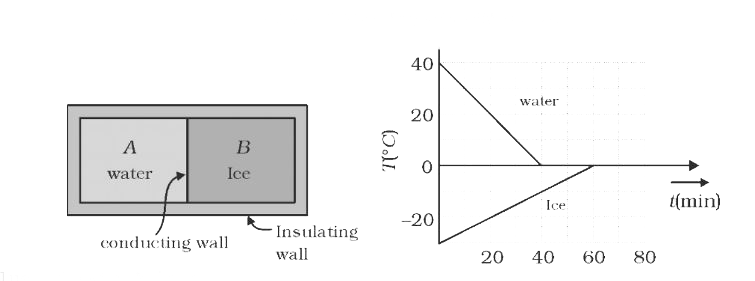
A 0.60 kg sample of water and a sample of ice are placed in two compartments A and B separated by a conducting wall, in a thermally insulated container. The rate of heat transfer from the water to the ice through the conducting wall is constant P, until thermal equilibrium is reached. The temperature T of the liquid water and the ice are given in graph as functions of time t. Temperature of the compartments remain homogeneous during whole heat transfer process. Given specific heat of ice `=2100J//Kg-K` , specific heat of water `= 4200J//kg-K` and latent heat of fusion of ice `=3.3xx10^(5)J//kg`.

The initial mass of the ice in the container is equal to :

A

`0.36 kg`

B

`1.2 kg`

C

`2.4 kg`

D

`3.6 kg`

Text Solution

Verified by Experts

The correct Answer is:

C

Sample of ice has been reciving heat at constant rate `P` from water. Its temperature has increased by `30^(@)C` in time `60min`.
Therefore `(m_(i)s_(i)DeltaT_(i))/(P) = 60 min`.
`rArr m = ((60 xx 60s)xx(42W))/((2100J//kg).(30^(@)C)) =2.4 kg`
Promotional Banner

Topper's Solved these Questions

  • CALORIMETRY AND THERMAL EXPANSION

    RESONANCE ENGLISH|Exercise Exercise-2|1 Videos
  • CALORIMETRY AND THERMAL EXPANSION

    RESONANCE ENGLISH|Exercise Exercie-3|1 Videos
  • CALORIMETRY AND THERMAL EXPANSION

    RESONANCE ENGLISH|Exercise Exercise-1|1 Videos
  • CALORIMETRY

    RESONANCE ENGLISH|Exercise Exercise|19 Videos
  • CAPACITOR

    RESONANCE ENGLISH|Exercise Exercise|45 Videos

Similar Questions

Explore conceptually related problems

A 0.60 kg sample of water and a sample of ice are placed in two compartmetnts A and B separated by a conducting wall, in a thermally insulated container. The rate of heat transfer from the water to the ice through the conducting wall is constant P, until thermal equilibrium is reached. The temperature T of the liquid water and the ice are given in graph as functions of time t. Temperature of the compartments remain homogeneous during whole heat transfer process. Given specific heat of ice =2100 J//kg-K , specific heat of water =4200 J//kg-K , and latent heat of fusion of ice =3.3xx10^5 J//kg .

A 0.60 kg sample of water and a sample of ice are placed in two compartmetnts A and B separated by a conducting wall, in a thermally insulated container. The rate of heat transfer from the water to the ice through the conducting wall is constant P, until thermal equilibrium is reached. The temperature T of the liquid water and the ice are given in graph as functions of time t. Temperature of the compartments remain homogeneous during whole heat transfer process. Given specific heat of ice =2100 J//kg-K , specific heat of water =4200 J//kg-K , and latent heat of fusion of ice =3.3xx10^5 J//kg . Initial mass of the ice in the container equal to

A 0.60 kg sample of water and a sample of ice are placed in two compartmetnts A and B separated by a conducting wall, in a thermally insulated container. The rate of heat transfer from the water to the ice through the conducting wall is constant P, until thermal equilibrium is reached. The temperature T of the liquid water and the ice are given in graph as functions of time t. Temperature of the compartments remain homogeneous during whole heat transfer process. Given specific heat of ice =2100 J//kg-K , specific heat of water =4200 J//kg-K , and latent heat of fusion of ice =3.3xx10^5 J//kg . Initial mass of the ice in the container equal to

A 0.60 kg sample of water and a sample of ice are placed in two compartmetnts A and B separated by a conducting wall, in a thermally insulated container. The rate of heat transfer from the water to the ice through the conducting wall is constant P, until thermal equilibrium is reached. The temperature T of the liquid water and the ice are given in graph as functions of time t. Temperature of the compartments remain homogeneous during whole heat transfer process. Given specific heat of ice =2100 J//kg-K , specific heat of water =4200 J//kg-K , and latent heat of fusion of ice =3.3xx10^5 J//kg . The value of rate P is?

A 0.60 kg sample of water and a sample of ice are placed in two compartmetnts A and B separated by a conducting wall, in a thermally insulated container. The rate of heat transfer from the water to the ice through the conducting wall is constant P, until thermal equilibrium is reached. The temperature T of the liquid water and the ice are given in graph as functions of time t. Temperature of the compartments remain homogeneous during whole heat transfer process. Given specific heat of ice =2100 J//kg-K , specific heat of water =4200 J//kg-K , and latent heat of fusion of ice =3.3xx10^5 J//kg . The mass of the ice formed due to conversion from the water till thermal equilibrium is reached is equal to

A 0.60 kg sample of water and a sample of ice are placed in two compartmetnts A and B separated by a conducting wall, in a thermally insulated container. The rate of heat transfer from the water to the ice through the conducting wall is constant P, until thermal equilibrium is reached. The temperature T of the liquid water and the ice are given in graph as functions of time t. Temperature of the compartments remain homogeneous during whole heat transfer process. Given specific heat of ice =2100 J//kg-K , specific heat of water =4200 J//kg-K , and latent heat of fusion of ice =3.3xx10^5 J//kg . The mass of the ice formed due to conversion from the water till thermal equilibrium is reached is equal to

Liquid water is denser than ice due to

Find the quantity of heat required to convert 40 g of ice at -20^(@) C into water at 20^(@) C. Given L_(ice) = 0.336 xx 10^(6) J/kg. Specific heat of ice = 2100 J/kg-K Specific heat of water = 4200 J/kg-K

Do water and ice have the same specific heats?

A metal piece weighing 15 g is heated to 100^(@)C and then immersed in a mixture of ice and water at the thermal equilibrium. The volume of the mixture is found to be reduced by 0.15 cm^(3) with the temperature of mixture remaining constant. Find the specific heat of the metal. Given specific gravity of ice = 0.92 , specific gravity of water at 0^(@)C = 1.0 , latent heat of fusion of ice = 80 cal-g^(-1) .

RESONANCE ENGLISH-CALORIMETRY AND THERMAL EXPANSION-Exercise
  1. Earth receives 1400 W//m^2 of solar power. If all the solar energy fal...

    Text Solution

    |

  2. A 50gram lead bullet, specific heat 0.02 is initially at 30^(@) C. It...

    Text Solution

    |

  3. The temperature of 100g of water is to be raised from 24^@C to 90^@C b...

    Text Solution

    |

  4. An electrically heated coil is immersed in a calorimeter containing 36...

    Text Solution

    |

  5. As a result of temp rise of 32^(@)C, a bar with a crack at its centre ...

    Text Solution

    |

  6. Level of a certain liquid at 0^(@)C and 100^(@)C are 0 and 10 mm on a ...

    Text Solution

    |

  7. A simple seconds pendulum is constructed out of a very thin string of ...

    Text Solution

    |

  8. A steel rod of length 25cm has a cross-sectional area of 0.8cm^(2) . T...

    Text Solution

    |

  9. A 1-L flask contains some mercury. It is found that at different tempe...

    Text Solution

    |

  10. When two non reactive samples at different temperatures are mixed in a...

    Text Solution

    |

  11. Two identical beakers with negligible thermal expansion are filled wit...

    Text Solution

    |

  12. When m gm of water at 10^(@)C is mixed with m gm of ice at 0^(@)C, whi...

    Text Solution

    |

  13. A bimetallic strip is formed out of two identical strips one of copper...

    Text Solution

    |

  14. There is a rectangular metal plate in which two cavities in the shape ...

    Text Solution

    |

  15. A 0.60 kg sample of water and a sample of ice are placed in two compar...

    Text Solution

    |

  16. A 0.60 kg sample of water and a sample of ice are placed in two compar...

    Text Solution

    |

  17. A 0.60 kg sample of water and a sample of ice are placed in two compar...

    Text Solution

    |

  18. In a container of negligible heat capacity, 200 gm ice at 0^(@)C and 1...

    Text Solution

    |

  19. In a container of negligible heat capacity 200 gm ice at 0^(@)C and 10...

    Text Solution

    |

  20. In a container of negligible heat capacity, 200 gm ice at 0^(@)C and 1...

    Text Solution

    |
