Home
Class 11
PHYSICS
A metal rod of Young's modulas Y and coe...

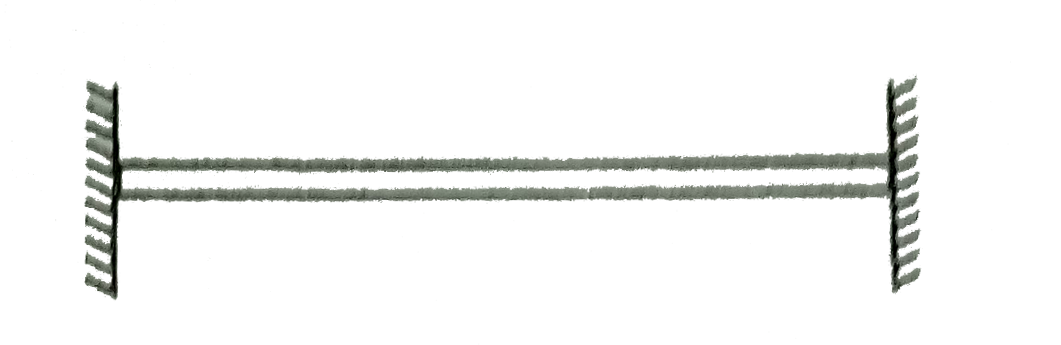
A metal rod of Young's modulas `Y` and coefficient of thermal expansion `alpha` is held at its two ends such that its length remains invariant. If its temperature is raised by `t^(@)c`, then the linear stress developed in it is

A

`(Y)/(alphat)`

B

`Y alpha t`

C

`(1)/((Y alpha t))`

D

`(alpha t)/(Y)`

Text Solution

Verified by Experts

The correct Answer is:
B

`(Deltal)/(l) = alpha. Delta T`
and `Y = (F//A)/(Deltal//l)`

So, `F = A Y alphat`
Thermal stress `((F)/(A)) = Y alphat`.
Promotional Banner

Topper's Solved these Questions

  • CALORIMETRY AND THERMAL EXPANSION

    RESONANCE ENGLISH|Exercise Advanced Level Problems|13 Videos
  • CALORIMETRY AND THERMAL EXPANSION

    RESONANCE ENGLISH|Exercise Exercie-3|1 Videos
  • CALORIMETRY

    RESONANCE ENGLISH|Exercise Exercise|19 Videos
  • CAPACITOR

    RESONANCE ENGLISH|Exercise Exercise|45 Videos

Similar Questions

Explore conceptually related problems

A metal rod of Young's modules Y and coefficient of thermal expansion alpha is held at its two ends such that its length remains constant. If its temperature is raised by t^(@)C , the linear stress developed in it is

A metal rod has length L, radius of its cross-section r. Youngs modulus Y and thermal coefficient of linear expansion is α.It is clamped between two rigid supports with negligible tension. If its temperature is increased by T^@C , then force exerted by the rod on any of the supports is

A rod of length / and radius r is held between two rigid walls so that it is not allowed to expand. If its temperature is increased, then the force developed in it is proportional to

A metal rod if fixed rigidly at two ends so as to prevent its thermal expension. If L, alpha , Y respectively denote the length of the rod , coefficient of linear thermal expension and Young's modulus of its material, then for an increase in temperature of the rod by Delta T, the longitudinal stress developed in the rod is

A metal rod of length l, cross-sectional area A, Young's modulus Y and coefficient of linear expansion alpha is heated to t^(@)C . The work that can be performed by the rod when heated is

A thin rod, length L_(0) at 0^(@)C and coefficient of linear expansion alpha has its two ends mintained at temperatures theta_(1) and theta_(2) respectively Find its new length .

The radius of a ring is R and its coefficient of linear expansion is alpha. If the temperature of ring increases by theta then its circumfrence will increase by

find out the increase in moment of inertia I of a uniform rod (coefficient of linear expansion alpha ) about its perpendicular bisector when its temperature is slightly increased by Delta T.

A pendulum clock keeps correct time at 0^(@)C . Its mean coefficient of linear expansions is alpha//.^(@)C , then the loss in seconds per day by the clock if the temperature rises by t^(@)C is

STATEMENT - 1 : A metallic rod placed upon smooth surface is heated. The strain produced is ZERO. STATEMENT - 2 : Strain is non-zero only when stress is developed in the rod. STATEMENT - 3 : Two metallic rods of length l_(1) and l_(2) and coefficient of linear expansion alpha_(1) and alpha_(2) are heated such that the difference of their length ramains same at ALL termperatures Then (alpha_(1))/(alpha_(2))=(l_(2))/(l_(1))

