Home
Class 11
PHYSICS
Two rods of different metals having the ...

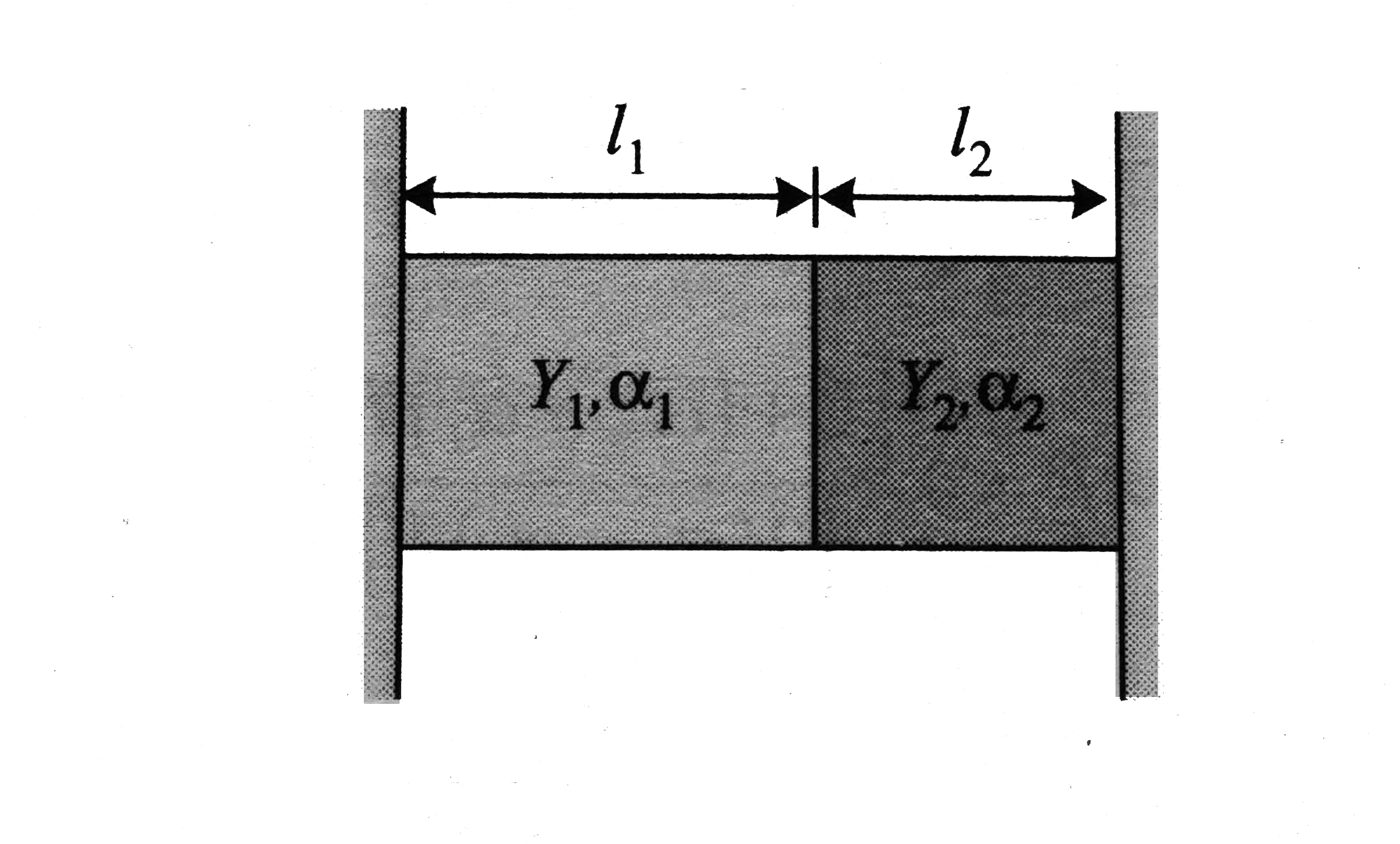
Two rods of different metals having the same area of cross section A are placed between the two massive walls as shown is Fig. The first rod has a length `l_1`, coefficient of linear expansion `alpha_1` and Young's modulus `Y_1`. The correcsponding quantities for second rod are `l_2,alpha_2` and `Y_2`. The temperature of both the rods is now raised by `t^@C`.
i. Find the force with which the rods act on each other (at higher temperature) in terms of given quantities.
ii. Also find the length of the rods at higher temperature.

Text Solution

Verified by Experts

The correct Answer is:
`F = (AT(L_(1)alpha_(1)+L_(2)alpha_(2))Y_(1)Y_(2))/(L_(1)Y_(2)+L_(1)Y_(1))`, Length of the rod `= L_(1) +(L_(1)L_(2)T(Y_(1)alpha_(1)-Y_(2)alpha_(2)))/(L_(1)Y_(2)+L_(2)Y_(1))`, Length of second rod `= L_(2)+(L_(1)L_(2)T(Y_(2)alpha_(2)-Y_(1)alpha_(1)))/(L_(1)Y_(2)+L_(2)Y_(1))`

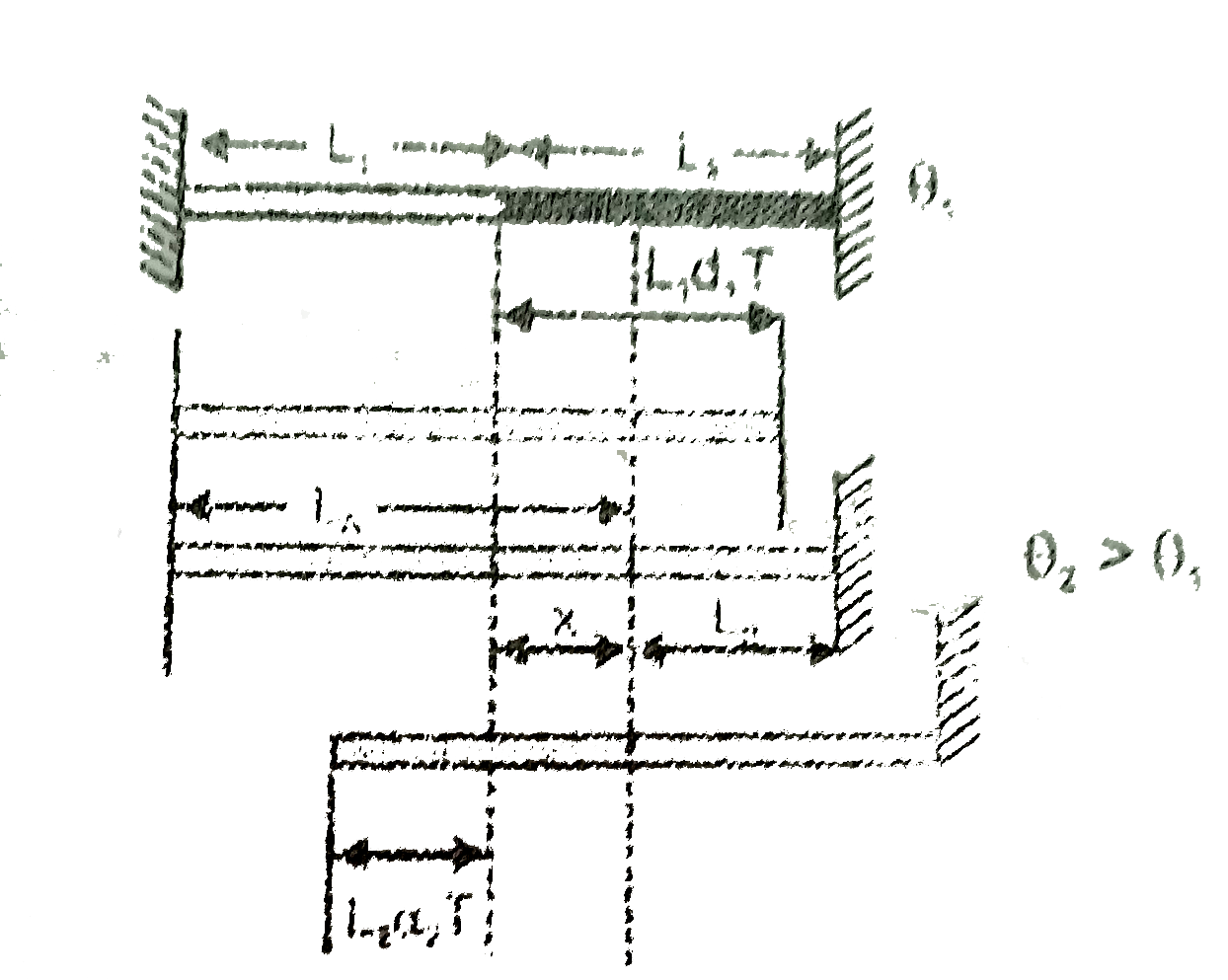
`L_(A) = L_(1) +x`
`L_(B) = L_(2) - x`
`Y = (F xx l)/(Ae)`

`e = (F xxl)/(YA) =` extension or compression due to force
`e = L_(1) alpha_(1) T -x =(FL_(1))/(Y_(1)A) ……….(1)`
`e = L_(2) alpha_(2) T +x = (FL_(2))/(Y_(2)A) ....(2)`
By adding equation (1) and equation (2)
We get `F = (AT(L_(1)alpha_(1)+L_(2)alpha_(2))Y_(1)Y_(2))/(L_(1)Y_(2)+L_(2)Y_(1))`
By dividing (1) and (2)
We get `x = (L_(1)L_(2)T(Y_(1)alpha_(1)-Y_(2)alpha_(2)))/(L_(1)Y_(2)+L_(2)Y_(1))`
So, `L_(A) = L_(1)+x, L_(B) = L_(2) - x`
Promotional Banner

Topper's Solved these Questions

  • CALORIMETRY AND THERMAL EXPANSION

    RESONANCE ENGLISH|Exercise Exercie|9 Videos
  • CALORIMETRY

    RESONANCE ENGLISH|Exercise Exercise|19 Videos
  • CAPACITOR

    RESONANCE ENGLISH|Exercise Exercise|45 Videos

Similar Questions

Explore conceptually related problems

Two metal rods of the same length and area of cross-section are fixed end to end between rigid supports. The materials of the rods have Young moduli Y_(1) and Y_(2) , and coefficient of linear expansion alpha_(1) and alpha_(2) . The junction between the rod does not shift and the rods are cooled

Two rods of different materials are placed between massive walls as shown in figure. The cross section of the rods is A, their moduil of elastricity are E_(1) and E_(2) respectively. If rods are heated by t degrees, then (coefficients of liner expansion of material of rods are alpha_(1) and alpha_(2) respectively)

There are two rods of length l_1 and l_2 and coefficient of linear expansions are alpha_1 and alpha_2 respectively. Find equivalent coefficient of thermal expansion for their combination in series.

The variation of length of two metal rods A and B with change in temperature is shown in Fig. the coefficient of linear expansion alpha_A for the metal A and the temperature T will be

A uniform rod of length L , has a mass per unit length lambda and area of cross section A . The elongation in the rod is l due to its own weight, if it suspended form the celing of a room. The Young's modulus of the rod is

Two metallic rods of length l and 3l have coefficient of linear expansion alpha and 3alpha respectively. The coefficient of linear expansion ofr their series combinations, is

A rod has variable co-efficient of linear expansion alpha = (x)/(5000) . If length of the rod is 1 m . Determine increase in length of the rod in (cm) on increasing temperature of the rod by 100^(@)C .

The moment of inertia of a rod about its perpendicular bisector is I . When the temperature of the rod is increased by Delta T , the increase in the moment of inertia of the rod about the same axis is (Here , alpha is the coefficient of linear expansion of the rod )

An isosceles triangles is formed with a thin rod of length l_(1) and coefficient of linear expansion alpha_(1) , as the base and two thin rods each of length l_(2) and coefficient of linear expansion alpha_(2) as the two sides. The distance between the apex and the midpoint of the base remain unchanged as the temperature is varied. the ratio of lengths (l_(1))/(l_(2)) is

An isosceles triangles is formed with a thin rod of length l_(1) and coefficient of linear expansion alpha_(1) , as the base and two thin rods each of length l_(2) and coefficient of linear expansion alpha_(2) as the two sides. The distance between the apex and the midpoint of the base remain unchanged as the temperature is varied. the ratio of lengths (l_(1))/(l_(2)) is

