Home
Class 11
PHYSICS
A particle which is initially at rest at...

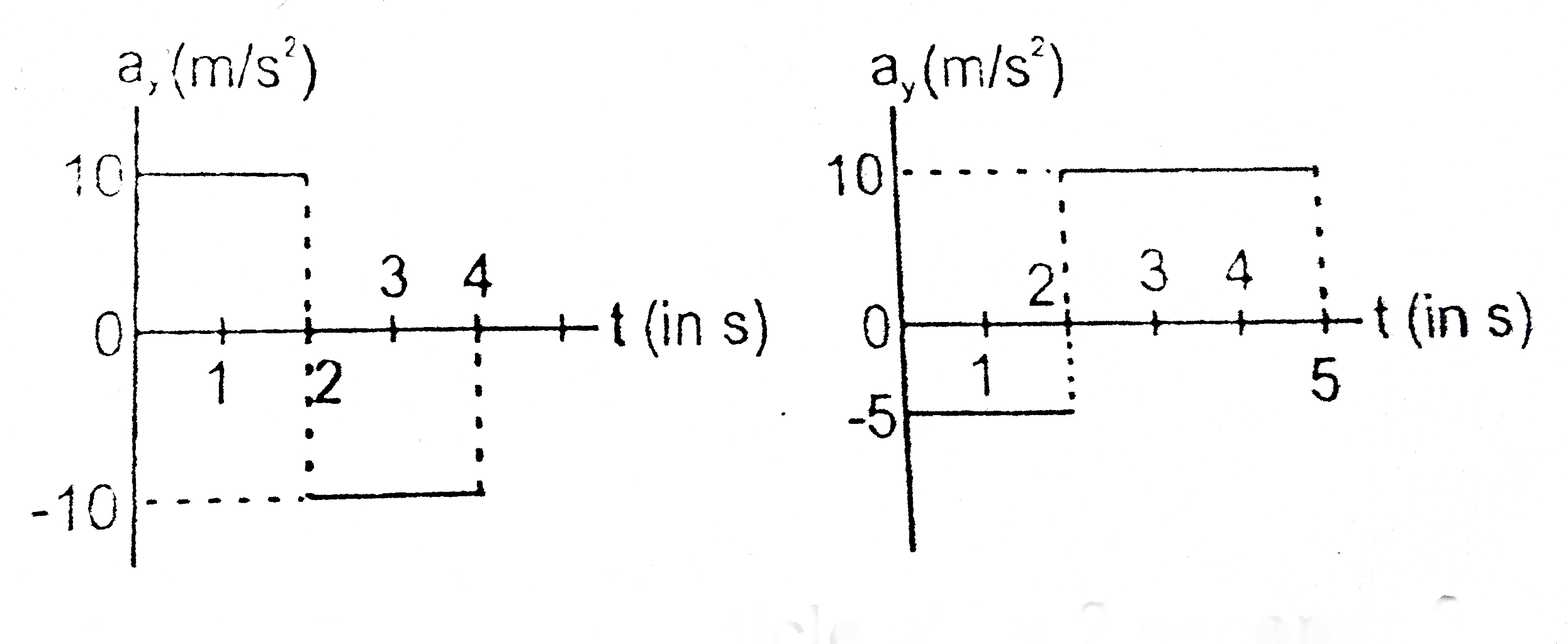
A particle which is initially at rest at the origin, is subjection to an acceleration with `x-` and `y-` components as shown. After time `t=5` , the particle has no acceleration.

When is the particle at its farthest distance from the `y-` axis ?

A. 3 sec.
B. 2 sec.
C. 4 sec.
D. 1 sec.

A

`3 sec.`

B

`2 sec.`

C

`4 sec.`

D

`1 sec.`

Text Solution

Verified by Experts

The correct Answer is:

C

`At, t=2sec (t=2sec )`
`v_(x)=u_(x)+a_(x)t=0+10xx2=20m//s`
`v_(y)=u_(y)+a_(y)t=0-5xx2=-10m//s`
`v=sqrt(v_(x)^(2)+v_(y)^(2))=sqrt((20)^(2)+(-10)^(2))=10sqrt(5)m//s`
From `t=0, t=4 sec`
`x[(1)/(2)(10)(2)^(2)]_((0rarr2))+[(10xx2)2-(1)/(2)(10)(2)^(2)]_((2rarr 4))`
`x=40m`
`y=[-(1)/(2)5(2)^(2)]_((0rarr2))-[(10)(2)-(1)/(2)(10)(2)^(2)]_((2rarr4))`
`y=-10m`
Hence , average velcoity of particle between `t=0 ` to `t=4 sec` is
`v_(av)=(Deltax)/(Deltat)=(sqrt((40)^(2)+(-10)^(2)))/(4)`
`v_(av)=(5)/(2)sqrt(17)m//s`
`At, t=2sec, u=10xx2=20m/s`
After `t=2sec`
`v=u+at`
`0=20-10t`
`t=2sec.`
Hence, at `t=4` . the particle is at its farthest distance from the `y-`axis.
The particle is at farthest distance from `y-` axis at `tgt=4`. Hence the available correct choice is `t=4`.
Promotional Banner

Topper's Solved these Questions

  • DAILY PRACTICE PROBLEMS

    RESONANCE ENGLISH|Exercise dpp 70|7 Videos
  • DAILY PRACTICE PROBLEMS

    RESONANCE ENGLISH|Exercise dpp 71|8 Videos
  • DAILY PRACTICE PROBLEMS

    RESONANCE ENGLISH|Exercise dpp 69|5 Videos
  • CURRENT ELECTRICITY

    RESONANCE ENGLISH|Exercise Exercise|53 Videos
  • ELASTICITY AND VISCOCITY

    RESONANCE ENGLISH|Exercise Advanced Level Problems|9 Videos

Similar Questions

Explore conceptually related problems

A particle which is initially at rest at the origin, is subjection to an acceleration with x- and y- components as shown. After time t=5 , the particle has no acceleration. What is the magnitude of velocity of the particle at t=2 seconds ?

A particle which is initially at rest at the origin, is subjection to an acceleration with x- and y- components as shown. After time t=5 , the particle has no acceleration. What is the magnitude of average velocity of the particle between t=0 and t=4 seconds ? A. (5)/(2)sqrt(13)m//s B. (5)/(2)sqrt(17)m//s C. 30m//s D. None of these

A wheel which is initially at rest is subjected to a constant angular acceleration about its axis. It rotates through an angle of 15^@ in time t sec. Then how much it rotates in the next 2t sec

A particle is moving along the x-axis whose acceleration is given by a= 3x-4 , where x is the location of the particle. At t = 0, the particle is at rest at x = 4//3m . The distance travelled by the particles in 5 s is

A particle is projected from the origin in X-Y plane. Acceleration of particle in Y direction is a. If equation of path of the particle is y = ax-bx^(2) , then find initial velocity of the particle.

Starting from rest, the acceleration of a particle is a=2(t-1). The velocity of the particle at t=5s is :-

A particle starts moving from rest with uniform acceleration. It travels a distance x in the first 2 sec and a distance y in the next 2 sec. Then

A particle starts from rest. Its acceleration is varying with time as shown in the figure. When the particle comes to rest, its distance from its starting point is

A particle experiences a constant acceleration for 20 sec after starting from rest. If it travels distance S_1 in the first 10 sec and a distance S_2 in the next 10 sec, Then

A particle experiences a constant acceleration for 20 sec after starting from rest. If it travels distance S_1 in the first 10 sec and a distance S_2 in the next 10 sec, Then

RESONANCE ENGLISH-DAILY PRACTICE PROBLEMS-comprehension
  1. A particle which is initially at rest at the origin, is subjection to ...

    Text Solution

    |

  2. A particle which is initially at rest at the origin, is subjection to ...

    Text Solution

    |

  3. A particle which is initially at rest at the origin, is subjection to ...

    Text Solution

    |

  4. Two smooth block are placed at a smooth corner as shown in fig. Both t...

    Text Solution

    |

  5. Two smooth block are placed at a smooth corner as shown in fig. Both t...

    Text Solution

    |

  6. Two smooth block are placed at a smooth corner as shown in fig. Both t...

    Text Solution

    |

  7. A meter stick AB of length 1 meter rests on a frictionless floor in ho...

    Text Solution

    |

  8. A meter stick AB of length 1 meter rests on a frictionless floor in ho...

    Text Solution

    |

  9. A meter stick AB of length 1 meter rests on a frictionless floor in ho...

    Text Solution

    |

  10. Figure shows an arrangement of pulleys and two blocks. All surfaces ar...

    Text Solution

    |

  11. Figure shows an arrangement of pulleys and two blocks. All surfaces ar...

    Text Solution

    |

  12. Figure shows an arrangement of pulleys and two blocks. All surfaces ar...

    Text Solution

    |

  13. Three blocks of masses 6 kg, 4 kg and 2 kg are pulled on a rough surfa...

    Text Solution

    |

  14. Three blocks of masses 6 kg, 4 kg and 2 kg are pulled on a rough surfa...

    Text Solution

    |

  15. Three blocks of masses 6 kg, 4 kg and 2 kg are pulled on a rough surfa...

    Text Solution

    |

  16. A block of mass m is placed on a rough inclined plane. The corfficient...

    Text Solution

    |

  17. A block of mass m is placed on a rough inclined plane. The corfficient...

    Text Solution

    |

  18. A block of mass m is placed on a rough inclined plane. The corfficient...

    Text Solution

    |

  19. Rain is falling with a velocity (-4hat(i)+8hat(j)-10hat(k)). A person ...

    Text Solution

    |

  20. Rain is falling with a velocity (-4hat(i)+8hat(j)-10hat(k)). A person ...

    Text Solution

    |
