
Home
Class 11
PHYSICS
Two blocks A and B are placed in contace...

Two blocks `A` and `B` are placed in contace on a horizontal surface. Faces of block `A` and `B`, which are in contact , are inclined at `30^(@)` with the horizontal, as shown. There is no friction between block `A` and any surface which is in contact with this whereas friction coefficient between block `B` and the surface is `(1)/(sqrt(3))`. A force `F` is applied in horizontal direction on block `A`. What is the minimum value of `F` at which the block `B` just start moving rightwards ?

A

`(40)/(sqrt(3))N`

B

`(80)/(sqrt(3))N`

C

`100N`

D

For any value of `F`, motion will not start

Text Solution

Verified by Experts

The correct Answer is:
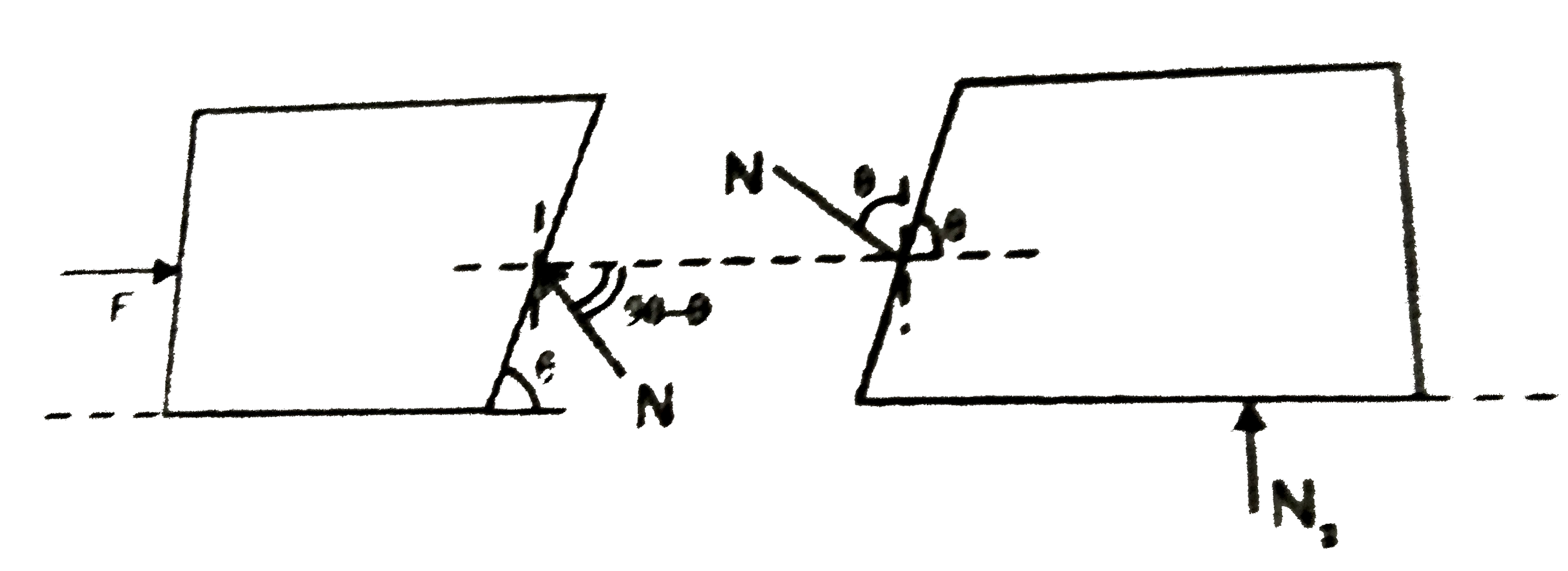
D

`F=Nsin theta, N=(F)/(sin theta)`
` N sin theta = mu (N cos theta+mg)`
`F=mu(F cot theta + mg)`
`F(1-mucot theta) = mumg`
`F=(mu mg)/(1-mucot theta)`

On putting `mu=(1)/(sqrt(3))` and `theta =30^(@_)`
`mu=(1)/(sqrt(3)) theta=30^(@)`
`F = oo`
Therefore motion will not start for any value of `F`.
Promotional Banner

Topper's Solved these Questions

  • DAILY PRACTICE PROBLEMS

    RESONANCE ENGLISH|Exercise dpp 32|8 Videos
  • DAILY PRACTICE PROBLEMS

    RESONANCE ENGLISH|Exercise dpp 33|8 Videos
  • DAILY PRACTICE PROBLEMS

    RESONANCE ENGLISH|Exercise dpp 30|4 Videos
  • CURRENT ELECTRICITY

    RESONANCE ENGLISH|Exercise Exercise|53 Videos
  • ELASTICITY AND VISCOCITY

    RESONANCE ENGLISH|Exercise Advanced Level Problems|9 Videos

Similar Questions

Explore conceptually related problems

A block of weight 200N is pulled along a rough horizontal surface at constant speed by a force 100N acting at an angle 30^(@) above the horizontal. The coefficient of friction between the block and the surface is

A wooden block of mass M resting on a rough horizontal surface is pulled with a force T at an angle q to the horizontal. If m is coefficient of kinetic friction between the block and the surface, the acceleration of the block is

Two blocks A and B are lying on the table as shown in the figure. The coefficient of friciton between block A and block B is mu . The coefficient of friction between block B and ground also mu . An external force F is applied in the direction shown. The maximum value of the force F that can be applied without moving the blocks.

A block of mass 5 kg rests on a inclined plane at an angle of 30^(@) with the horizontal. If the block just begins to slide, then what is the coefficient of static friction between the block and the surface?

A block of mass 5 kg rests on a inclined plane at an angle of 30^(@) with the horizontal. If the block just begins to slide, then what is the coefficient of static friction between the block and the surface?

A block of mass 5 kg rests on a inclined plane at an angle of 30^(@) with the horizontal. If the block just begins to slide, then what is the coefficient of static friction between the block and the surface?

A block of mass m is placed at rest on a horizontal rough surface with angle of friction phi . The block is pulled with a force F at an angle theta with the horizontal. The minimum value of F required to move the block is

A block of mass m is placed at rest on a horizontal rough surface with angle of friction phi . The block is pulled with a force F at an angle theta with the horizontal. The minimum value of F required to move the block is

A block is kept on a rough horizontal surface as shown. Its mass is 2 kg and coefficient of friction between block and surface (mu)=0.5. A horizontal force F is acting on the block. When

Two blocks of masses 1 kg and 2 kg are placed in contact on a smooth horizontal surface as shown in fig. A horizontal force of 6N is applied d(a) on a 1-kg block. Find the force of interaction of the blocks. .

