
Home
Class 11
PHYSICS
The system starts from rest and A attain...

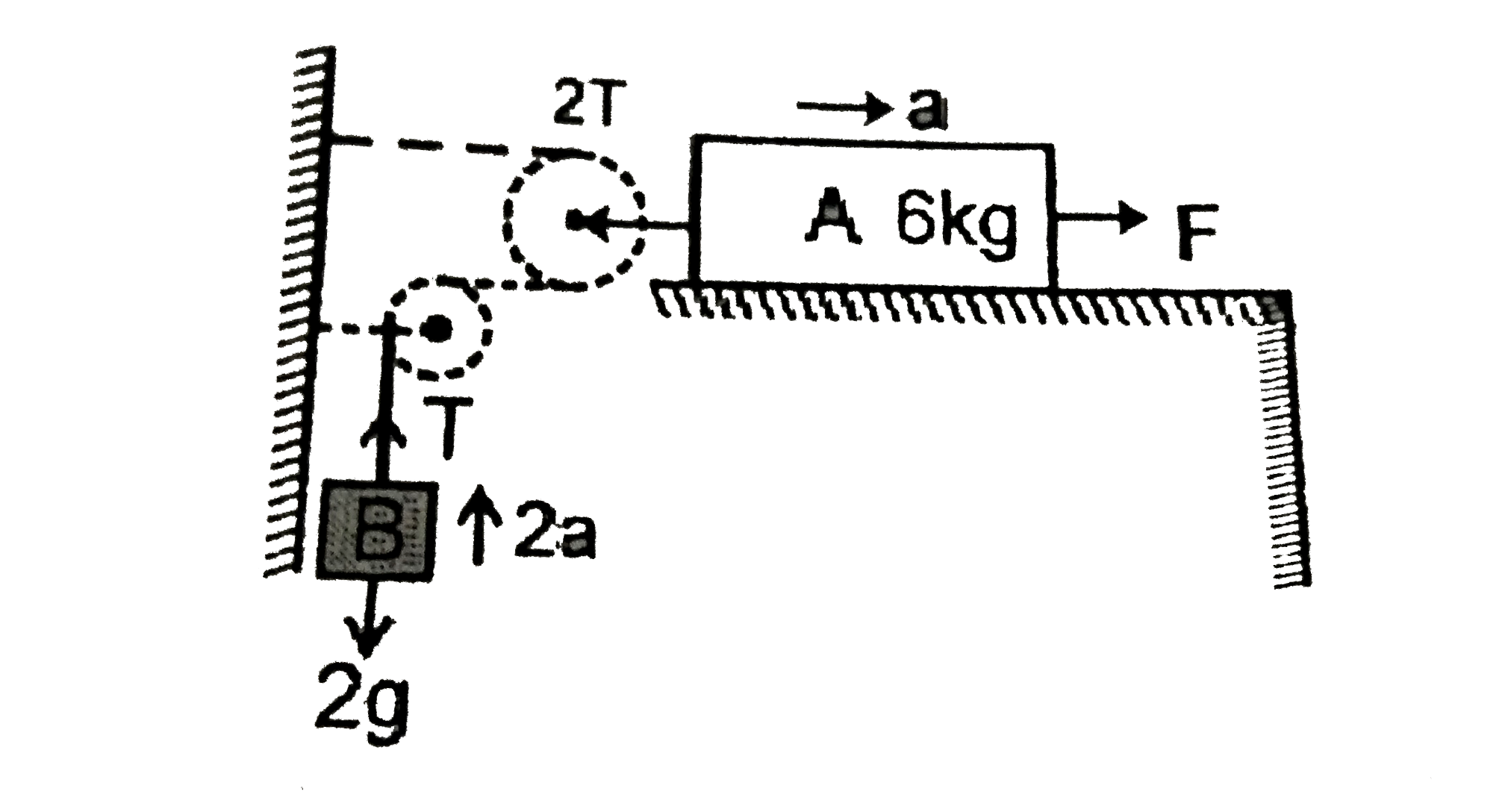
The system starts from rest and `A` attains a velocity of `5m//s` after it has moved `5m` toward right. Assuming the arrangement to be frictionless everywhere and pulley and string to be light, the value of the constant force `F` applied on `A` is:

A

`50N`

B

`75N`

C

`100N`

D

`96N`

Text Solution

Verified by Experts

The correct Answer is:
B

`(B)`
`a=(v^(2))/(2s)=(25)/(10)=2.5m//s^(2)`

For `6kg:-F-2T=6a`
For `2kg :- T-2g=2(2a)`
From `(1) & (2)F=75N`
Promotional Banner

Topper's Solved these Questions

  • DAILY PRACTICE PROBLEMS

    RESONANCE ENGLISH|Exercise dpp 33|8 Videos
  • DAILY PRACTICE PROBLEMS

    RESONANCE ENGLISH|Exercise dpp 34|5 Videos
  • DAILY PRACTICE PROBLEMS

    RESONANCE ENGLISH|Exercise dpp 31|7 Videos
  • CURRENT ELECTRICITY

    RESONANCE ENGLISH|Exercise Exercise|53 Videos
  • ELASTICITY AND VISCOCITY

    RESONANCE ENGLISH|Exercise Advanced Level Problems|9 Videos

Similar Questions

Explore conceptually related problems

A particle starting from rest attains a velocity of 50 ms^(-1) in 5 s. The acceleration of the particle is

A block slides on ice with a velocity of 5m//s comes to rest after moving through a distance of 13.5m . Find the coefficient of friction ?

If the system is released from rest, determine the speeds of both masses after B has moved 1 m. Neglect friction, the masses of pulleys and inextensible string.

A body starting from rest has an acceleration of 5m//s^(2) . Calculate the distance travelled by it in 4^(th) second.

A block B is placed over a cart which in turn lies over a smooth horizontal floor. Block A and Block C are connected to block B with light inextensible strings passing over light frictionless pulleys fixed to the cart as shown. Initially the blocks and the cart are at rest. All the three blocks have mass m and the cart has mass M(M=3m) . Now a constant horizontal force of magnitude F is applied to block A towards right. Q. Let the coefficient of friction between block B and cart is mu(mugt0) and friction is absent everywhere else. Then the maximum value of force F applied to block A such that there is no relative acceleration between block B and cart is

In the arrangement shown in fig. m_(1)=1kg, m_(2)=2 kg . Pulleys are massless and strings are light. For what value of M, the mass m_(1) moves with constant velocity.

Blocks m_(1) and m_(2) starts from rest and move to right with accelerations as shown. If t is in second then the time when block m_(3) again come to rest from t =0 is (pulley and strings are ideal) : .

Blocks shown in figure moves with constant velocity 20 m/s towards right. All surfaces in contact are rough. The friction force applied by B on A is

Blocks shown in figure moves with constant velocity 10 m/s towards right. All surgaces in contact are rough. The friction force applied by B on A is :-

Two masses m_1=5kg and m_2=4.8kg tied to a string are hanging over a light frictionless pulley. What is the acceleration of the masses when left free to move?

