Home
Class 11
PHYSICS
In the arrangement shown, W(1) = 200N, W...

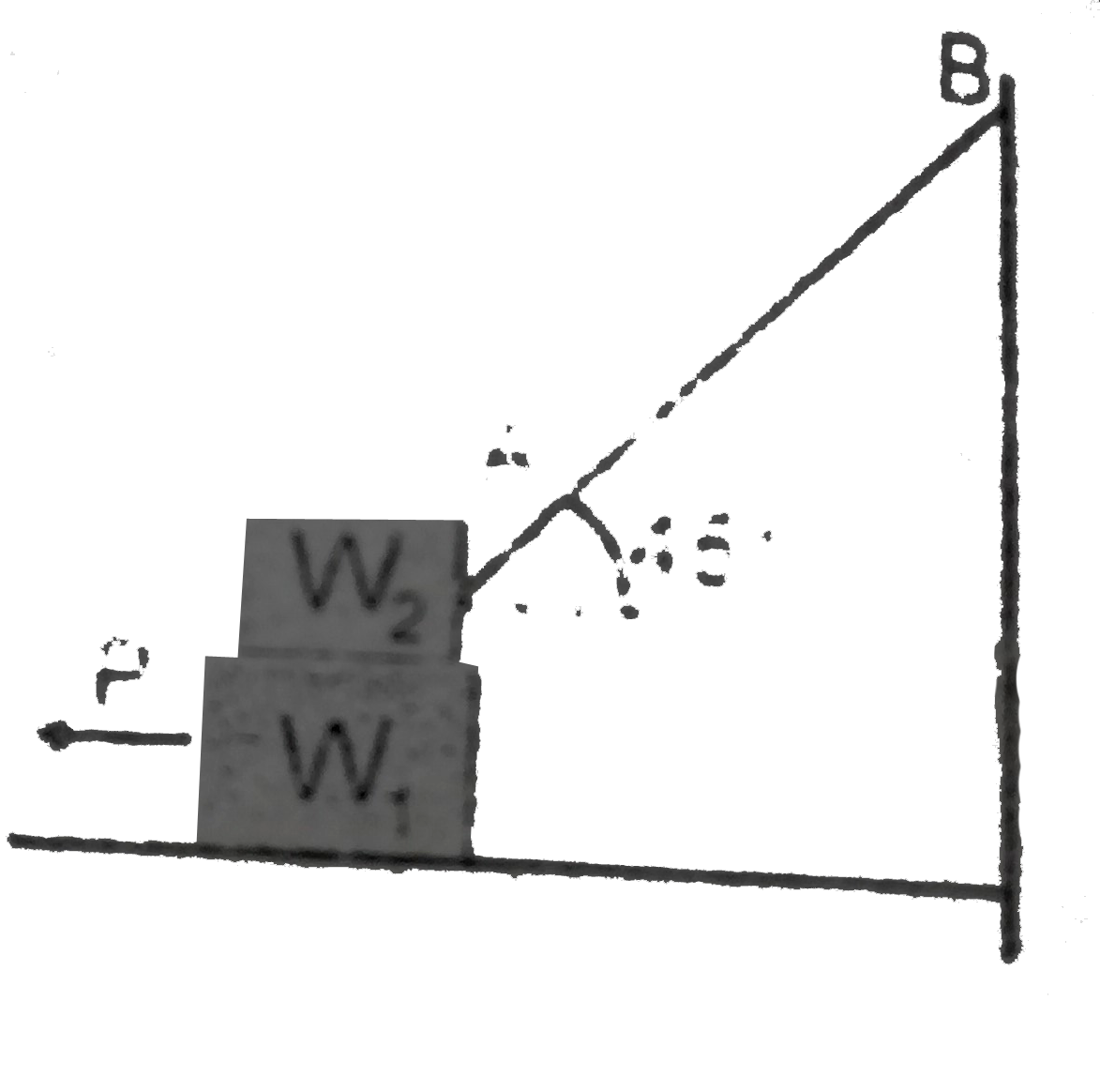
In the arrangement shown, `W_(1) = 200N, W_(2) = 100 N,mu = 0.25` for all surfaces in contact. The block `W_(1)` just slides under the block `W_(2)`

A

A pull of `50N` is to be applied on `W_(1)`

B

A pull of `90N` is to be applied on `W_(1)`

C

Tension in the string `AB` is `10sqrt(2)N`

D

Tension in the string `AB` is `20sqrt(2)N`

Text Solution

Verified by Experts

The correct Answer is:
B, D

`B,D`

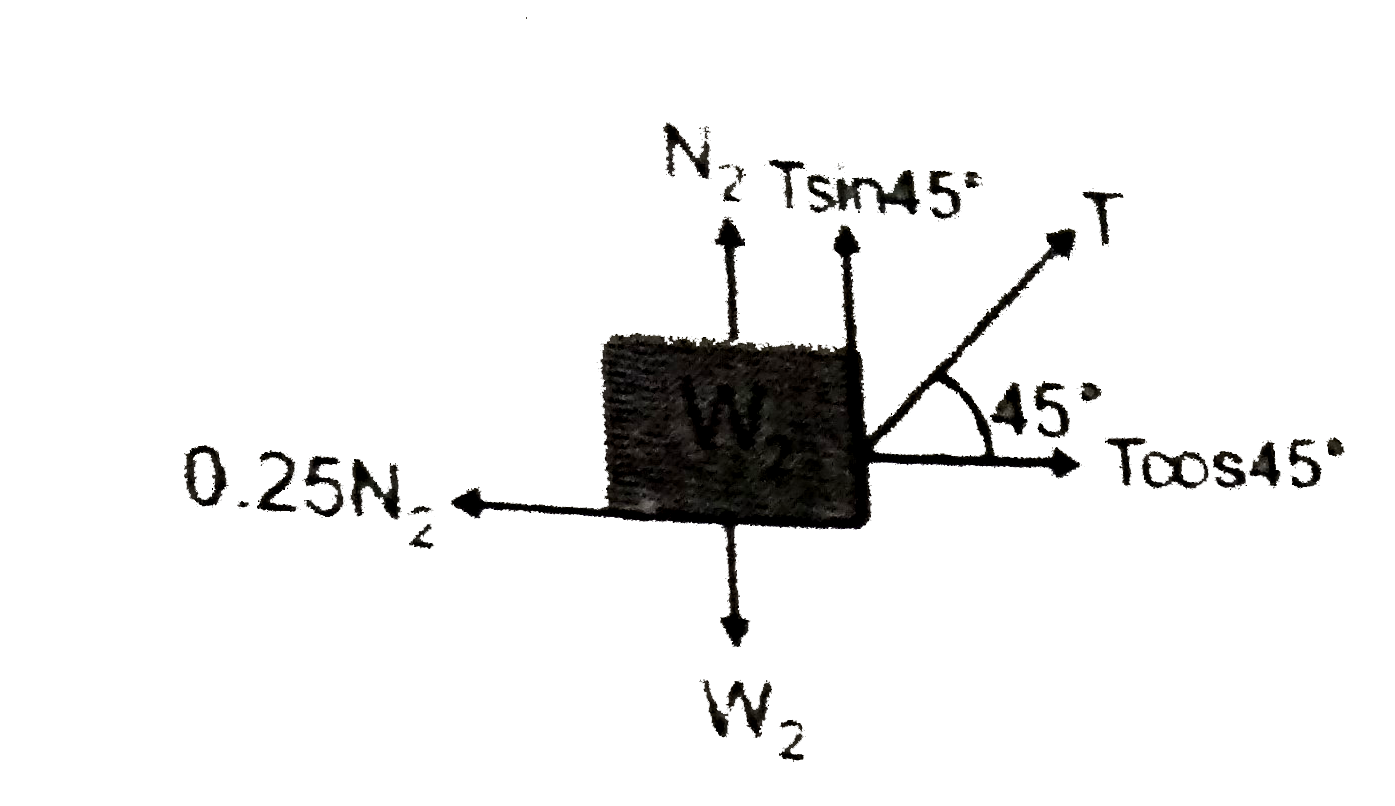
For `W_(2):`
`N_(2)+T sin 45^(@)=W_(2)=100 ….(1)`
`Tcos 45^(@)=0.25N_(2) ….(2)`
`rArr T=20sqrt(2)N,N_(2)=80N`

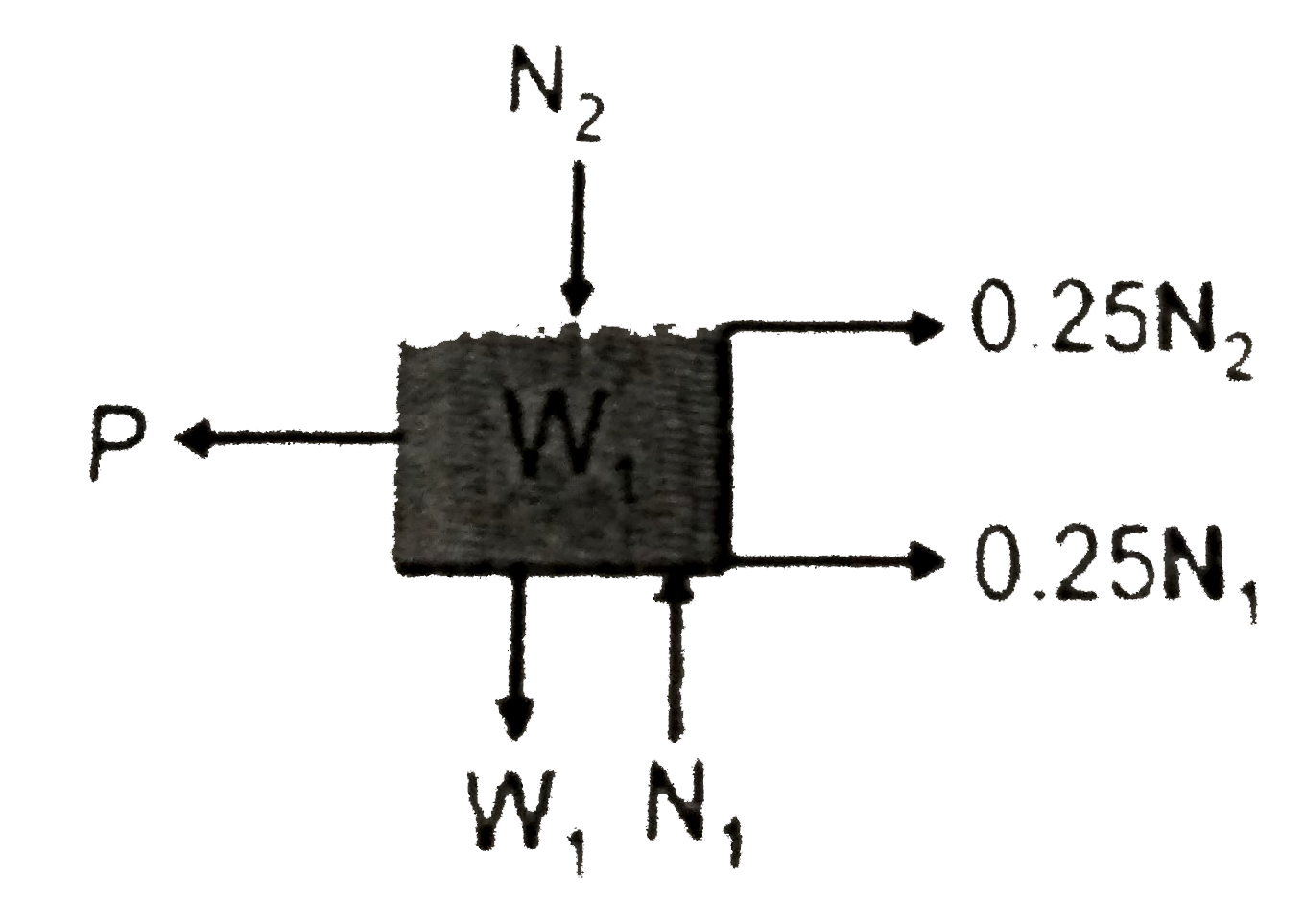
For `W_(1):`
`P=0.25(N_(1)+N_(2)) ...(3)`
`N_(1)+W_(1)=N_(1) ....(4)`
`=N_(1)=280N`
Promotional Banner

Topper's Solved these Questions

  • DAILY PRACTICE PROBLEMS

    RESONANCE ENGLISH|Exercise dpp 34|5 Videos
  • DAILY PRACTICE PROBLEMS

    RESONANCE ENGLISH|Exercise DPP 35|5 Videos
  • DAILY PRACTICE PROBLEMS

    RESONANCE ENGLISH|Exercise dpp 32|8 Videos
  • CURRENT ELECTRICITY

    RESONANCE ENGLISH|Exercise Exercise|53 Videos
  • ELASTICITY AND VISCOCITY

    RESONANCE ENGLISH|Exercise Advanced Level Problems|9 Videos

Similar Questions

Explore conceptually related problems

Calculate the Force (F) required to cause the block of mass m_(1) = 20 kg just to slide under the block of mass m_(2) = 10 kg [ coefficient of friction mu = 0*25 for all surfaces ]

In the circuit shown in fig. X_(C ) = 100 Omega,(X_L)=200 Omega and R=100 Omega . The effective current through the source is

The relative density of a material of a body is found by weighing it first in air and then in water. If the weight of he body in air is W_(1) = 8.00 +- N and the weight in water is W_(2) = 6.00 +- 0.05 N , then the relative density rho_(r ) = W_(1)//( W_(1) - W_(2)) with the maximum permissible eror is

The cathode of a photoelectric cell is changed such that the work function changes from (W_(1) to W_(2) (W_(2) gt W_(1)) . If the current before and after change are I_(1) and I_(2) , all other conditions remaining unchanged , then (assuming hv gt W_(2) )

In the figure, the block B of mass m starts from rest at the top of a wedge W of mass M . All surfaces are without friction. W can slide on the ground. B slides down onto the ground, moves along it with a speed v, has an elastic collision with the wall, and climbs back on to W .

In the figure shown, a spring mass system is placed on a horizontal smooth surface in between two vertical rigid walls W_(1) and W_(2) . One end of spring is fixed with wall W_(1) and other end is attached with mass m which is free to move. Initially, spring is tension free and having natural length l_(0) . Mass m is compressed through a distance a and released. Taking the collision between wall W_(2) and mass m as elastic and K as spring constant, the average force exerted by mass m on wall W_(2) in one oscillation of block is

Two weights W_(1) and W_(2) in equilibrium and at rest, are suspended as shown in figure. Then the ratio (W_(1))/(W_(2)) is :

In a given figure system is in equlibrium, If W_(1) = 300 N. Then W_(2) is approximately equal to

If R_(1) and R_(2) are filament resistances of a 200 W and a 100 W bulb respectively, designed to operate on the same voltage, then :

A man is standing on a weighing machine with a block in his hand. The machine records w. When he takes the block upwards with some acceleration the machine records w_(1). When he takes the block down with some acceleration, the machine records w_(2). Then choose correct option