Home
Class 11
PHYSICS
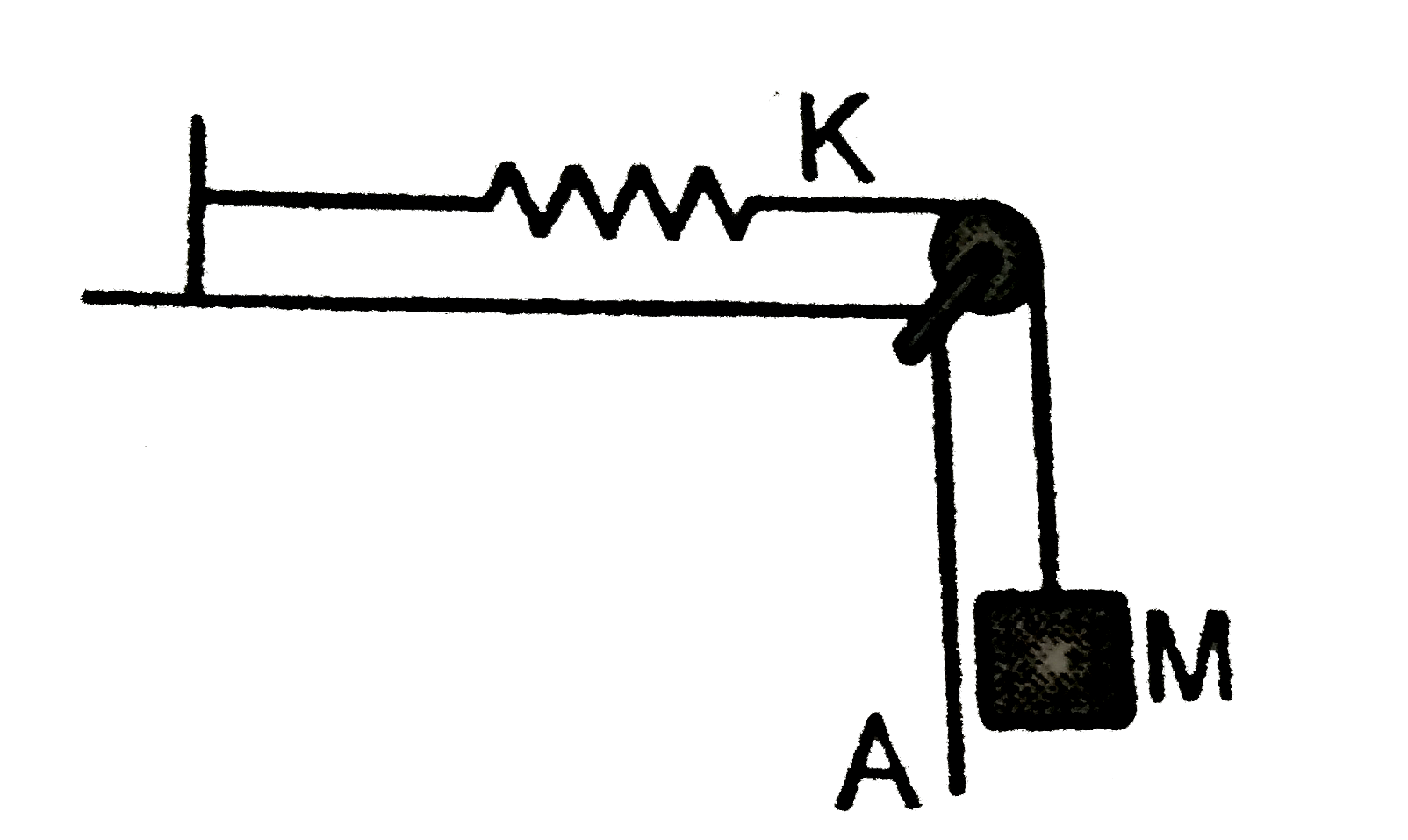
Block A in the figure is released from r...

Block `A` in the figure is released from rest when the extension in the spring is `x_(0)(x_(0) lt mg//k)`. The maximum downward displacement of the block is (there is no friction) :

A

`(2Mg)/(K)-2x_(0)`

B

`(Mg)/(2K)+x_(0)`

C

`(2Mg)/(K)-x_(0)`

D

`(2Mg)/(K)+x_(0)`

Text Solution

Verified by Experts

The correct Answer is:

A

`(1)/(2)kx_(0)^(2)+Mgh=(1)/(2) k (x_(0)+h)^(2)+0`
`rArr h=(2Mg)/(k)-2x_(0)`
Maximum downward displacement
`=[(2Mg)/(k)-2x_(0)]`
Promotional Banner

Topper's Solved these Questions

  • DAILY PRACTICE PROBLEMS

    RESONANCE ENGLISH|Exercise dpp 38|5 Videos
  • DAILY PRACTICE PROBLEMS

    RESONANCE ENGLISH|Exercise dpp 39|3 Videos
  • DAILY PRACTICE PROBLEMS

    RESONANCE ENGLISH|Exercise dpp 36|5 Videos
  • CURRENT ELECTRICITY

    RESONANCE ENGLISH|Exercise Exercise|53 Videos
  • ELASTICITY AND VISCOCITY

    RESONANCE ENGLISH|Exercise Advanced Level Problems|9 Videos

Similar Questions

Explore conceptually related problems

In figure, the stiffness of the spring is k and mass of the block is m . The pulley is fixed. Initially, the block m is held such that the elongation in the spring is zero and then released from rest. Find: a. the maximum elongation in the spring. b. the maximum speed of the block m . Neglect the mass of the spring and that of the string. Also neglect the friction.

Two blocks of equal mass m are connected by an unstretched spring and the system is kept at rest on a frictionless horizontal surface. A constant force F is applied on the first block pulling away from the other as shown in Fig. If the extension of the spring is x_(0) at time t , then the displacement of the first block at this instant is

Two blocks of equal mass m are connected by an unstretched spring and the system is kept at rest on a frictionless horizontal surface. A constant force F is applied on the first block pulling away from the other as shown in Fig. If the extension of the spring is x_(0) at time t , then the displacement of the first block at this instant is

Two blocks each of mass m are joined together using an ideal spring of force constant K and natural length l_(0) . The blocks are touching each other when the system is released from rest on a rough horizontal surface. Both the blocks come to rest simultaneously when the extension in the spring is (l_(0))/4 . The coefficient of friction between each block and the surface (assuming it to be same between any of the blocks and the surface) is :

Two blocks each of mass m are joined together using an ideal spring of force constant K and natural length l_(0) . The blocks are touching each other when the system is released from rest on a rough horizontal surface. Both the blocks come to rest simultaneously when the extension in the spring is (l_(0))/4 . The coefficient of friction between each block and the surface (assuming it to be same between any of the blocks and the surface) is :

Two blocks each of mass m, connected by an un-stretched spring are kept at rest on a frictionless horizontal surface. A constant force F is applied on one of the blocks pulling it away from the other as shown in figure. (a)Find accelaration of the mass center. (b) Find the displacement of the centre of mass as function of time t. (c) If the extension of the spring is X_(0) at an instant t, find the displacements of the two blocks relative to the ground at this instant.

Consider the situation shown in figure. Mass of block A is m and that of blcok B is 2m. The force constant of string is k. Friction is absent everywhere. System is released from rest with the spring unstretched. Find (a) The maximum extension of the spring x_(m) (b) The speed of block A when the extension in the springt is x=(x_(m))/(2) (c ) The net acceleration of block B when extension in the spring is x=(x_(m))/(4).

A 4.00 kg block carrying a charge Q = 50.0muC is connected to a spring for which k = 100 N/ m. The block lies on a frictionless horizontal track, and the system is immersed in a uniform electric field of magnitude E = 5.00 xx 10^5 V/m , directed as shown in figure. If the block is released from rest when the spring is unstretched (at x = 0). (a) By what maximum amount does the spring expand? (b) What is the equilibrium position of the block? (c) Show that the block's motion is simple harmonic and determine its period. (d) Repeat part (a) if the coefficient of kinetic friction between block and surface is 0.2.

Find the maximum tension in the spring if initially spring at its natural length when block is released from rest.

In the figure shown, a spring of spring constant K is fixed at on end and the other end is attached to the mass 'm' . The coefficient of friction between block and the inclined plane is mu . The block is released when the spring is in tis natural length. Assuming that the theta gt mu , the maximum speed of the block during the motion is.
