Home
Class 11
PHYSICS
Block m is released from rest when sprin...

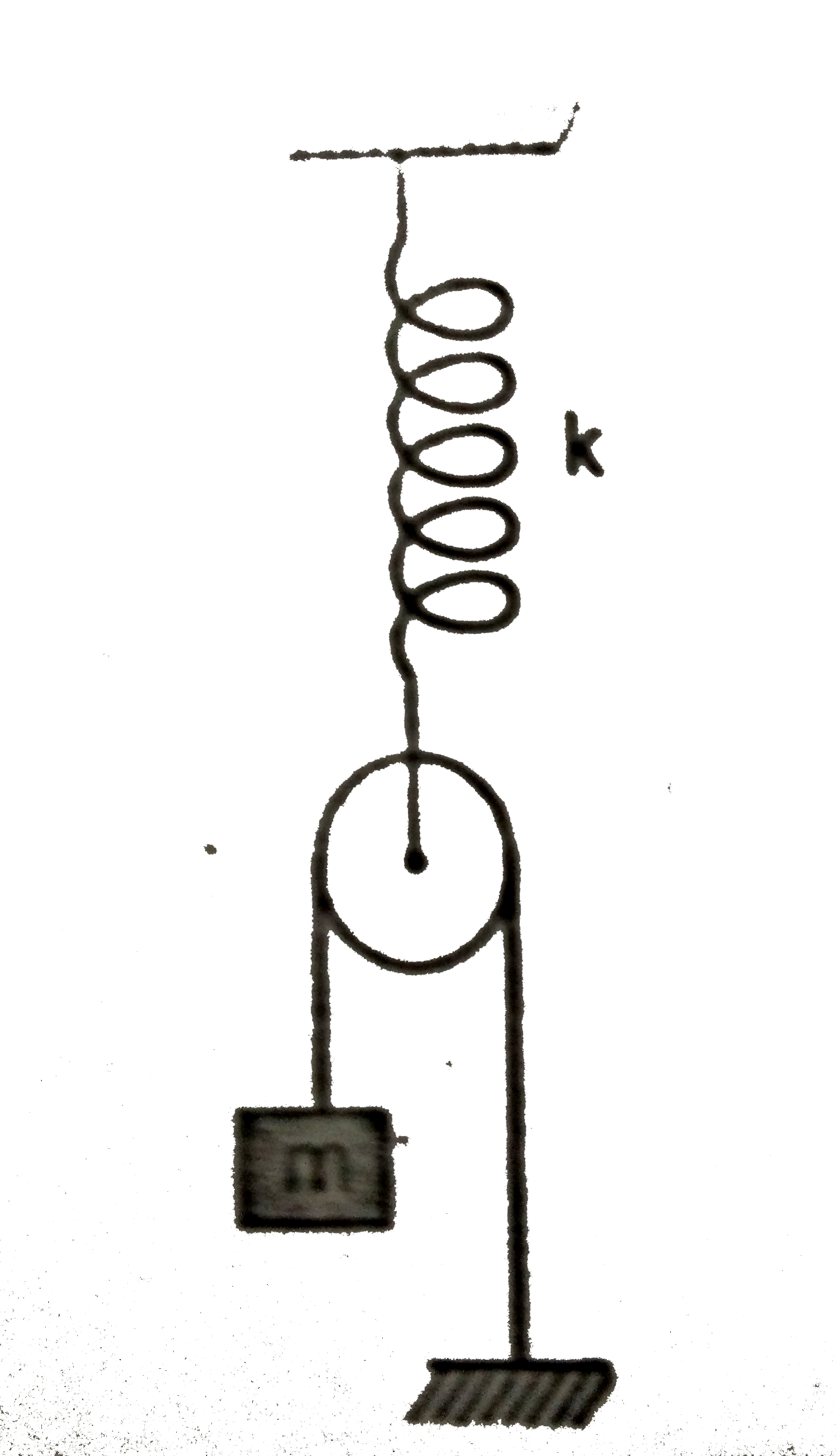
Block `m` is released from rest when spring is in its natural length `(` assume pulley is ideal and block does not strike on ground during it's motion in vertical plane `)`
than `:`

A

maximum elongation in spring is `4mg//k`

B

maximum elongation in spring is `2mg//k`

C

maximum speed of block is `2gsqrt((m)/(k))`

D

maximum speed of block is `gsqrt((m)/(k))`

Text Solution

Verified by Experts

The correct Answer is:

A, C

By energy conservation `(1)/(2)kx^(2)=mg(2x)`
`rArrx=(4mg)/(k)(` maximum elongation `)`
at equilibrium `kx=2mg`
`rArr x=(2mg)/(k)`
So `(K.E.)_(max)=mg(2x)-(1)/(2)kx^(2)`
`=2mg((2mg)/(k))-(1)/(2)k((2mg)/(k))^(2)`
`(1)/(2)mv_(max)^(2)=(2m^(2)g^(2))/(k)`
`rArr v_(max)=2gsqrt((m)/(k))`
Promotional Banner

Topper's Solved these Questions

  • DAILY PRACTICE PROBLEMS

    RESONANCE ENGLISH|Exercise dpp 41|7 Videos
  • DAILY PRACTICE PROBLEMS

    RESONANCE ENGLISH|Exercise dpp 42|7 Videos
  • DAILY PRACTICE PROBLEMS

    RESONANCE ENGLISH|Exercise dpp 39|3 Videos
  • CURRENT ELECTRICITY

    RESONANCE ENGLISH|Exercise Exercise|53 Videos
  • ELASTICITY AND VISCOCITY

    RESONANCE ENGLISH|Exercise Advanced Level Problems|9 Videos

Similar Questions

Explore conceptually related problems

The block of mass m is released when the spring was in its natrual length. Spring constant is k. Find the maximum elongation of the spring.

In the figure, block A is released from rest when the spring is its natural length for the block B of mass m to leave contact with the ground at some stage what should be the minimum mass of block A? .

In figure, block A is released from rest, when spring is at its natural unstretched length. For block B of mass M to leave contact with the ground at some stage, the minimum mass of A must be

The system is released from rest with spring intially in its natural length. If mass of the block m = 10 kg. and spring constant k = 100 N//m , then maximum extension in spring is :

Find the maximum tension in the spring if initially spring at its natural length when block is released from rest.

A 1kg block situated on a rough incline is connected to a spring of spring constant 100Nm^(-1) as shown in figure,. The block is released from rest with the spring in the unstretched position. The block moves 10cm down the incline before coming to rest. Find the coefficient of friction between the block and the incline. Assume that the spring has negligible mass and the pulley is frictionless.

A 20-kg block attached to a spring of spring constant 5Nm^-1 is released from rest at A. The spring at this instant is having an elongation of 1m . The block is allowed to move in smooth horizontal slot with the help of a constant force 50N in the rope as shown. The velocity of the block as it reaches B is (assume the rope to be light)

In the figure shown, a spring of spring constant K is fixed at on end and the other end is attached to the mass 'm' . The coefficient of friction between block and the inclined plane is mu . The block is released when the spring is in tis natural length. Assuming that the theta gt mu , the maximum speed of the block during the motion is.

A block of mass m is attached to a spring of force constant k whose other end is fixed to a horizontal surface. Initially the spring is in its natural length and the block is released from rest. The average force acting on the surface by the spring till the instant when the block has zero acceleration for the first time is
