Home
Class 11
PHYSICS
Three particles A,B and C move in a cir...

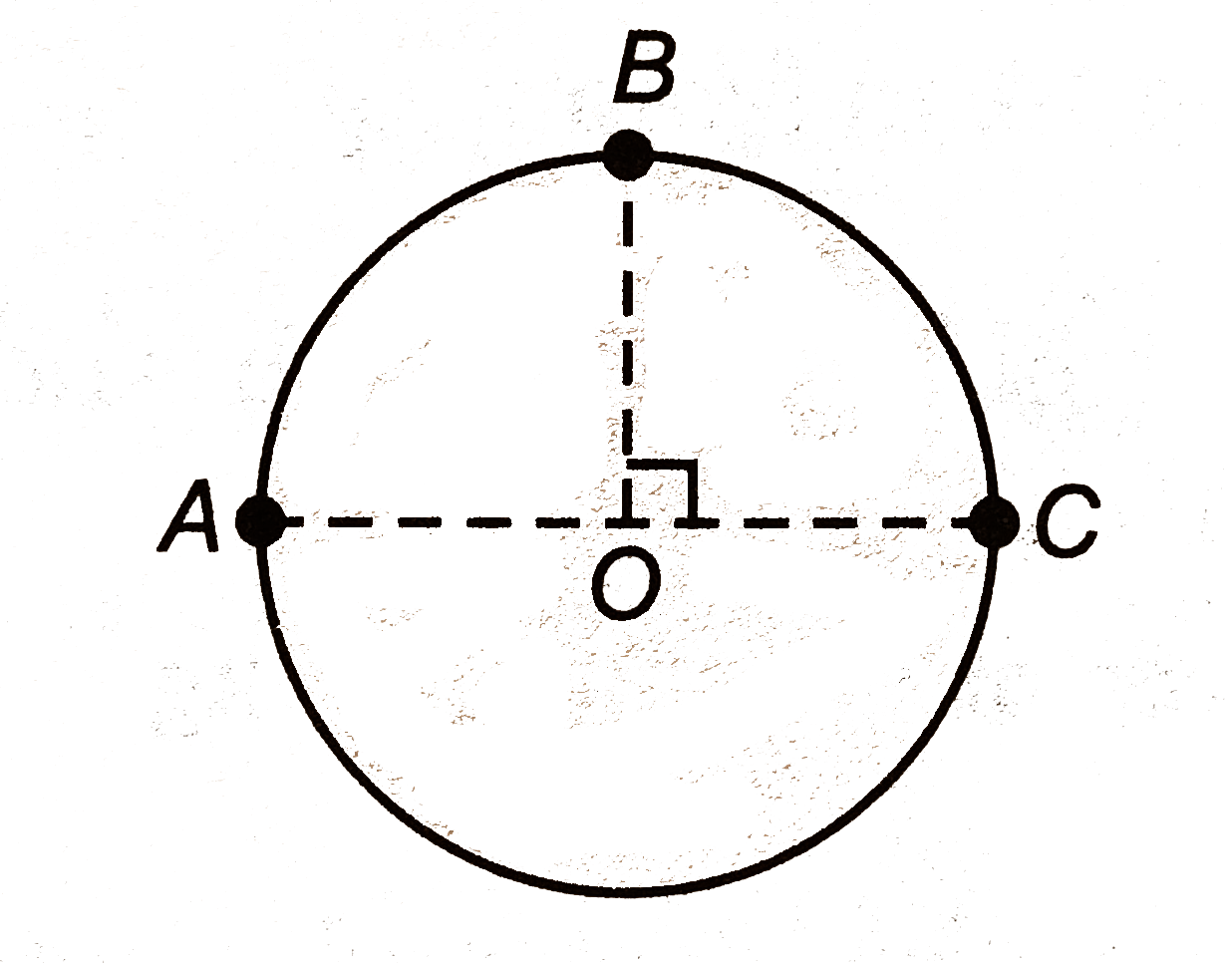
Three particles `A,B` and `C` move in a circle in anticlockwise direction with speeds `1min^(-1),2.5ms^(-1)` and `2ms^(-1)` respectively. The initial positions of `A`,`B` and `C` are shown in fig. The ratio of distance travelled by `B` and `C` by the instant `A,B` and `C` meet for the first time is

A

`3:2`

B

`5:4`

C

`3:5`

D

`3:7`

Text Solution

Verified by Experts

The correct Answer is:

B

The ratio of distance travelled by `B` and`C` in same duration of time `t` is `=v_(B):v_(C)=5:4`
Promotional Banner

Topper's Solved these Questions

  • DAILY PRACTICE PROBLEMS

    RESONANCE ENGLISH|Exercise dpp 42|7 Videos
  • DAILY PRACTICE PROBLEMS

    RESONANCE ENGLISH|Exercise dpp 43|11 Videos
  • DAILY PRACTICE PROBLEMS

    RESONANCE ENGLISH|Exercise dpp 40|5 Videos
  • CURRENT ELECTRICITY

    RESONANCE ENGLISH|Exercise Exercise|53 Videos
  • ELASTICITY AND VISCOCITY

    RESONANCE ENGLISH|Exercise Advanced Level Problems|9 Videos

Similar Questions

Explore conceptually related problems

Three particles A, B and C move in a circle of radius r=(1)/(pi) m, in anti-clockwise direaction with speed 1ms^(-1), 2.5ms^(-1) and 2ms^(-1) respectively. The initial position of A, B and C are as shown in figure. The ratio of distance travelled by B and C by the instant A, B and C meet for the first time is

Three particles A,B and C move in a circle in anticlockwise direction with speeds 1min^(-1),2.5ms^(-1) and 2ms^(-1) respectively. The initial positions of A,B and C shown in figure . the ratio of distance travelled by A ,B and C by the instant they meet for the first time is

Buses A and B are moving in the same direction with speed 20 ms^(-1) and 15 ms^(-1) respectively. Find the relative velcoity of A w.r.t. B and relative velocity of B w.r.t. A.

Three particles of masses 1 kg, 2 kg and 3 kg are situated at the corners of an equilateral triangle move at speed 6ms^(-1), 3ms^(-1) and 2ms^(-1) respectively. Each particle maintains a direction towards the particles at the next corners symmetrically. Find velocity of CM of the system at this instant

Two particles A and B start at the origin O and travel in opposite directions along the circular path at constant speeds v_(A)=1.4ms^(-1) and v_(B)=3ms^(-1) respectively. The time when they collide and the magnitude of the acceleration of B just before this happens are

Two particles are thrown simultaneously from points A and B with velocities u_1 = 2ms^(-1) and u_2 - 14 ms^(-1) , respectively, as shown in figure. Minimum separation between A and B is

Two particles are thrown simultaneously from points A and B with velocities u_1 = 2ms^(-1) and u_2 - 14 ms^(-1) , respectively, as shown in figure. The relative velocity of B as seen from A in

The velocities of A and B shown in fig. Find the speed (in ms^(-1) ) of block C. (Assume that the pulleys and string are ideal).

Two particles are moving in different circles in same plane with different angular velocities as shown in figure. At t = 0, initial positions of particles A and B are shown by dots on the respective circles. Initial distance between particles is 1m. Particle A move anticlockwise in the first circle whereas B moves clockwise in the second circle. Angle described (rotated) by A and B in time 't' are theta_(A)=((pi)/2t) and theta_(B)=(pit) respectively. here theta is in radian and t is in second. Radius of each circle is shown in diagram. At time t=2 second, the angular velocity of the particle A with respect to the particle B is

If a and b are position vector of two points A,B and C divides AB in ratio 2:1, then position vector of C is
