Home
Class 11
PHYSICS
A particle of mass 0.1kg is launched at ...

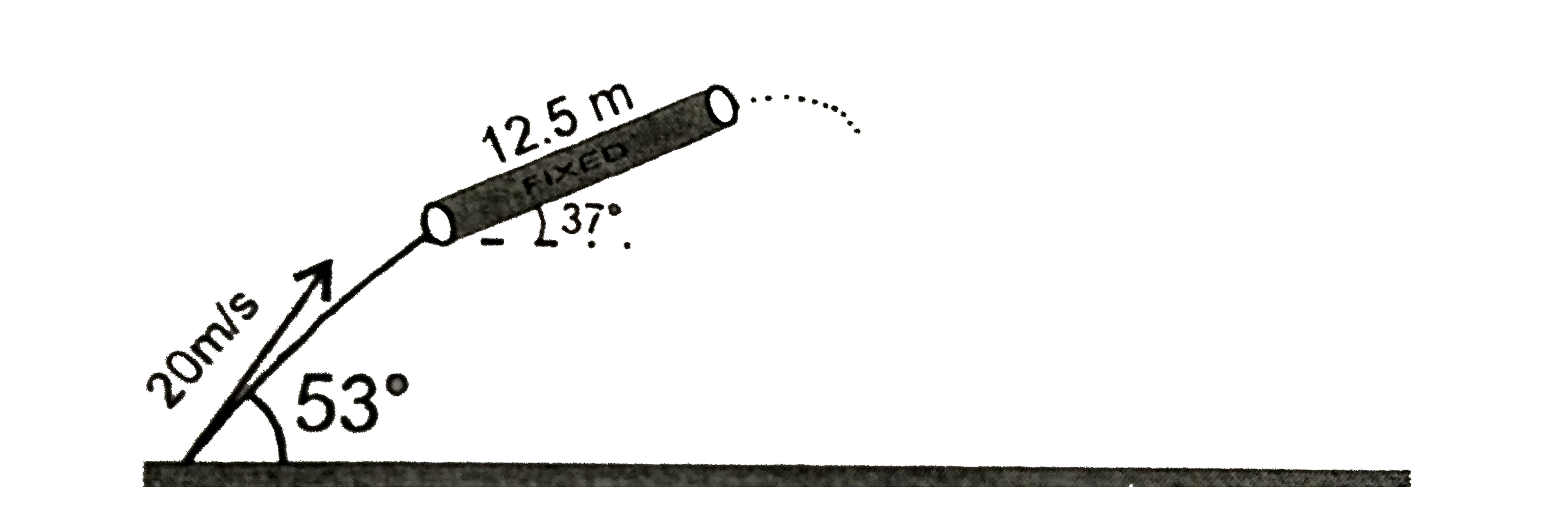
A particle of mass `0.1kg` is launched at an angle of `53^(@)` with the horizontal . The particle enters a fixed rough hollow tube whose length is slightly less than `12.5m` and which is inclined at an angle of `37^(@)` with the horizontal as shown in figure. It is known that the velocity of ball when it enters the tube is parallel to the axis of the tube. The coefficient of friction betweent the particle and tube inside the tube is `mu=(3)/(8)[` Take `g=10m//g^(2)]`

The kinetic energy of the particle when it comes out of the tube is approximately equal to `:`

A

zero

B

`4J`

C

`7.2J`

D

`11.2J`

Text Solution

Verified by Experts

The correct Answer is:
A

The initial velocity is `15m//s` acceleration of practicle is `(g sin theta + mu g cos theta )`
downwards along the tube.

`:. A=10 sin 37 +(3)/(8) xx10 xx cos 37=10xx(3)/(5)+(3)/(8)xx 10 xx(4)/(5)=9m//s^(2)`
` :. V ^(2)=u^(2)+2as`
`V^(2)=15^(2)-2xx9xx12.5=0`
`:. V^(2)=0`
Given that the tube is slightly less than `12.5m`. It means the particle will just drop from tube. Hence `K.E.` at the tube end `=0`
Promotional Banner

Topper's Solved these Questions

  • DAILY PRACTICE PROBLEMS

    RESONANCE ENGLISH|Exercise dpp 70|7 Videos
  • DAILY PRACTICE PROBLEMS

    RESONANCE ENGLISH|Exercise dpp 71|8 Videos
  • DAILY PRACTICE PROBLEMS

    RESONANCE ENGLISH|Exercise dpp 69|5 Videos
  • CURRENT ELECTRICITY

    RESONANCE ENGLISH|Exercise Exercise|53 Videos
  • ELASTICITY AND VISCOCITY

    RESONANCE ENGLISH|Exercise Advanced Level Problems|9 Videos

Similar Questions

Explore conceptually related problems

A particle of mass 0.1kg is launched at an angle of 53^(@) with the horizontal . The particle enters a fixed rough hollow tube whose length is slightly less than 12.5m and which is inclined at an angle of 37^(@) with the horizontal as shown in figure. It is known that the velocity of ball when it enters the tube is parallel to the axis of the tube. The coefficient of friction betweent the particle and tube inside the tube is mu=(3)/(8)[ Take g=10m//g^(2)] The velocity of the particle as it enters the tube is :

A particle of mass 0.1kg is launched at an angle of 53^(@) with the horizontal . The particle enters a fixed rough hollow tube whose length is slightly less than 12.5m and which is inclined at an angle of 37^(@) with the horizontal as shown in figure. It is known that the velocity of ball when it enters the tube is parallel to the axis of the tube. The coefficient of friction betweent the particle and tube inside the tube is mu=(3)/(8)[ Take g=10m//g^(2)] The distance from the point of projection where the particle will land on the horizontal plane after coming out from the tube is approximately equal to :

A particle of mass m is projected with velocity making an angle of 45^(@) with the horizontal When the particle lands on the level ground the magnitude of the change in its momentum will be .

A particle is thrown with a speed is at an angle theta with the horizontal. When the particle makes an angle phi with the horizontal, its speed changes to v, then

Water rises in a capillary tube to a height 4 cm. If the tube is inclined at an angle of 45^(@) with the vertical , find the position of the water in the tube.

The pollen tube enters the ovule through

An incompressible liquid flows through a horizontal tube as shown in the figure. Then the velocity 'v' of the fluid is:

The range of a projectile, when launched at an angle of 15^(@) with the horizontal is 1.5 km. what is the range of the projectile, when launched at an angle of 45^(@) to the horizontal with the same speed ?

A particle is thrown at time t = 0 with a velocity of 10 ms^(-1) at an angle 60^@ with the horizontal from a point on an inclined plane, making an angle of 30^@ with the horizontal. The time when the velocity of the projectile becomes parallel to the incline is

A particle is thrown at time t = 0 with a velocity of 10 ms^(-1) at an angle 60^@ with the horizontal from a point on an inclined plane, making an angle of 30^@ with the horizontal. The time when the velocity of the projectile becomes parallel to the incline is

RESONANCE ENGLISH-DAILY PRACTICE PROBLEMS-comprehension
  1. A small block of mass m is released from a fixed smooth wedge in figur...

    Text Solution

    |

  2. A particle of mass 0.1kg is launched at an angle of 53^(@) with the ho...

    Text Solution

    |

  3. A particle of mass 0.1kg is launched at an angle of 53^(@) with the ho...

    Text Solution

    |

  4. A particle of mass 0.1kg is launched at an angle of 53^(@) with the ho...

    Text Solution

    |

  5. Two bodies A and B of masses 10 kg and 5 kg placed very slightly seper...

    Text Solution

    |

  6. Two bodies A and B of masses 10 kg and 5 kg placed very slightly seper...

    Text Solution

    |

  7. Two bodies A and B of masses 10 kg and 5 kg placed very slightly seper...

    Text Solution

    |

  8. One end of massless inextensible string of length l is fixed and other...

    Text Solution

    |

  9. One end of massless inextensible string of length l is fixed and other...

    Text Solution

    |

  10. One end of massless inextensible string of length l is fixed and other...

    Text Solution

    |

  11. Figure shows an irregular wedge of mass m placed on a smooth horizont...

    Text Solution

    |

  12. Figure shows an irregular wedge of mass m placed on a smooth horizont...

    Text Solution

    |

  13. Figure shows an irregular wedge of mass m placed on a smooth horizont...

    Text Solution

    |

  14. An initially stationary box on a frictionless floor explodes into two ...

    Text Solution

    |

  15. An initially stationary box on a frictionless floor explodes into two ...

    Text Solution

    |

  16. Two racing cars 'A' and 'B' having masses 'M' and '2m' respectively st...

    Text Solution

    |

  17. Two racing cars 'A' and 'B' having masses 'M' and '2m' respectively st...

    Text Solution

    |

  18. Two racing cars 'A' and 'B' having masses 'M' and '2m' respectively st...

    Text Solution

    |

  19. Two racing cars 'A' and 'B' having masses 'M' and '2m' respectively st...

    Text Solution

    |

  20. Two beads of mass 2m and m, connected by a rod of length l and of negl...

    Text Solution

    |

