Home
Class 11
PHYSICS
Two bodies A and B of masses 10 kg and 5...

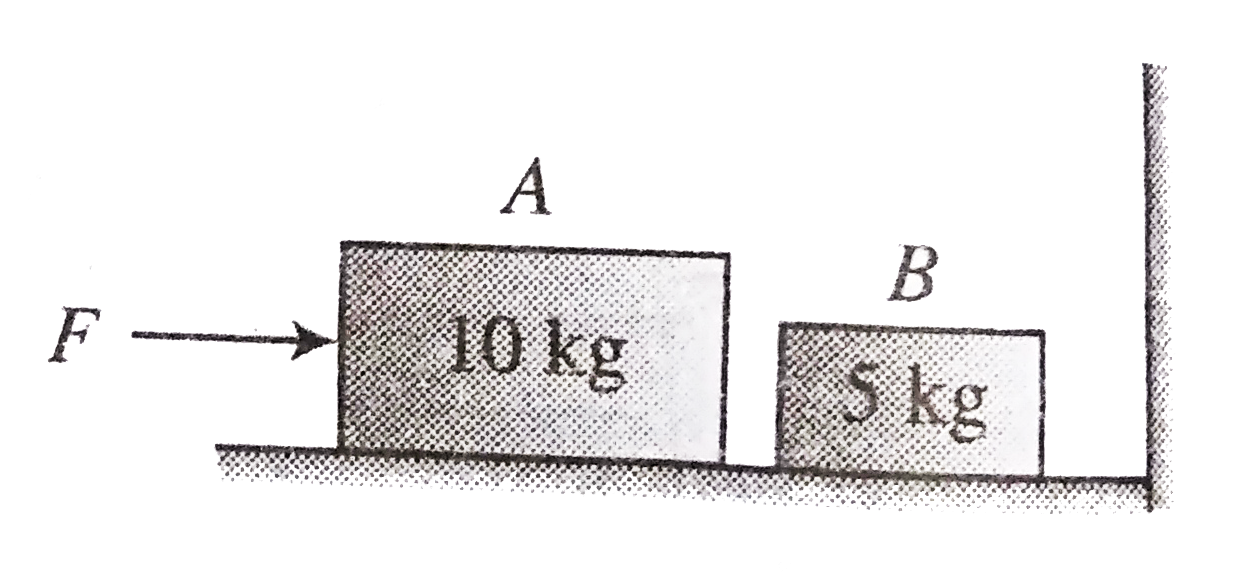
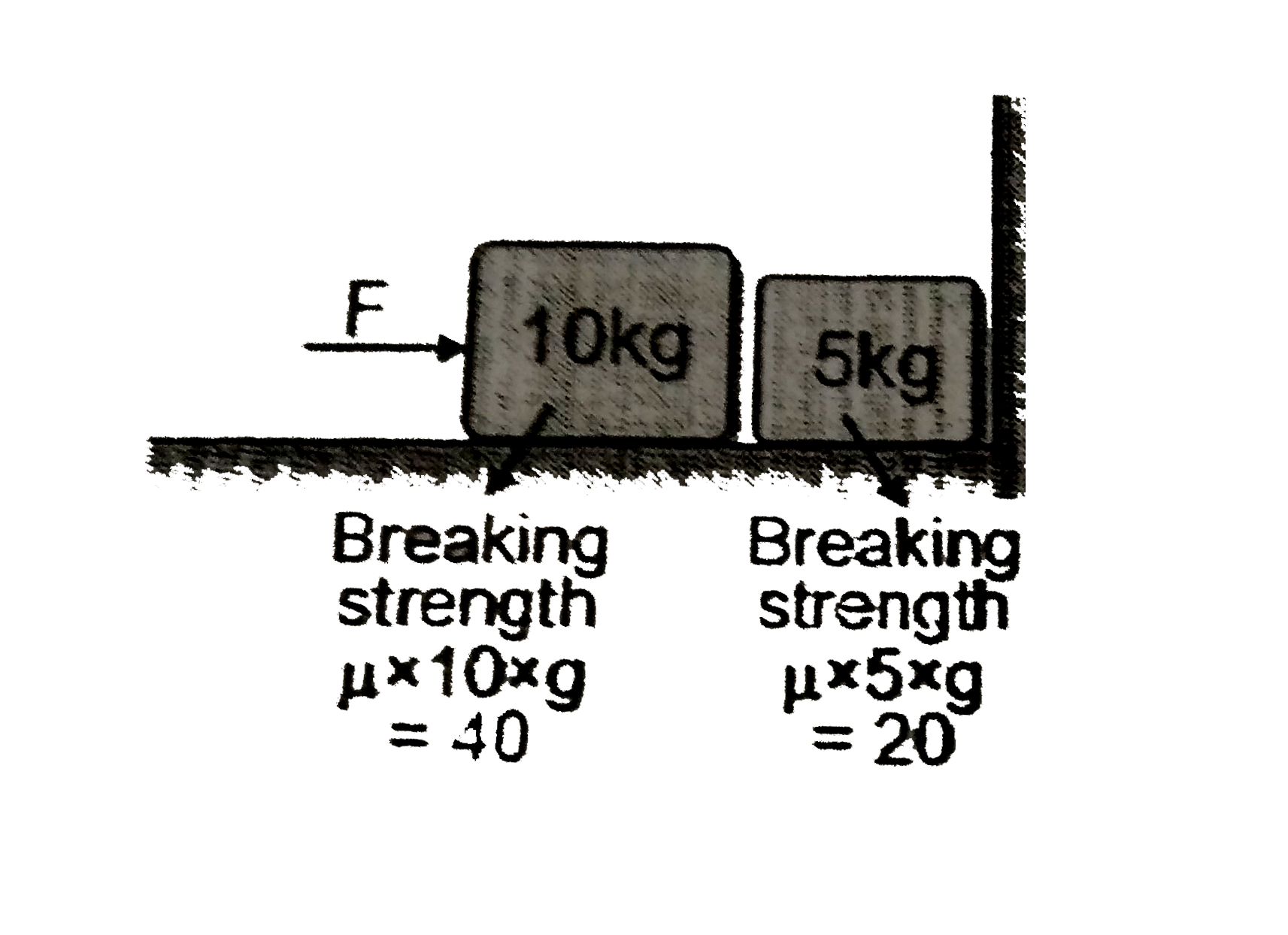
Two bodies A and B of masses `10 kg` and `5 kg` placed very slightly seperated as shown in figure The coefficient of friction between the floor and the block are as `mu_(s) = 0.4` block A is pushed by an external force F The value of F can be changed when the weight between block A and ground breaks block A will start prssing block B will start pressing the vertical wall

If `F = 20N`,with how much force block A press block B?

A

`10N`

B

`20N`

C

`30N`

D

Zero

Text Solution

Verified by Experts

The correct Answer is:
D

If `F=20N, 10 kg` block will not move and it would not press `5kg` and So `N=0` .
Promotional Banner

Topper's Solved these Questions

  • DAILY PRACTICE PROBLEMS

    RESONANCE ENGLISH|Exercise dpp 70|7 Videos
  • DAILY PRACTICE PROBLEMS

    RESONANCE ENGLISH|Exercise dpp 71|8 Videos
  • DAILY PRACTICE PROBLEMS

    RESONANCE ENGLISH|Exercise dpp 69|5 Videos
  • CURRENT ELECTRICITY

    RESONANCE ENGLISH|Exercise Exercise|53 Videos
  • ELASTICITY AND VISCOCITY

    RESONANCE ENGLISH|Exercise Advanced Level Problems|9 Videos

Similar Questions

Explore conceptually related problems

Two bodies A and B of masses 10 kg and 5 kg placed very slightly seperated as shown in figure The coefficient of friction between the floor and the block are as mu_(s) = 0.4 block A is pushed by an external force F The value of F can be changed when the weight between block A and ground breaks block A will start prssing block B will start pressing the vertical wall If F = 50N the friction force acting between block B and ground will be

Two bodies A and B of masses 10 kg and 5 kg placed very slightly seperated as shown in figure The coefficient of friction between the floor and the block are as mu_(s) = 0.4 block A is pushed by an external force F The value of F can be changed when the weight between block A and ground breaks block A will start pressing block B will start pressing the vertical wall The force of friction acting on B verius with the applied force F acceleration to curve

A block of mass m = 4 kg is placed over a rough inclined plane as shown in fig . The coefficient of friction between the block and the plane mu = 0.5 A force F = 10N is applied on the block at an angle of 30^(@) . Find the contact force between the block and the plane. k

For the arrangement shown in the figure the coefficient of friction between the two blocks is mu . If both the blocks are identical and moving ,then the acceleration of each block is

A force of 100 N is applied on a block of mass 3 kg as shown in figure. The coefficient of friction between the surface and the block is 1/4 .Then the friction force acting on the block is

A block A slides over an another block B which is placed over a smooth inclined plane as shown in figure . The coefficient of friction between the two blocks A and B is mu . Mass of block B is two times the mass of block A . The acceleration of the centre of mass of two blocks is

Three blocks of masses 5 kg, 3 kg and 2 kg are placed on a rough surface as shown in figure. Coefficient of friction between block and surface is same for all the blocks and is equal to mu = 0.2 . A horizontal force of 15 N is applied on 5 kg block. The force exerted by 3 kg block on 2 kg block is : (g = 10 m/ s^(2) )

Two blocks A and B of masses 10 kg and 15 kg are placed in contact with each other rest on a rough horizontal surface as shown in the figure. The coefficient of friction between the blocks and surface is 0.2. A horizontal force of 200 N is applied to block A. The acceleration of the system is ("Take g"=10ms^(-2))

The coefficient of static friction between the two blocks shown in figure is mu and the table is smooth. What maximum horizontal forced F can be applied to he block of mass M so that the block move together?

The coefficient of static friction between the two blocks shown in figure is mu and the table is smooth. What maximum horizontal forced F can be applied to he block of mass M so that the block move together?

RESONANCE ENGLISH-DAILY PRACTICE PROBLEMS-comprehension
  1. A particle of mass 0.1kg is launched at an angle of 53^(@) with the ho...

    Text Solution

    |

  2. A particle of mass 0.1kg is launched at an angle of 53^(@) with the ho...

    Text Solution

    |

  3. Two bodies A and B of masses 10 kg and 5 kg placed very slightly seper...

    Text Solution

    |

  4. Two bodies A and B of masses 10 kg and 5 kg placed very slightly seper...

    Text Solution

    |

  5. Two bodies A and B of masses 10 kg and 5 kg placed very slightly seper...

    Text Solution

    |

  6. One end of massless inextensible string of length l is fixed and other...

    Text Solution

    |

  7. One end of massless inextensible string of length l is fixed and other...

    Text Solution

    |

  8. One end of massless inextensible string of length l is fixed and other...

    Text Solution

    |

  9. Figure shows an irregular wedge of mass m placed on a smooth horizont...

    Text Solution

    |

  10. Figure shows an irregular wedge of mass m placed on a smooth horizont...

    Text Solution

    |

  11. Figure shows an irregular wedge of mass m placed on a smooth horizont...

    Text Solution

    |

  12. An initially stationary box on a frictionless floor explodes into two ...

    Text Solution

    |

  13. An initially stationary box on a frictionless floor explodes into two ...

    Text Solution

    |

  14. Two racing cars 'A' and 'B' having masses 'M' and '2m' respectively st...

    Text Solution

    |

  15. Two racing cars 'A' and 'B' having masses 'M' and '2m' respectively st...

    Text Solution

    |

  16. Two racing cars 'A' and 'B' having masses 'M' and '2m' respectively st...

    Text Solution

    |

  17. Two racing cars 'A' and 'B' having masses 'M' and '2m' respectively st...

    Text Solution

    |

  18. Two beads of mass 2m and m, connected by a rod of length l and of negl...

    Text Solution

    |

  19. Two beads of mass 2m and m, connected by a rod of length l and of negl...

    Text Solution

    |

  20. Two beads of mass 2m and m, connected by a rod of length l and of negl...

    Text Solution

    |

