Home
Class 11
PHYSICS
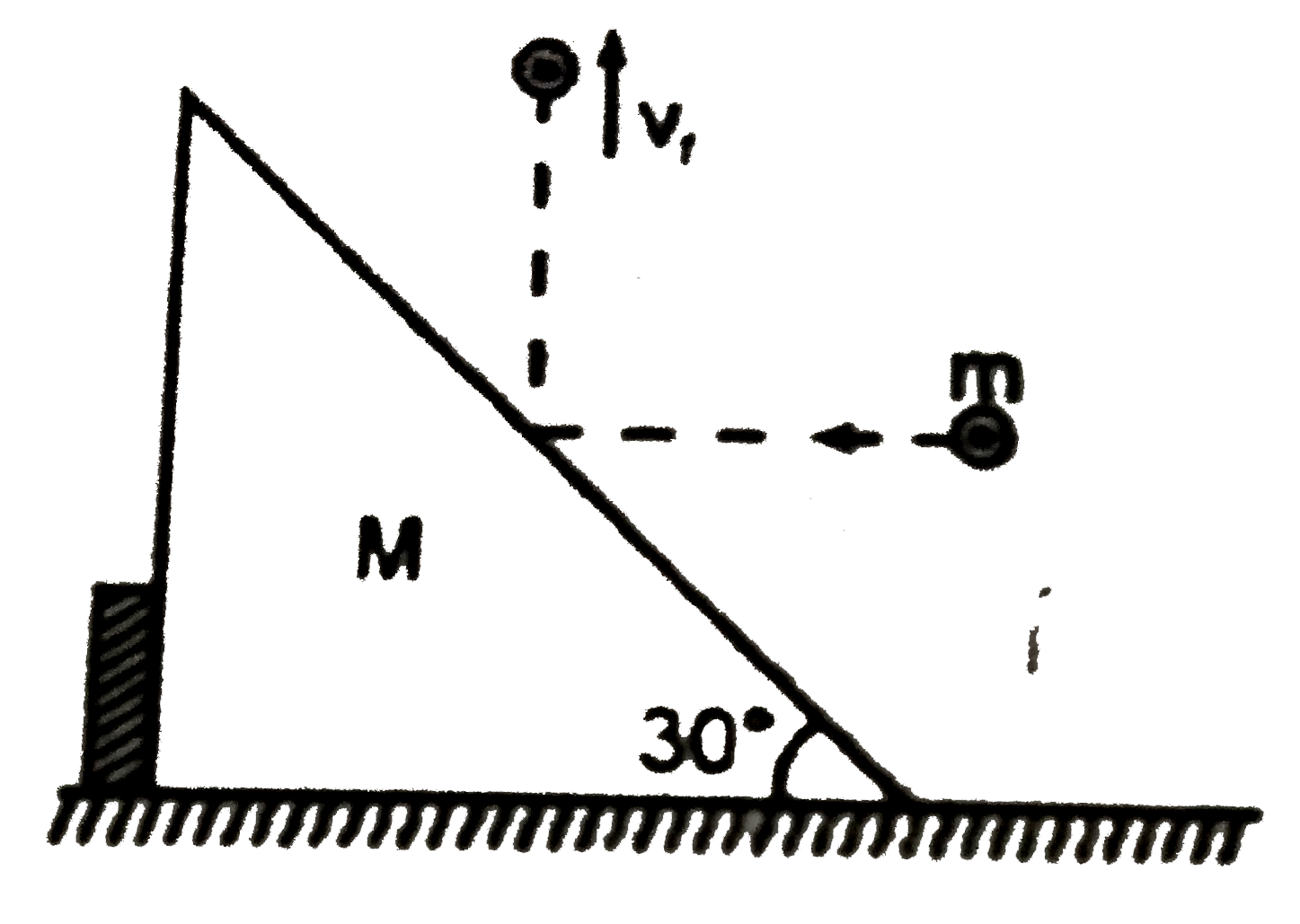
As shown in the figure a body of mass m...

As shown in the figure a body of mass `m` moving horizontally with speed `sqrt(3) m//s` hits a fixed smooth wedge and goes up with a velocity `v_(f)` in the vertical direction. If `/_` of wedge is `30^(@)`, the velocity `v_(f)` will be `:`

A

`sqrt(3)m//s`

B

`3m//s`

C

`(1)/(sqrt(3))m//s`

D

this is not possible

Text Solution

Verified by Experts

The correct Answer is:

D

Velocity along the plane does not change
So `sqrt(3)Sin f o^(@)=V_(1)sin 30^(@)`
`rArrV_(1)=3m//sgt sqrt(3)m//s`
Which in impossible `:. Ans. (D)`
Promotional Banner

Topper's Solved these Questions

  • DAILY PRACTICE PROBLEMS

    RESONANCE ENGLISH|Exercise dpp 56|7 Videos
  • DAILY PRACTICE PROBLEMS

    RESONANCE ENGLISH|Exercise dpp 57|7 Videos
  • DAILY PRACTICE PROBLEMS

    RESONANCE ENGLISH|Exercise dpp 54|8 Videos
  • CURRENT ELECTRICITY

    RESONANCE ENGLISH|Exercise Exercise|53 Videos
  • ELASTICITY AND VISCOCITY

    RESONANCE ENGLISH|Exercise Advanced Level Problems|9 Videos

Similar Questions

Explore conceptually related problems

As shown in the figure a body of mass m moving vertically with speed 3 m/s hits a smooth fixed inclined plane and rebounds with a velocity v_(f) in the horizontal direction . If angle of plane with horizontal is 30^(@) , the velocity v_(f) will be

In the block moves up with constant velocity v m/s. Find F

A body is projected horizontally with a speed v_(0) find the velocity of the body when it covers equal distance in horizontal and vertical directions.

A body of mass m moving with a constant velocity v hits another body of the same mass moving with the same velocity v but in the opposite direction and sticks to it. The velocity of the compound body after collision is

A system is shown in the figure. Block A is moving with 1m//s towards left. Wedge is moving with 1m//s towards right. Then speed of the block B will be :

What is the power required to push the woodn wedge horizontally with constant speed v_(0) to raise the heavy block M, as shown in the figure. All surfaces are frictionless.

A mass m moving horizontal (along the x-axis) with velocity v collides and sticks to mass of 3m moving vertically upward (along the y-axis) with velocity 2v . The final velocity of the combination is

A body of mass m, moving with velocity mu collides elasticity with another body at rest having mass M. If the body of mass M moves with velocity V, then the velocity of the body of mass m after the impact is

A body of mass m moving with velocity u hati collides elastically with a body at rest of mass 3m and then the final velocity of body mass m is v hatj . Find the relation between v and u

A body of mass M hits normally a rigid wall with velocity V and bounces back with the same velocity. The impulse experienced by the body is
