Home
Class 11
PHYSICS
Figure shows an ideal pulley block of ma...

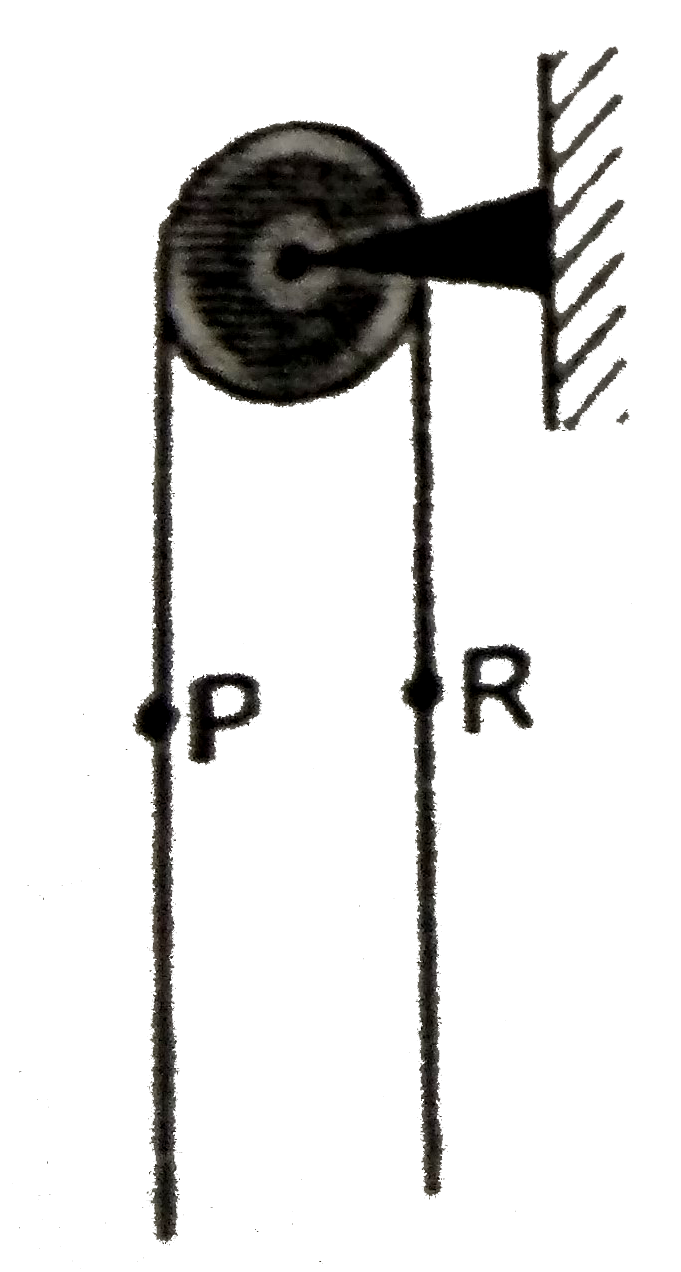
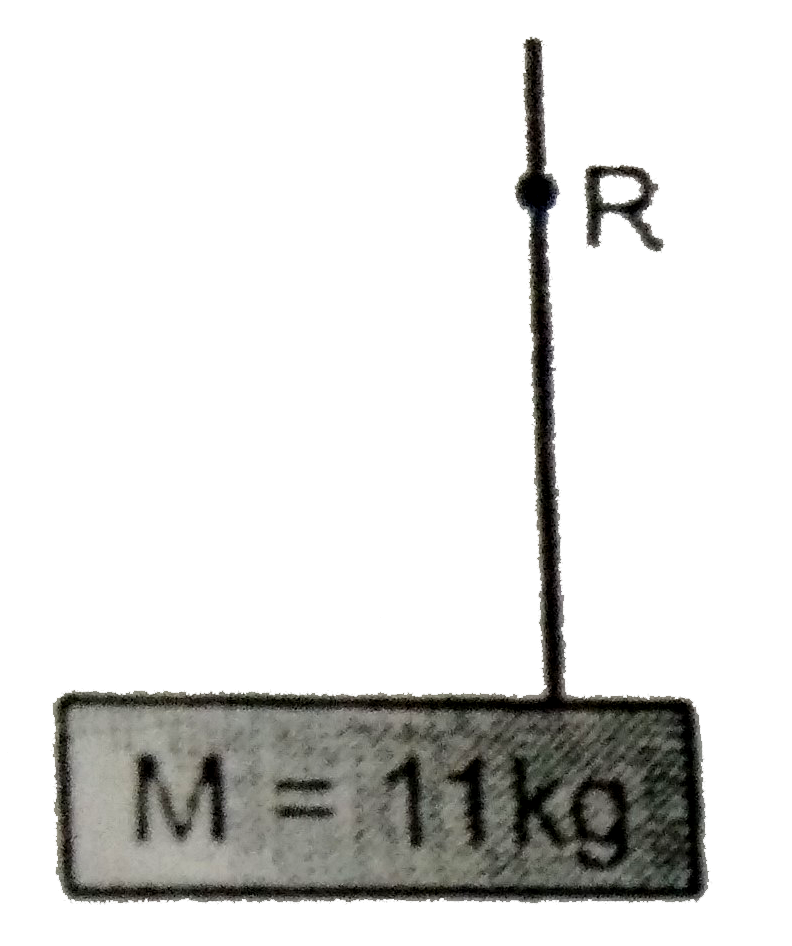
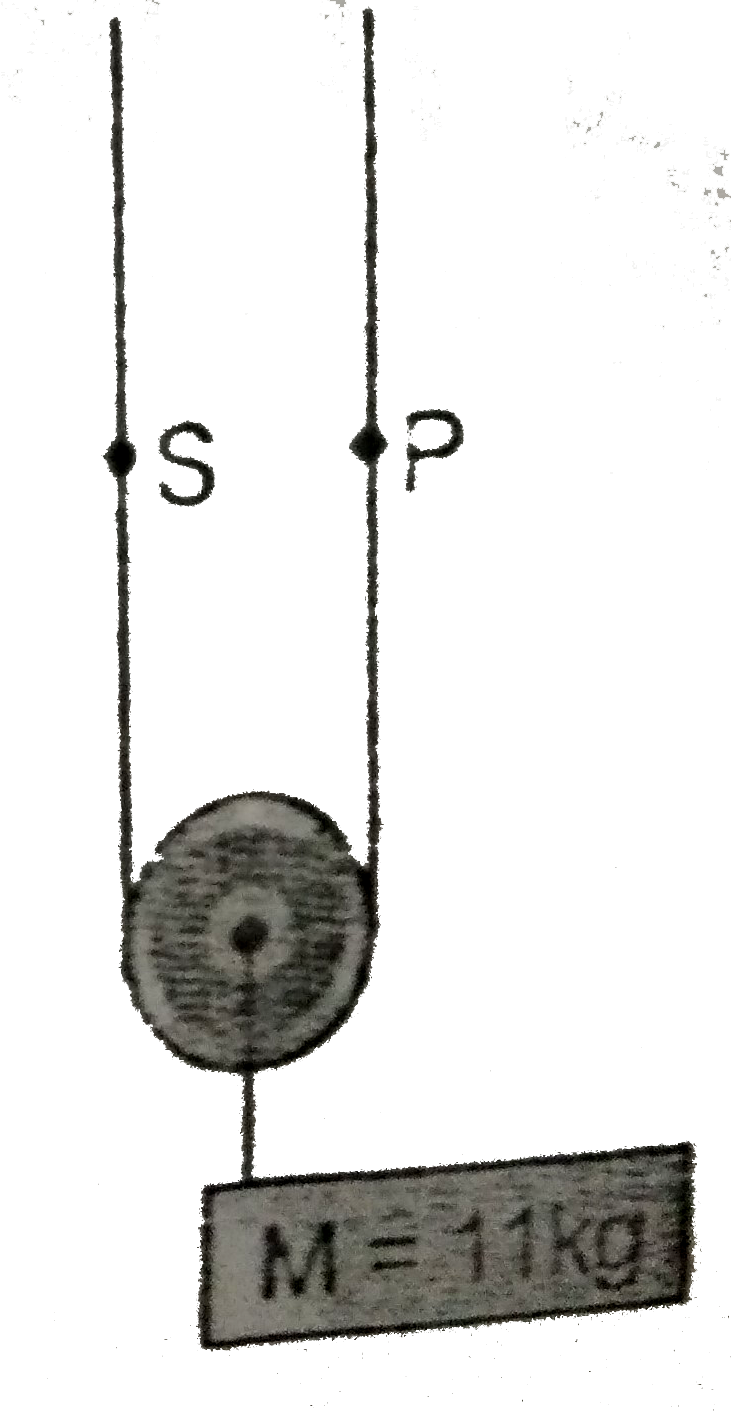
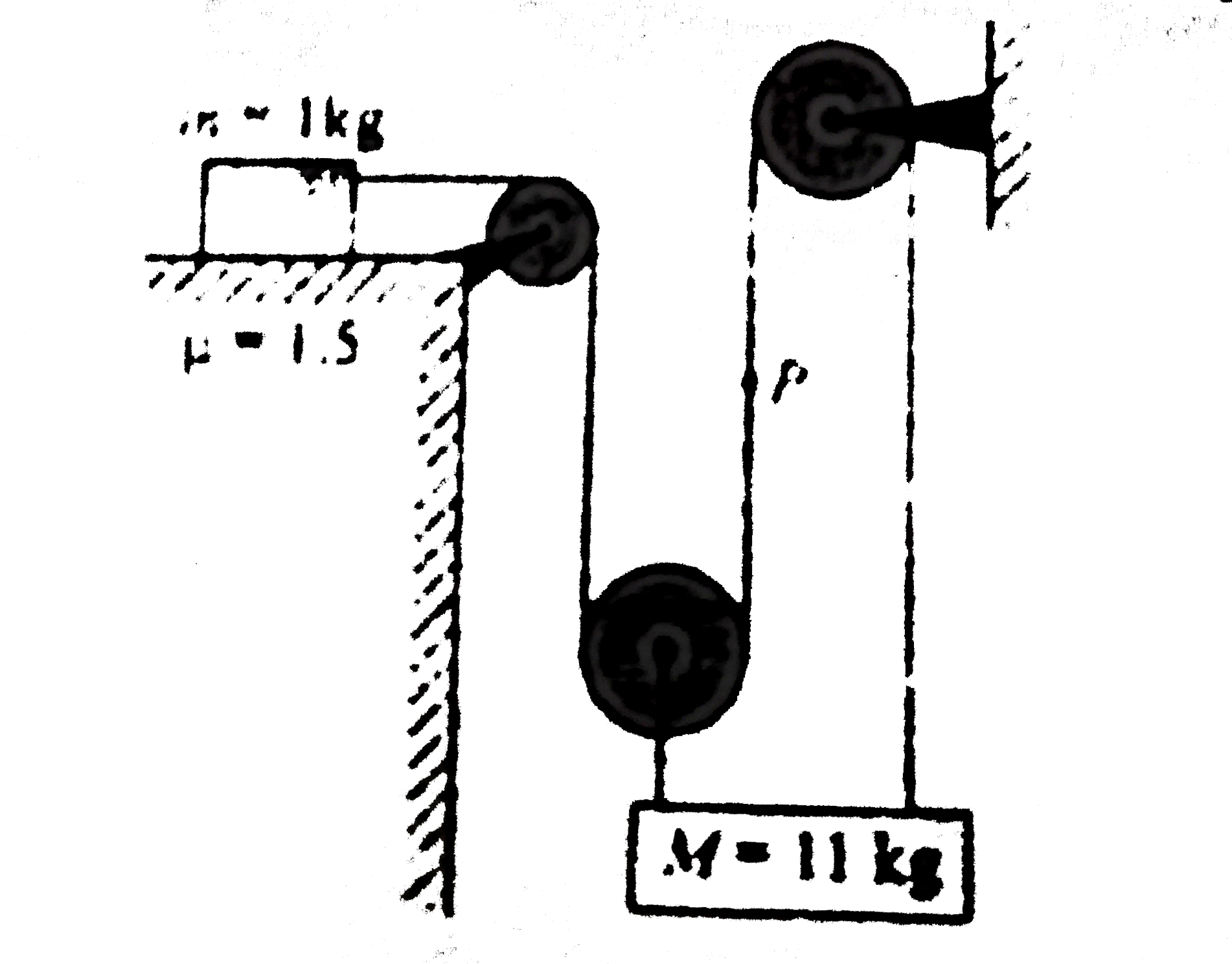
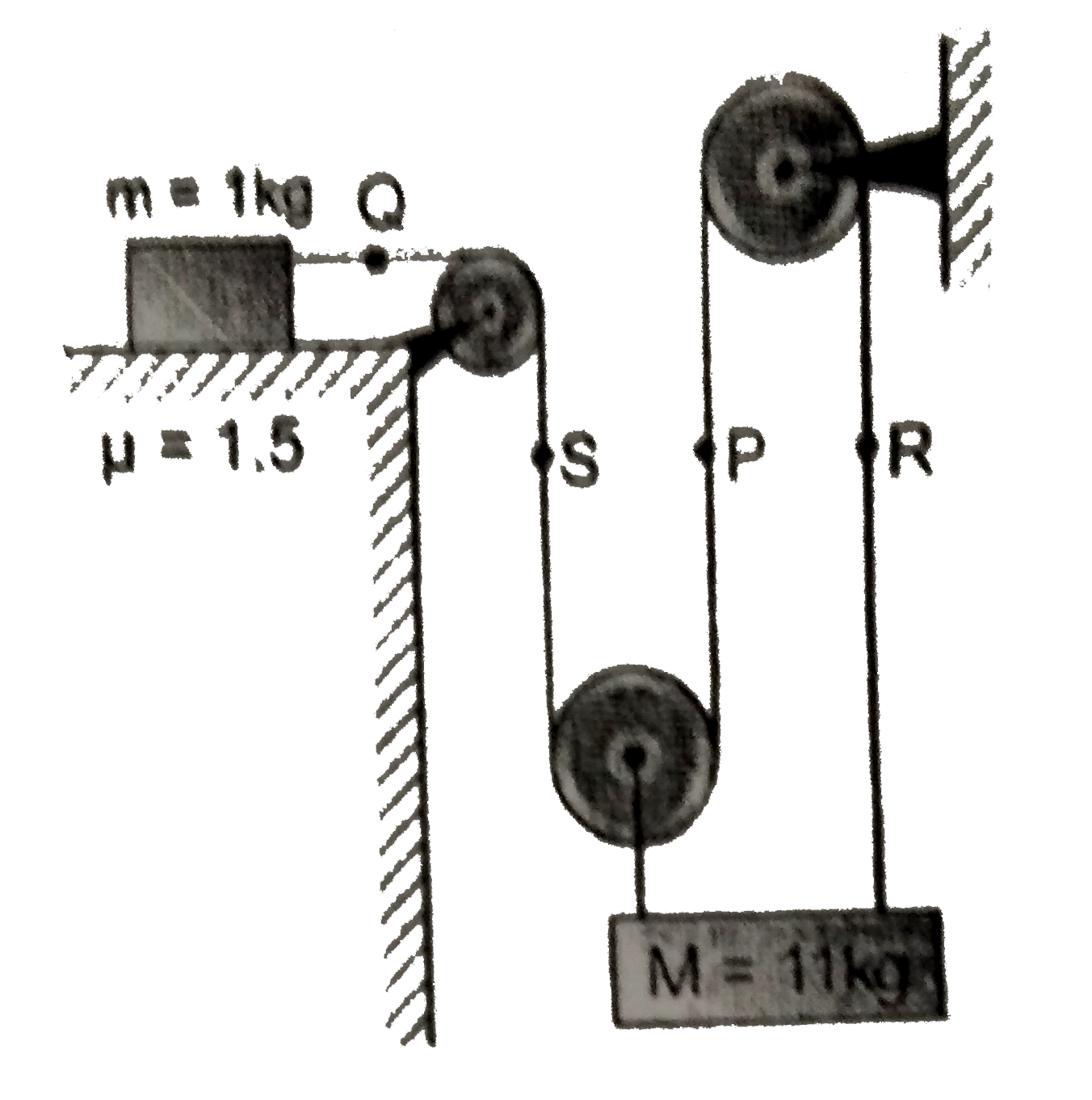
Figure shows an ideal pulley block of mass m = 1 kg. resting on a rough ground with friction coefficient `mu = 1.5`. Another block of mass `M = 11 kg` is hanging as shown. When system is released it is found that the magnitude of acceleration of point P on string is a. Find value of 4a in `m//s^(2)` (Use `g = 10 m//s^(2)`)

Text Solution

Verified by Experts

The correct Answer is:
13


Sol.
If the point `P` has an acceleration a upwards then the acceleration of point `R` will be a downwards.

The point `R` has an acceleration a downwards so the block will also have an acceleration a downwards.

The point `P` has an acceleration a upwards, the block has an acceleration a downwards so the acceleration of `S` will be `3a` downwards . `("because" (vec(a)_(S)+vec(a)_(P))/(2)=vec(a) _(block ))`.
The point `Q` will also have an acceleration `3a` towards right.
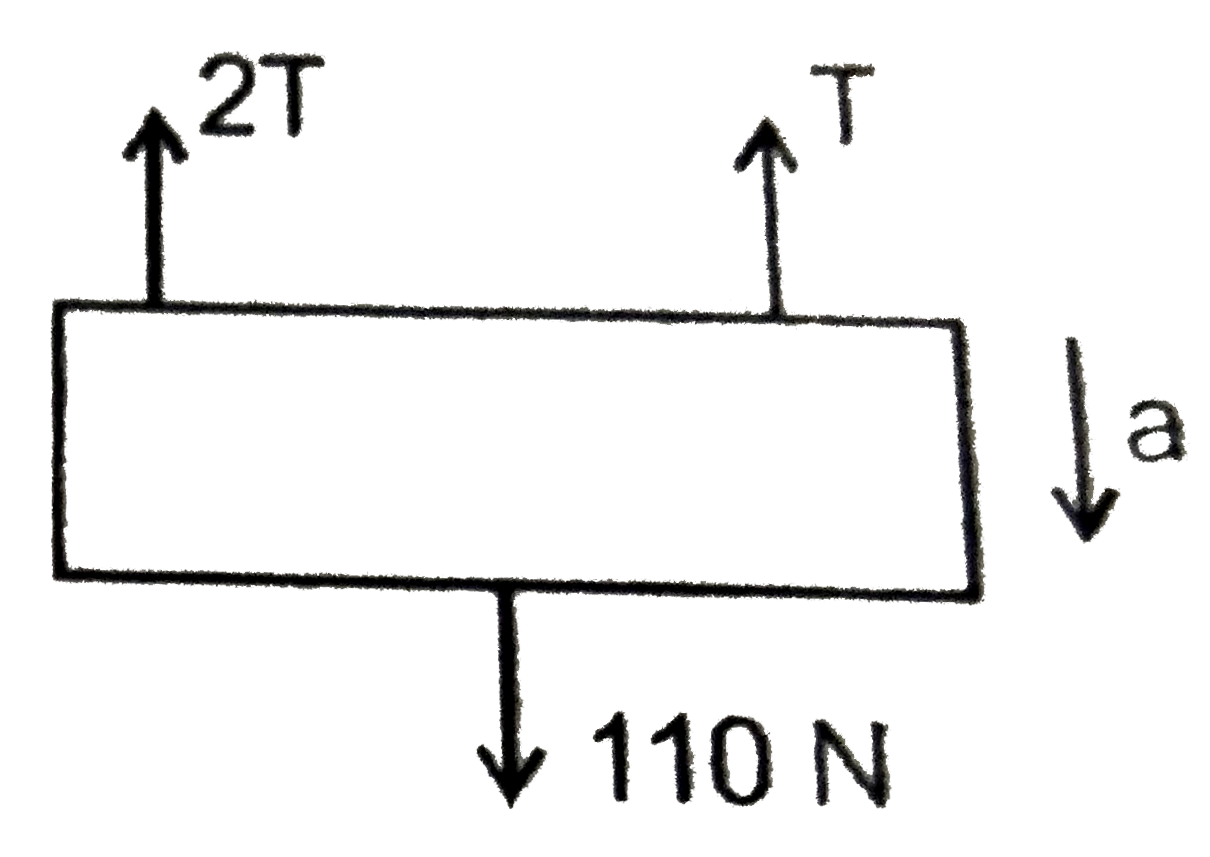
The `F.B.D.` of `11kg` block
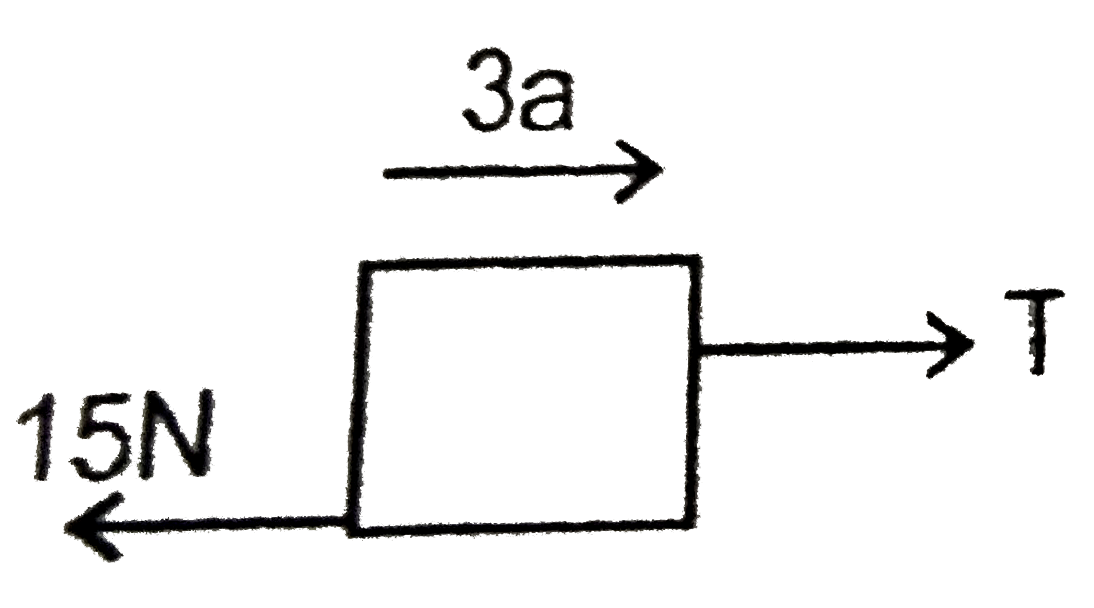
The `F.B.D.` of `1kg` block

Using `FBD` of `11kg` block, which will have acceleration a downwards.
`110-3T=11a` ....(1) (in downwards direction)
FOR `1kg` block, which will have acceleration `3a, T-15=3a` (in horizontal direction)
or `3T-45=9a` ....(2)
on adding equation (1) & (2) we get
`20a=65rArr 4a=13m//s^(2)`
Promotional Banner

Topper's Solved these Questions

  • DAILY PRACTICE PROBLEMS

    RESONANCE ENGLISH|Exercise dpp61|6 Videos
  • DAILY PRACTICE PROBLEMS

    RESONANCE ENGLISH|Exercise DPP 62|4 Videos
  • DAILY PRACTICE PROBLEMS

    RESONANCE ENGLISH|Exercise dpp 59|5 Videos
  • CURRENT ELECTRICITY

    RESONANCE ENGLISH|Exercise Exercise|53 Videos
  • ELASTICITY AND VISCOCITY

    RESONANCE ENGLISH|Exercise Advanced Level Problems|9 Videos

Similar Questions

Explore conceptually related problems

Two identical ladders, each of mass M and length L are resting on the rough horizontal surface as shown in the figure. A block of mass m hangs from P. if the system is in equilibrium, find the magnitude and the direction of frictional force at A and B.

Two blocks of masses 5 kg and 4 kg are connected with ideal string which is passing over an ideal pulley as shown in figure. If the system is released from rest then the magnitude of acceleration of the blocks will be (Take g = 10 ms^-2 and sqrt3 = 1.7 )

Two blocks each of mass 4 kg connected by a light string which is passing over an ideal pulley is as shown in figure. If the system is released from rest then the acceleration (in m/ s^2 ) of centre of mass is (g = 10 m/ s^2 )

The magnitudes of accelerations of blocks of mass 2 kg and 4 kg are respectively . ( Pulleys and threads are massless) ( g = 10 m//s^(2 )

A block of mass m_1 = 4kg lying on a plane inclined at an angle of 30^(@) , is connected to another freely suspended block of mass m_2 = 6kg with the help of a string passing over a smooth pulley as shown in the figure. The acceleration of each block is (g = 10 m/ s^2 )

Two blocks of masses 10 kg and 9 kg are connected with light string which is passing over an ideal pulley as shown in figure. If system is released from rest then the acceleration of 9 kg block at the given instant is about (Assume all the surfaces are smooth and g = 10 m/s^2 )

Two blocks of masses 3 kg and 6 kg are connected by a string as shown in the figure over a frictionless pulley. The acceleration of the system is A. 4m // s^2 B. 2m//s^2 C. zero D. 6m//s^2

A block of mass m=5kg is resting on a rough horizontal surface for which the coefficient of friction is 0.2 . When a force F=40N is applied, the acceleration of the block will be (g=10m//s^(2)) .

If coeffiecient of friction between the block of mass 2kg and table is 0.4 then out acceleration of the system and tension in the string. (g=10m//s^(2))

In figure shown if 2 kg block is moving at an acceleration 2 m//s^(2) , find the elongationin spring and acceleration of 4 kg block at this instant. Take g= 10m//s^(2) .