Home
Class 11
PHYSICS
A solid cylinder A, of mass 12 kg is bei...

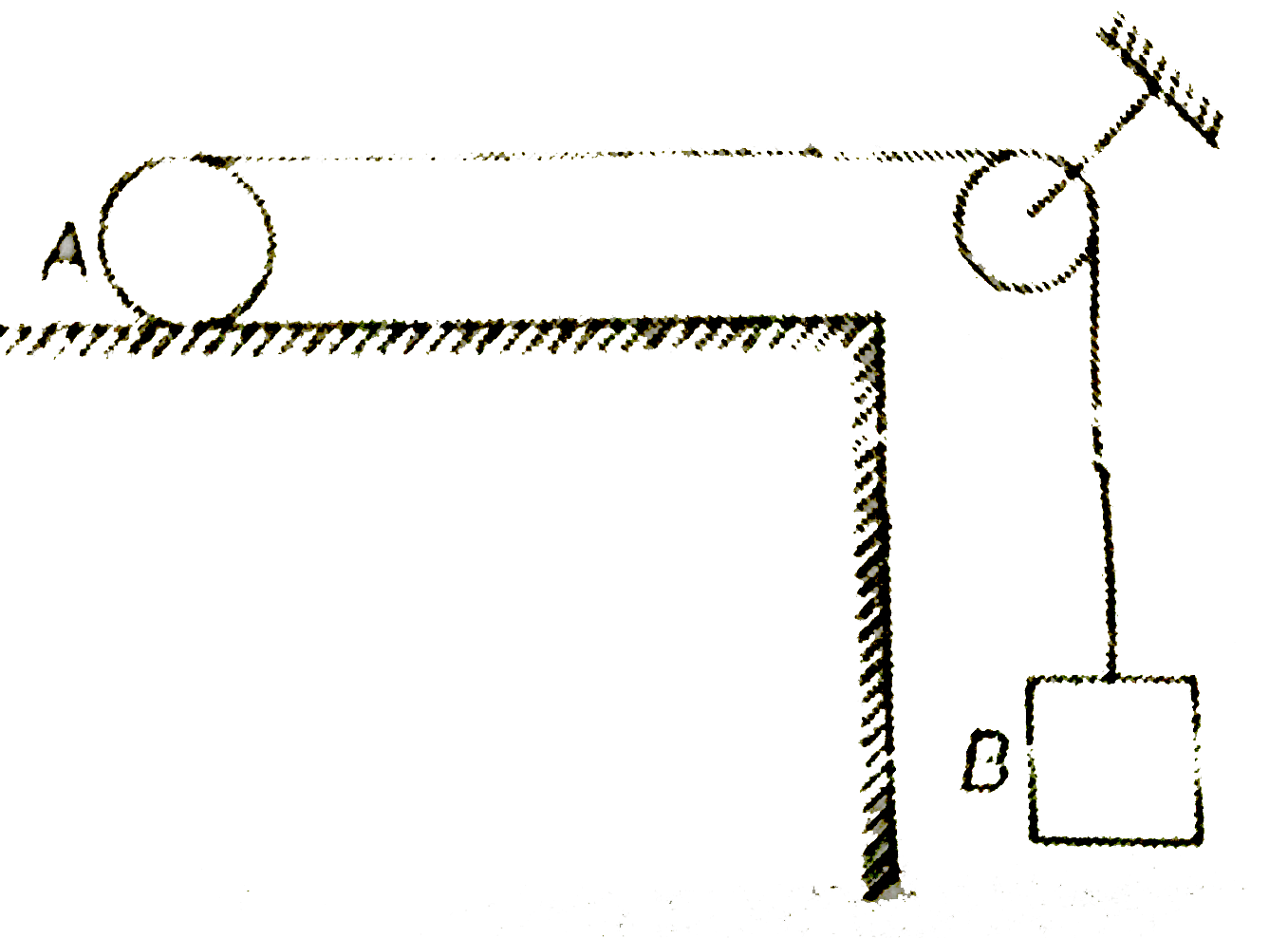
A solid cylinder A, of mass 12 kg is being pulled by another weight B(3 kg) along a rough horizontal plane as shown in figure. (pulley is massless). The weight B is attached to the end of a string wound aroung the circumference of cylinder. There is no slipping anywhere and string is inextensilbe , find acceleration ( in `m//s^(2)`) of A.

Text Solution

Verified by Experts

The correct Answer is:
`a=(20)/(7)` or `(2g)/(7)`


`T2R=[(12R^(2))/(2)+12R^(2)]alpha`
`T2R=18R^(2)alpha`
`6g-T=6xx2alphaR`
`T=60-12alphaR`
`T=9alphaR`
`9alphaR=60-12alphaR`
`alphaR=(60)/(21)=(20)/(7)`
` a=(20)/(7)or (2g)/(7)`
Promotional Banner

Topper's Solved these Questions

  • DAILY PRACTICE PROBLEMS

    RESONANCE ENGLISH|Exercise dpp 66|4 Videos
  • DAILY PRACTICE PROBLEMS

    RESONANCE ENGLISH|Exercise dpp 67|2 Videos
  • DAILY PRACTICE PROBLEMS

    RESONANCE ENGLISH|Exercise dpp 64|5 Videos
  • CURRENT ELECTRICITY

    RESONANCE ENGLISH|Exercise Exercise|53 Videos
  • ELASTICITY AND VISCOCITY

    RESONANCE ENGLISH|Exercise Advanced Level Problems|9 Videos

Similar Questions

Explore conceptually related problems

Find the acceleration of slid right circular roller A , weighing 12kg when it is being pulley by another weight B (6 kg) along the horizontal plane as in figure ( pulley in massless ) . The weight B is attached to the end of a string wound around the circularference of roller. Assume there is no slipping of the roller and the string is inextensible.

The block of mass m is being pulled by a horizontal force F=2 mg applied to a string as shown in figure (Take g=10(m)/(s^2) ). The pulley is massless and is fixed at the edge of an immovable table. What is the value of force exerted by the supporting table on the pulley (in Newton)

The block of mass m is being pulled by a horizontal force F=2 mg applied to a string as shown in figure (Take g=10(m)/(s^2) ). The pulley is massless and is fixed at the edge of an immovable table. What is the value of force exerted by the supporting table on the pulley (in Newton)

A uniform solid. cylinder A of mass can freely rotate about a horizontal axis fixed to a mount of mass m_(2) . A constant horizontal force F is applied to the end K of a light thread tightly wound on the cylinder. The friction between the mount and the supporting horizontal plane is assumed to be absent. Find the acceleration of the point K .

A block of mass 10 kg, moving with acceleration 2m//s^(2) on horizontal rough surface is shown in figure

A uniform rod of mass m length l is attached to smooth hinge at end A and to a string at end B as shown in figure. It is at rest. The angular acceleration of the rod just after the string is cut is :

The rope shown in figure is wound around a cylinder of mass 4 kg and moment of inertia 0.02 kgm^2 about the cylinder axis. If the cylinder rolls without slipping, then the linear acceleration of its centre of mass is. .

A spool (consider it as a double disc system joined by a short tube at their centre) is placed on a horizontal surface as shown Fig. A light string wound several times over the short connecting tube leaves it tangentially and passes over a light pulley. A weight of mass m is attached to the end of the string. The radius of the connecting tube is r and mass of the spool is M and radius is R . Find the acceleration of the falling mass m . Neglect the mass of the connecting tube and slipping of the spool.

Find the acceleration of the 6 kg block in the figure. All the surfaces and pulleys are smooth. Also the strings are inextensible and light. [Take g = 10 m//s^(2) ] .

A ball of mass 0.12 kg is being whirled in a horizontal circle at the end of a string 0.5 m long. It is capable of making 231 revolutions in one minute. Find the breaking tension of the string

