Home
Class 11
PHYSICS
Two masses 'm' and '2m' are placed in fi...

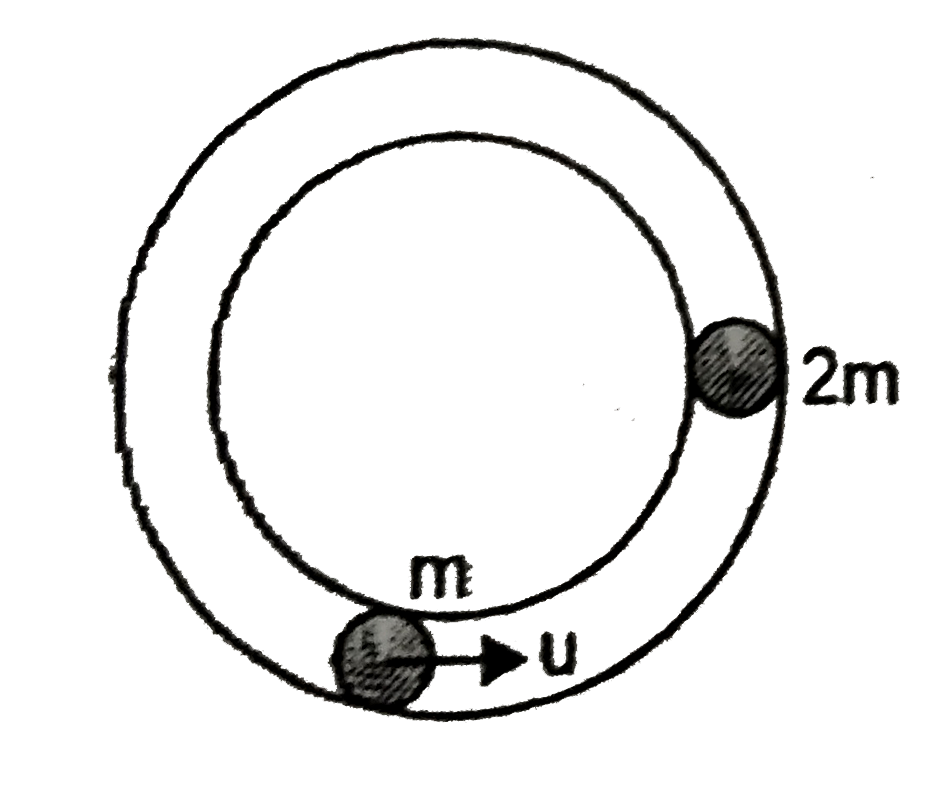
Two masses `'m'` and `'2m'` are placed in fixed horizontal circular smooth hollow tube as shown. The mass `'m'` is moving with speed `'u'` and the amss `'2m'` is stationary . After their first collision, the time elapsed for next collision. `(` coefficient of restitution `e=1//2)`

A

`(2pir)/(u)`

B

`(4pir)/(u)`

C

`(3pir)/(u)`

D

`(12pir)/(u)`

Text Solution

Verified by Experts

The correct Answer is:

B

`(B)` Let the speeds of balls of mass `m` and `2m` after collision be `v_(1)` and `v_(2)` as shown in figure.
Applying conservation of momentum
`mv_(1)+2mv_(2)=m u ` and `-v_(1)+v_(2)=(u)/(2)`
solving we get `v_(1)=0` and `v_(2)=(u)/(2)`
Hence the ball of mass `m` comes to rest and ball of mass `2m` moves with speed `(u)/(2)`.
`t=(2pir)/(u//2)=(4pir)/(u)`
Promotional Banner

Topper's Solved these Questions

  • DAILY PRACTICE PROBLEMS

    RESONANCE ENGLISH|Exercise comprehension|127 Videos
  • DAILY PRACTICE PROBLEMS

    RESONANCE ENGLISH|Exercise dpp 70|7 Videos
  • DAILY PRACTICE PROBLEMS

    RESONANCE ENGLISH|Exercise dpp 68|7 Videos
  • CURRENT ELECTRICITY

    RESONANCE ENGLISH|Exercise Exercise|53 Videos
  • ELASTICITY AND VISCOCITY

    RESONANCE ENGLISH|Exercise Advanced Level Problems|9 Videos

Similar Questions

Explore conceptually related problems

An object of mass m moving with speed u collides one dimentionally with another identical object at rest. Find their velocities after collision, if coefficient of restitution of collision is e.

An object of mass m moving with speed u collides one dimentionally with another identical object at rest. Find their velocities after collision, if coefficient of restitution of collision is e.

A block of mass m moving at speed upsilon collides with another block of mass 2 m at rest. The lighter block comes to rest after the collision. Find the coefficient of restitution.

There are two blocks A and B placed on a smooth surface. Block A has mass 10 kg and its is moving with velocity 0.8 m/s towards stationary B of unknown mass. At the time of collision, their velocities are given by the following graph : Coefficient of restitution of the collision is

Two masses m_1 and m_2 are placed on a smooth horizontal surface and are connected by a string of negligible mass. A horizontal force F is applied on the mass m_2 as shown in the figure. The tension in the string is

Two small balls A and B, each of mass m, are joined rigidly at the ends of a light rof of length L. they are placed on a frictionless horizontal surface another ball of mass 2 m moving with speed u towards one of the ball and perpendicular to the length of the rod on the horizontal frictionless surface as shown int he figure. if the coefficient of restitution is 1/2 then the angular speed of the rod after the collision will be

A particle of mass m, collides with another stationary particle of mass M. If the particle m stops just after collision, then the coefficient of restitution for collision is equal to

A particle of mass m_(1) moves with speed v and collides head on with a stationary particles of mass m_(2) . The first particle continues to move in the same direction If (m_(1))/(m_(2)) is (e = coefficient of restitution )

A wedge of mass M is kept at rest on smooth surface a particle of mass m hits the wedge normally. Find the velocity of wedge and particle just after collision. Take coefficient of restitution as e .

A particle of mass m moving with speed V collides elastically with another particle of mass 2m. Find speed of smaller mass after head on collision
