Home
Class 11
PHYSICS
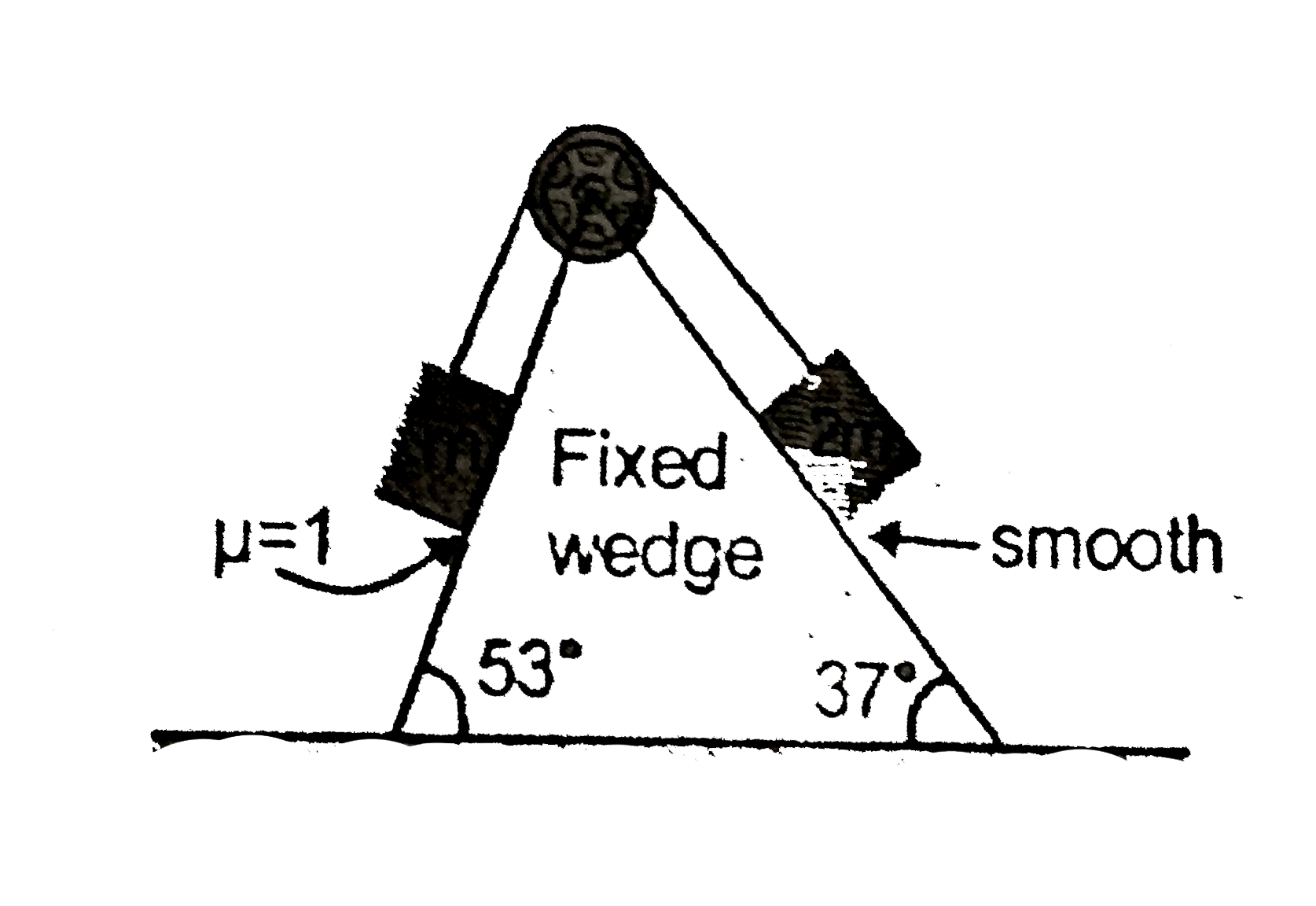
Two blocks of mass m and 2m are arranged...

Two blocks of mass `m` and `2m` are arranged on a wedge that is fixedd on a horizontal surface. Friction coefficient between the block and wedge are shown . Find the magnitude of acceleration of two blocks.

Text Solution

Verified by Experts

The correct Answer is:

Acceleration`=0`

Ans. Acceleration `=0`
Promotional Banner

Topper's Solved these Questions

  • DAILY PRACTICE PROBLEMS

    RESONANCE ENGLISH|Exercise dpp 79|4 Videos
  • DAILY PRACTICE PROBLEMS

    RESONANCE ENGLISH|Exercise dpp 80|4 Videos
  • DAILY PRACTICE PROBLEMS

    RESONANCE ENGLISH|Exercise DPP 77|8 Videos
  • CURRENT ELECTRICITY

    RESONANCE ENGLISH|Exercise Exercise|53 Videos
  • ELASTICITY AND VISCOCITY

    RESONANCE ENGLISH|Exercise Advanced Level Problems|9 Videos

Similar Questions

Explore conceptually related problems

The block of mass M and are arrenged as the situation in fig is shown.The coefficient of friction between two block is mu and that between the bigger block and the ground is mu find the acceleration of the block

Two block of masses m_(1) and m_(2) are placed side by side on a smooth horizontal surface as shown in fig. A horizontal force F is applied on the block . (a) Find the acceleration of each block. (b) Find the normal reaction between the two blocks.

Two blocks A and B of equal masses are attached to a string passing over a smooth pulley fixed to a wedge as shown in figure. Find the magnitude of acceleration of centre of mass of the two blocks when they are released from rest. Neglect friction.

Two blocks A and B of equal masses are attached to a string passing over a smooth pulley fixed to a wedge as shown in figure. Find the magnitude of acceleration of centre of mass of the two blocks when they are released from rest. Neglect friction.

Two block , with masses m_(1) and m_(2) are staked as shown in fig and placed on a frictionless horizontal surface . There is a friction between the two block .An external force of magnitude F is applied to the top block at an angle alpha below the horizontal . The coefficient of friction between m_(1) and m_(2) are mu_(s) b. If the two blocks move together, find their acceleration b . Calculate the maximum value of force so that blocks will move together

The block of mass m_(1) is placed on a wedge of an angle theta , as shown. The block is moving over the inclined surface of the wedge. Friction coefficient between the block and the wedge is mu_(1) , whereas it is mu_(2) between the wedge and the horizontal surface. if mu_(1)=1/2, theta=45^(@), m_(1)=4 kg, m_(2)=5 kg and g=10 m//s^(2) , find minimum value of mu_(2) so that the wedge remains stationary on the surface. express your answer in multiple of 10^(-3)

The block of mass m_(1) is placed on a wedge of an angle theta , as shown. The block is moving over the inclined surface of the wedge. Friction coefficient between the block and the wedge is mu_(1) , whereas it is mu_(2) between the wedge and the horizontal surface. if mu_(1)=1/2, theta=45^(@), m_(1)=4 kg, m_(2)=5 kg and g=10 m//s^(2) , find minimum value of mu_(2) so that the wedge remains stationary on the surface. express your answer in multiple of 10^(-3)

A block of mass "5kg" is placed on a wedge having inclination of 37^(@) with the horizontal. Coefficient of friction between block and wedge is 0.8. Then select the correct statement.

A block of mass m is moving on a rough horizontal surface. mu is the coefficient of kinetic friction between the block and the surface. What is the net force exerted by the surface on the block?

For no friction to act on a block kept on an accelerating wedge as shown in figure, acceleration a of the wedge should be -
