Home
Class 11
PHYSICS
A small smooth disc of mass m and radius...

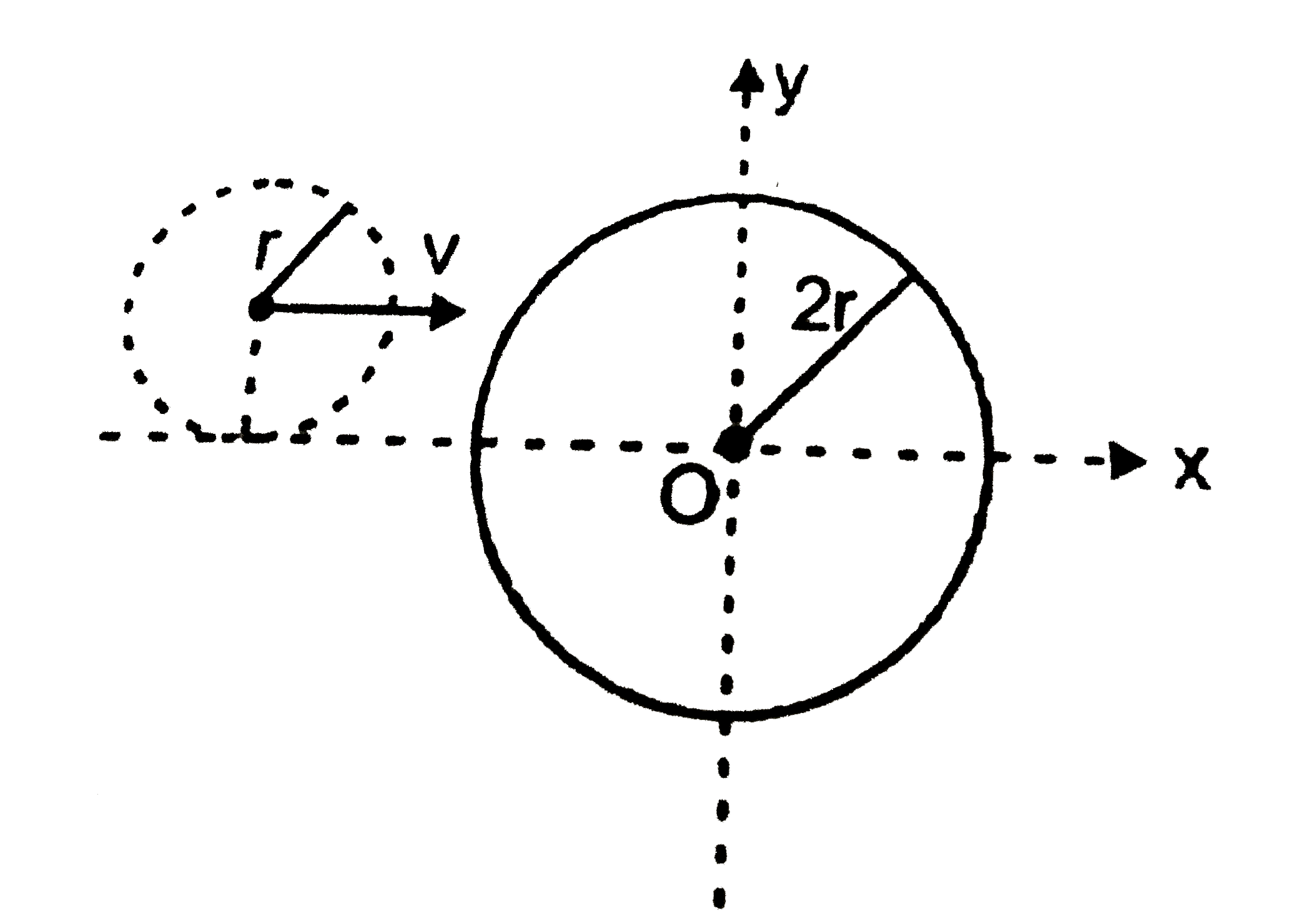
A small smooth disc of mass `m` and radius moving with an initial velocity `'v'` along the positive `x-` axis collided with a big disc of mass `2m` and radius `2r` which was initially at rest with its centre at origin as shown in figure.

If the coefficient of restitution is `0` then velocity of larger disc after collision is

A

`(8v)/(27)hat(i) -(2sqrt(2))/(27)vhat(j)`

B

`(8v)/(27)hat(i) +(2sqrt(2))/(27)vhat(j)`

C

`(v)/(3)hat(i)`

D

`(2sqrt(2))/(27)vhat(i)-(8v)/(2)hat(j)`

Text Solution

Verified by Experts

The correct Answer is:
A


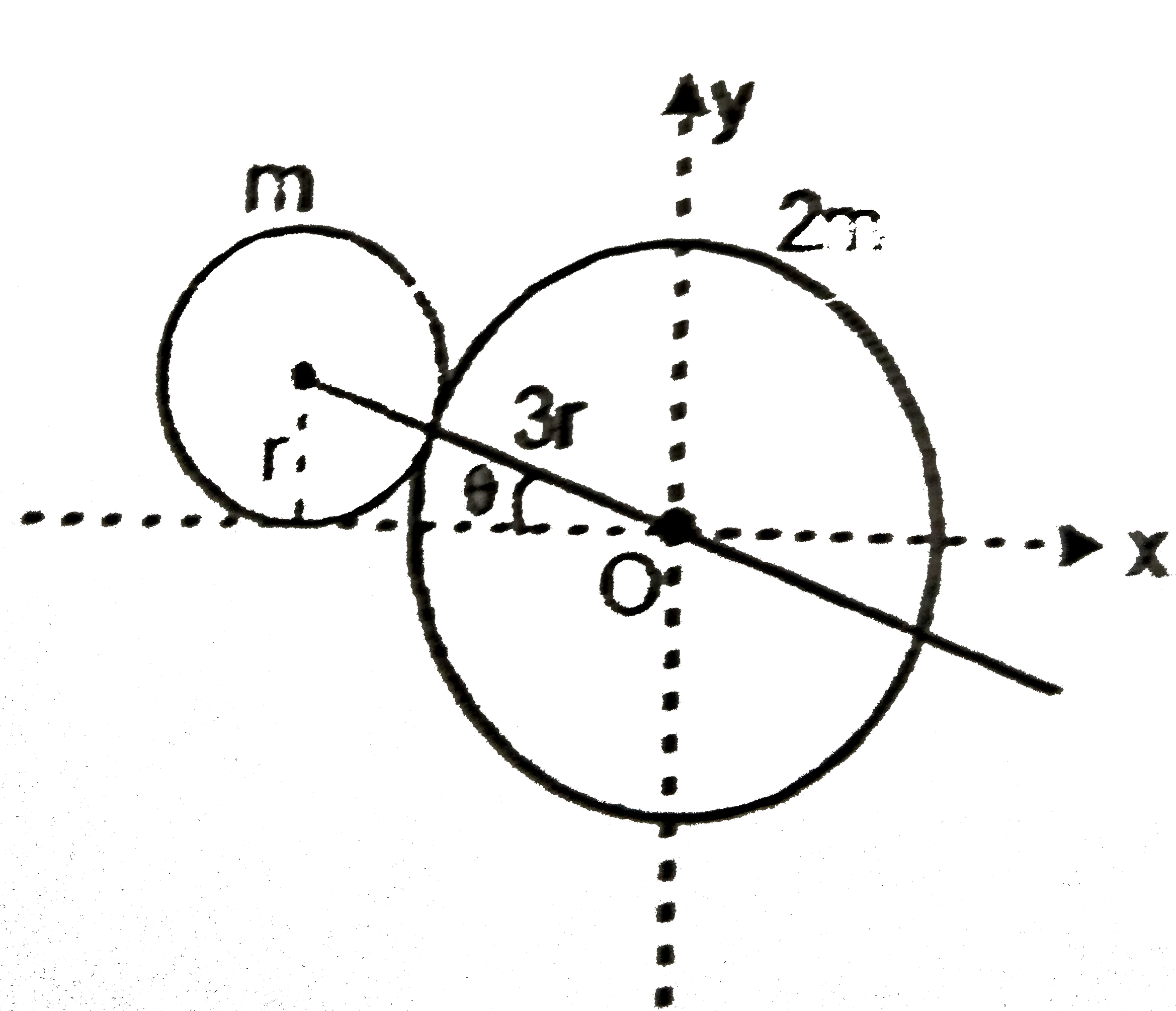
The larger sphere will move along line of impact.
`Abe=0,` velocity of larger sphere .
`v'=(mvcos theta )/(m+2m)=(v cos theta )/(3)`
velocity of larger sphere
`=v'cos theta hat(i)-v' sin theta hat(j)`
`=(v)/(3) cos^(2)theta hat(i)-(v)/(3) sin theta cos theta hat(j)`
`=(8)/(27)hat(i)-(2sqrt(2))/(27)hat(j)`
Promotional Banner

Topper's Solved these Questions

  • DAILY PRACTICE PROBLEMS

    RESONANCE ENGLISH|Exercise dpp 81|4 Videos
  • DAILY PRACTICE PROBLEMS

    RESONANCE ENGLISH|Exercise dpp 82|4 Videos
  • DAILY PRACTICE PROBLEMS

    RESONANCE ENGLISH|Exercise dpp 79|4 Videos
  • CURRENT ELECTRICITY

    RESONANCE ENGLISH|Exercise Exercise|53 Videos
  • ELASTICITY AND VISCOCITY

    RESONANCE ENGLISH|Exercise Advanced Level Problems|9 Videos

Similar Questions

Explore conceptually related problems

A block of mass m moving at a velocity upsilon collides head on with another block of mass 2m at rest. If the coefficient of restitution is 1/2, find the velocities of the blocks after the collision.

A disc of mass M and radius R rolls on a horizontal surface and then rolls up an inclined plane as shown in the figure. If the velocity of the disc is v, the height to which the disc will rise will be:

A disc of mass m and radius R is rolling without slipping as shown in the figure. The magnitude of net velocity of the point P is (OP = R/2)

A uniform cube of mass m and edge a moves on a horizontal surface along the positive x-axis, with initial velocity v_(0) . Then

The first ball of mass m moving with the velocity upsilon collides head on with the second ball of mass m at rest. If the coefficient of restitution is e , then the ratio of the velocities of the first and the second ball after the collision is

A circular disc of mass '2m' and radius '3r' is resting on a flat frictionless surface. Another circular disc of mass m and radius '2r' , moving with a velocity 'u' . hits the first disc as shown in the figure. The collision is elastic. What is the tangential component of final velocity of the smaller disc?

A circular disc of mass '2m' and radius '3r' is resting on a flat frictionless surface. Another circular disc of mass m and radius '2r' , moving with a velocity 'u' . hits the first disc as shown in the figure. The collision is elastic. What is the final velocity of the heavier disc?

A disc of mass M and radius R moves in the x-y plane as shown in the figure. The angular momentum of the disc at tihe instant shows is

A body of mass 2 m moving with velocity v makes a head - on elastic collision with another body of mass m which is initially at rest. Loss of kinetic energy of the colliding body (mass 2 m) is

A ball of mass m moving with velocity v collides head-on which the second ball of mass m at rest. I the coefficient of restitution is e and velocity of first ball after collision is v_(1) and velocity of second ball after collision is v_(2) then

