Home
Class 12
PHYSICS
All objects referred to the subsequent p...

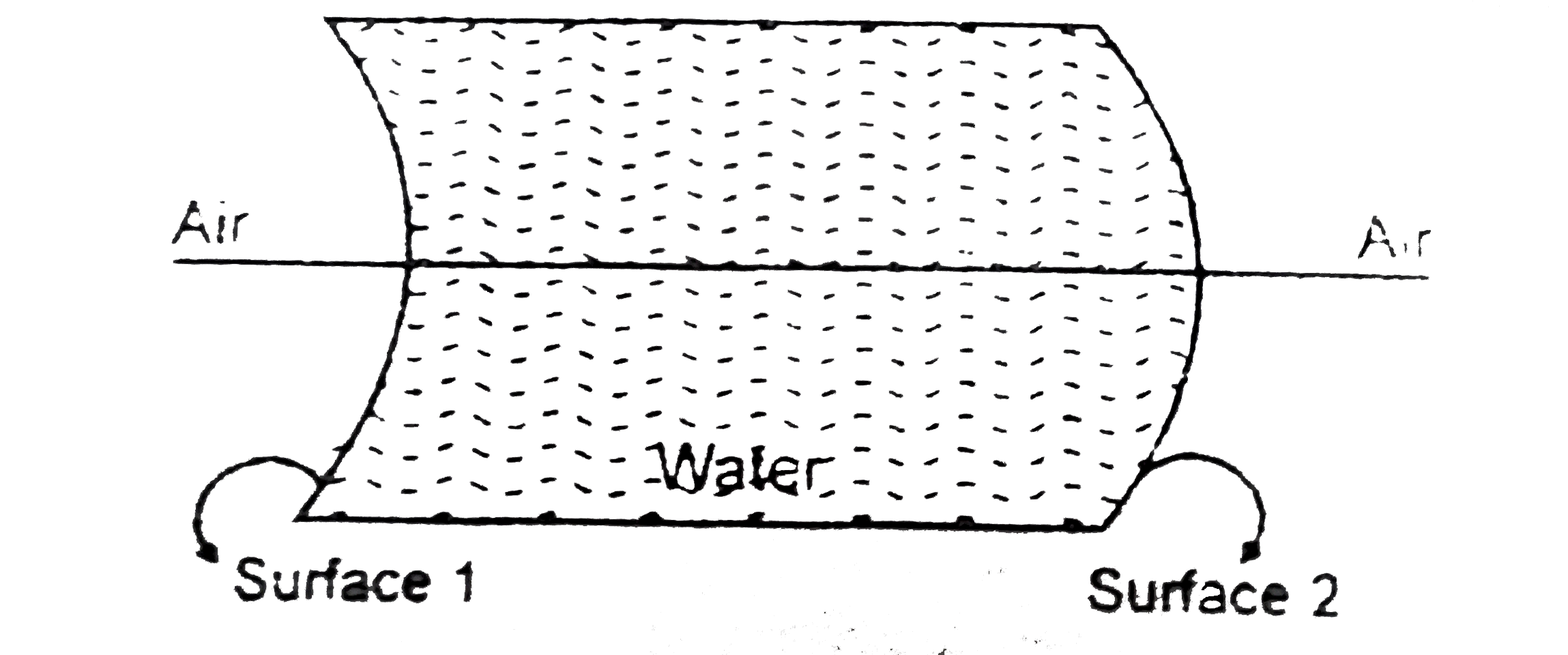
All objects referred to the subsequent problems lie on the principal axis.

In above question if the object is real, then the final image formed after two refractions :

A

may be real

B

may be virtual

C

must be virtual

D

both `A` and `B`

Text Solution

Verified by Experts

The correct Answer is:
D


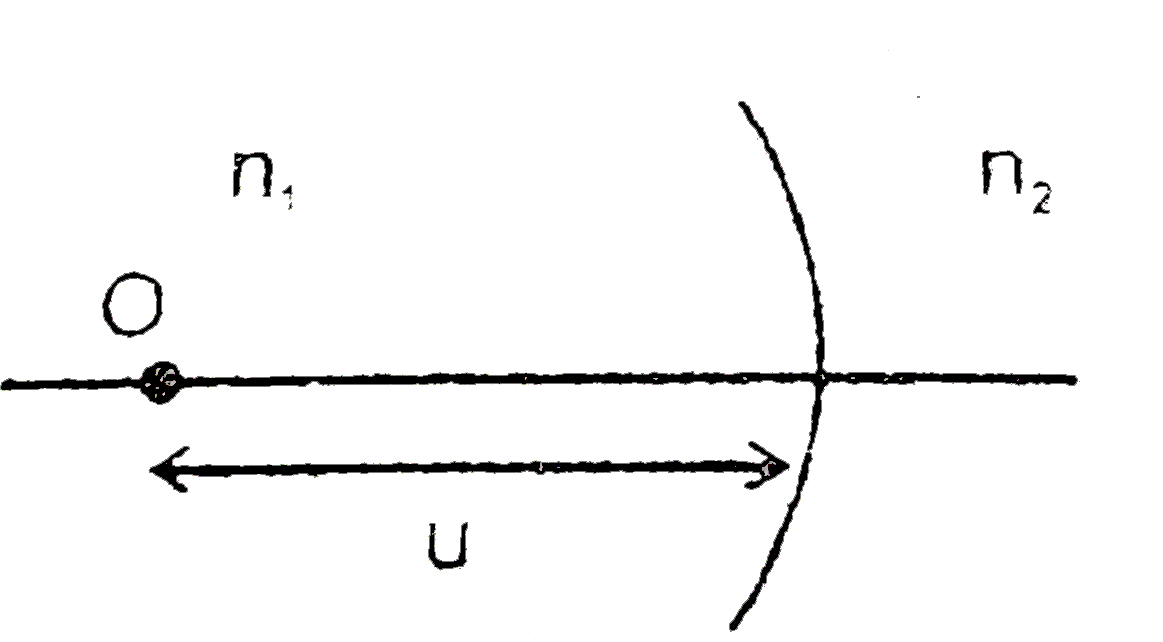
Consider object on left side of spherical surface seperating two media.
If real object is in rarer media i.e. `n_(1) lt n_(2)`
Then `(n_(2))/(v)=(n_(2)-n_(1))/((-u))+(n_(1))/(-R)=-ve`
Hence image shall be virtual for a real object lying
on concave side with rarer media....(1)
If real object is in denser media i.e. `n_(1) gt n_(2)`
`(n_(2))/(v)=(-(n_(1)-n_(2)))/((-u))+(n_(1))/((-R))=(n_(1)-n_(2))/(u)-(n_(1))/(R)`
`:.` Image is real if
`(n_(1)-n_(2))/(u) gt (n_(1))/(R)` or `u lt ((n_(1)-n_(2))R)/(n_(1))`.....(2)
and image is virtual if `u gt((n_(1)-n_(2))/(n_(1)))R`...(3)
From statements `1,2` and `3` we can easily conclude the answers.
Promotional Banner

Topper's Solved these Questions

  • DAILY PRACTICE PROBLEM

    RESONANCE ENGLISH|Exercise DPP No.11|20 Videos
  • DAILY PRACTICE PROBLEM

    RESONANCE ENGLISH|Exercise DPP No.12|9 Videos
  • DAILY PRACTICE PROBLEM

    RESONANCE ENGLISH|Exercise DPP No.9|20 Videos
  • CURRENT ELECTRICITY

    RESONANCE ENGLISH|Exercise High Level Problems (HIP)|19 Videos
  • ELECTRO MAGNETIC WAVES

    RESONANCE ENGLISH|Exercise Exercise 3|27 Videos

Similar Questions

Explore conceptually related problems

All objects referred to the subsequent problems lie on the principal axis. If light is incident on surface 1 from left, the image formed after the first refraction is definitely :

All objects referred to the subsequent problems lie on the principal axis. If light is incident on surface 2 from right then which of the following is true for images formed after a single refraction.

In the figure shown , a point object O is placed in air on the principal axis. The radius of curvature of the spherical surfaces is 60 cm. I is the final image formed after all reflections and refractions.

Figure shows a point object and a diverging lens Find the final image formed.

Figure shows a point object and a converging lens. Find the final image formed.

AB is the semi circular object of diameter (f/2) where f is the focal length, placed on the principal axis of a concave mirror with point A at the centre of curvature. A'B' is the image formed . The correct option is (Assume diameter of the object is along principal axis)

Figure shows an arrangement ofan equiconvex lens (f=20 cm in air) and a concave mirror (R=80cm). A point object O is placed on the principal axis at a distance 40 cm from the lens such that the final image is also formed at the position of object. Find d.

In Figure, a point object O is placed in air. A spherical boundary separates two media. Ab is the principall axis. The refractive index above AB is 1.6 and below AB is 2.0. The separation between the images formed due to refraction at a the spherical surface is (assume the radius of curvature (R) to be 1 unit)

Mirror in the arrangement shown in figure is moving up with speed 8 cm//sec . There is an object O outside water. Speed of final image formed after two refraction and one refraction and the reflection is : .

The minimum distance between an object and its real image formed by a convex lens is

