Home
Class 12
PHYSICS
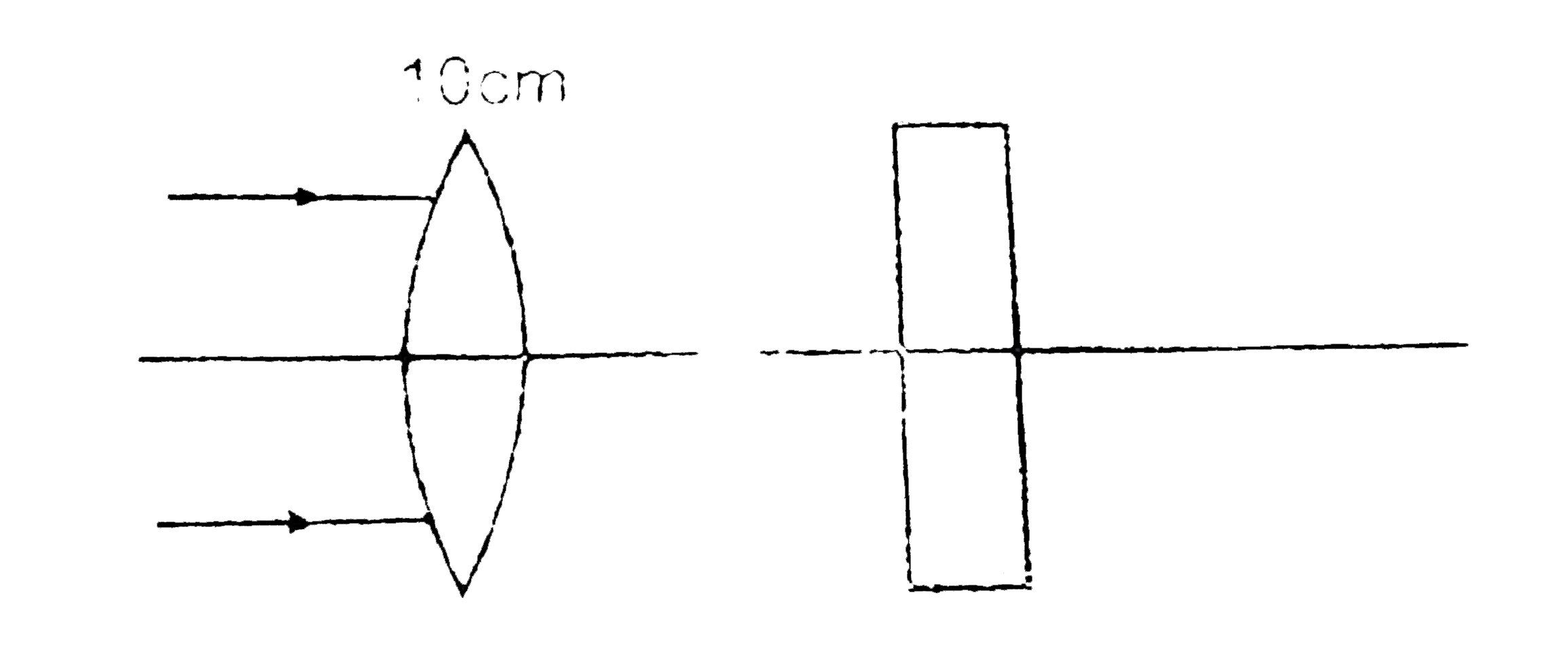
A parallel beam of light is incident on ...

A parallel beam of light is incident on a lens of focal length 10 cm. A parallel slab of refractive index 1.5 and thickness 3 cm is placed on the other side of the lens. Find the distance of the final image from the lens.
.

Text Solution

Verified by Experts

The correct Answer is:

A, C

As rays are parallel to the principal axis. Image is created by lens at the focus, By placing of glass-slab
Shift `= (1-(1)/(mu)).t =(1-(1)/(1.5))3=1 cm`
Irrespective of separation
Image is shifted to the night by `1 cm`
Total distance from lens.
`10 + 1 = 11 cm`.
Promotional Banner

Topper's Solved these Questions

  • DAILY PRACTICE PROBLEM

    RESONANCE ENGLISH|Exercise DPP No.13|20 Videos
  • DAILY PRACTICE PROBLEM

    RESONANCE ENGLISH|Exercise DPP No.14|9 Videos
  • DAILY PRACTICE PROBLEM

    RESONANCE ENGLISH|Exercise DPP No.11|20 Videos
  • CURRENT ELECTRICITY

    RESONANCE ENGLISH|Exercise High Level Problems (HIP)|19 Videos
  • ELECTRO MAGNETIC WAVES

    RESONANCE ENGLISH|Exercise Exercise 3|27 Videos

Similar Questions

Explore conceptually related problems

A parallel beam of light is incident on a lens of focal length 10cm. A parallel slab of refractive index 1.5 and thickness 3 cm is placed on the other side of the lens. The nature of the final image from the lens slab combination is: (Assume rays paraxial)

An optical system consists of a thin convex lens of focal length 30 cm and a plane mirror placed 15 cm behind the lens. An object is placed 15 cm in front of the lens. The distance of the final image from the object is

If the focal length of the lens is 20 cm, find the distance of the image from the lens in the following figure?

A converging beam of light is incident on a concave lens of focal length 20 cm. In the absence of the lens, the beam converges at a point 10 m behind the lens. Find where the beam will converge/diverge after refraction.

An object is placed at f//2 away from first focus of a convex lens where f is the focal length of the lens. Its image is formed at a distance 3f//2 in a slab of refractive index 3//2 , from the face of the slab facing the lens. Find the distance of this face of the slab from the second focus of the lens.

An object is placed at a distance 24 cm in front of a convex lens of focal length 8 cm. Calculate the distance of the image from the lens.

A parallel beam of rays is incident on a convergent lens with a focal length of 40 cm. Where should a divergent lens with a focal length of 15 cm be placed for the beam of rays to remain parallel after passing through the two lenses.

A point object is placed at a distance of 25cm from a convex lens. Its focal length is 22cm. A glass slab of refractive index 1.5 is inserted between the lens and the object, then the image is formed at infinity. Find the thickness of the glass slab (in cm).

A biconvex lens separates two media of refractive indices 1.3 and 1.7. the refractive index of the lens is 1.5 and the radii of curvature of the two sides of the lens are r_(1)=10cm and r_(2)=60cm . The medium of refractive index 1.3 extends to 78 cm from the lens and that of refractive index 1.7 extends of 34 cm from the lens. A luminous object O is at a distance of 144 cm from the lens. Find the position of the final image from the lens.

An object is placed at a distance of 10cm to the left on the axis of convex lens A of focal length 20cm. A second convex lens of focal length 10cm is placed coaxially to the right of the lens A at a distance of 5cm from A. Find the position of the final image and its magnification. Trace the path of the rays.
