Home
Class 12
PHYSICS
Mirror in the arrangement shown in figur...

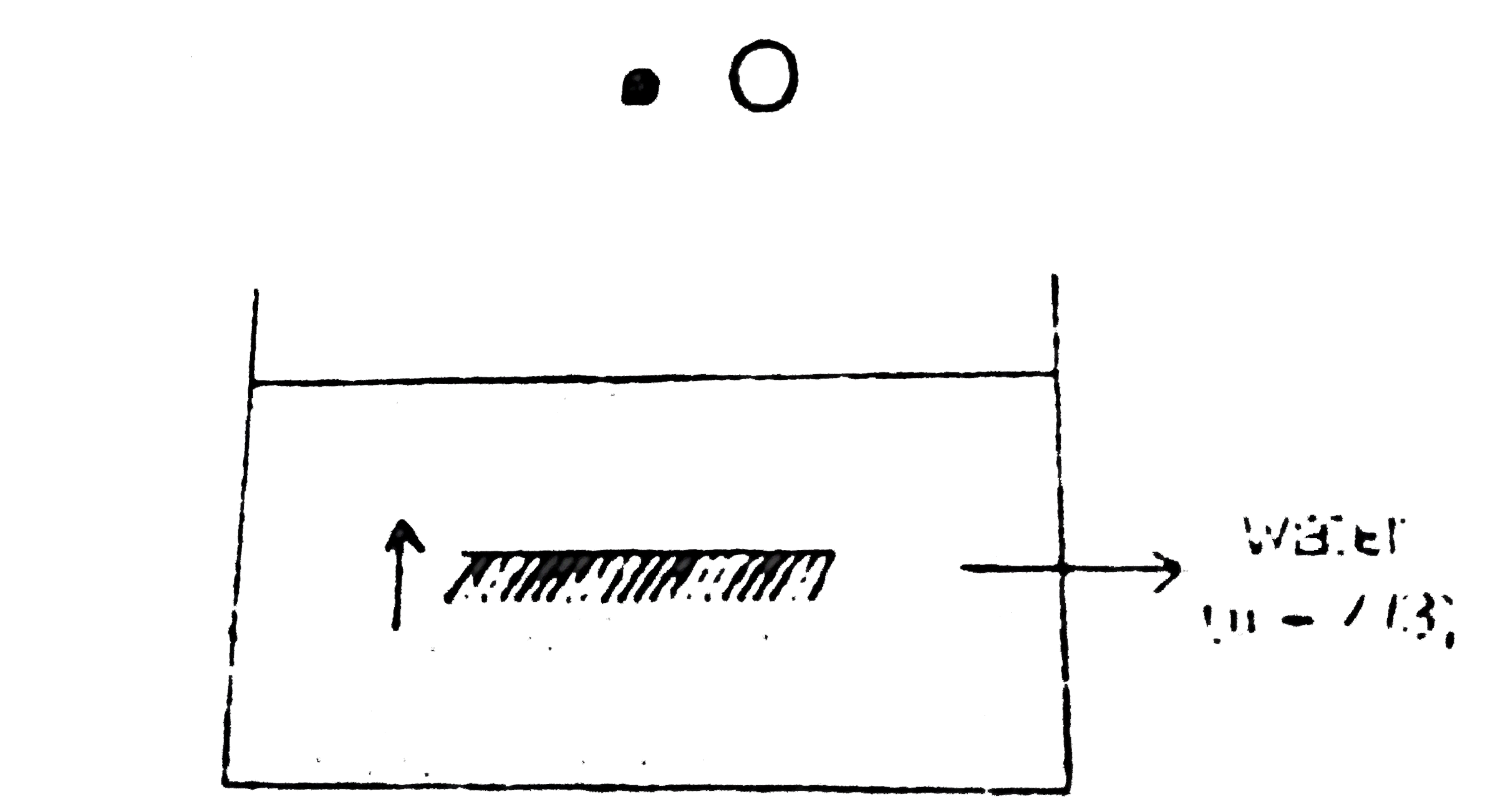
Mirror in the arrangement shown in figure is moving up with speed `8 cm//sec`. There is an object `O` outside water. Speed of final image formed after two refraction and one refraction and the reflection is :
.

A

`10 cm//s`

B

8 cm

C

`12 cm//s`

D

data insufficient

Text Solution

Verified by Experts

The correct Answer is:
C

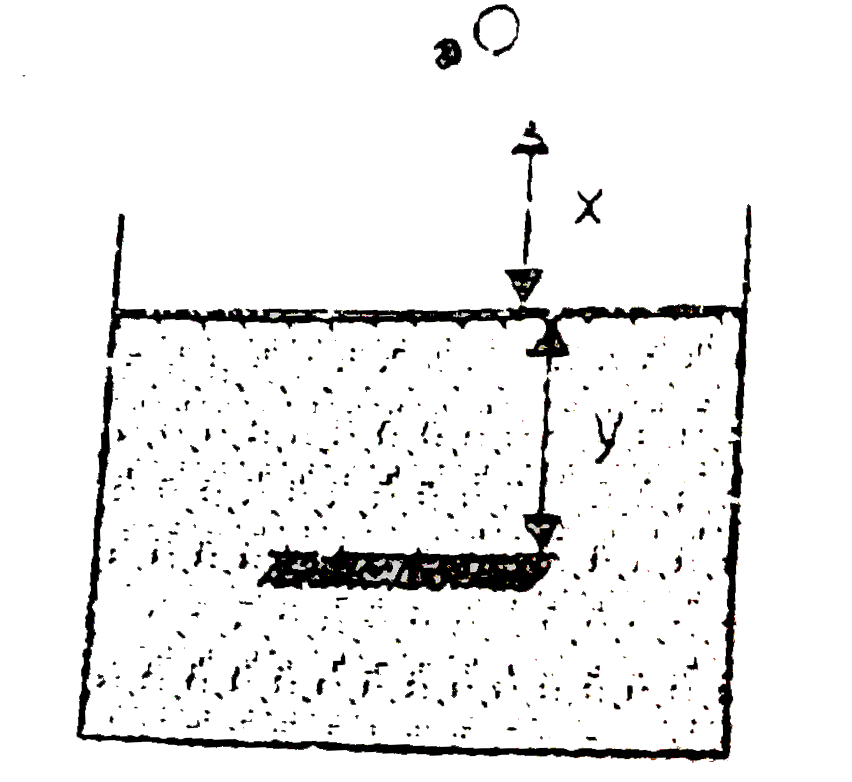
Apparent distance of mirror from O
`= x + (y)/(mu)`
Distance of final image from O

`=2(x+(y)/(mu))`
velocity of image
`=2((dx)/(dt)+(1)/(mu)(dy)/(dt))=(2)/(mu)xx 8 = (2)/(4//3) xx 8 = 12 cm//s`
Promotional Banner

Topper's Solved these Questions

  • DAILY PRACTICE PROBLEM

    RESONANCE ENGLISH|Exercise DPP No.24|9 Videos
  • DAILY PRACTICE PROBLEM

    RESONANCE ENGLISH|Exercise DPP No.25|20 Videos
  • DAILY PRACTICE PROBLEM

    RESONANCE ENGLISH|Exercise DPP No.22|9 Videos
  • CURRENT ELECTRICITY

    RESONANCE ENGLISH|Exercise High Level Problems (HIP)|19 Videos
  • ELECTRO MAGNETIC WAVES

    RESONANCE ENGLISH|Exercise Exercise 3|27 Videos

Similar Questions

Explore conceptually related problems

An insect at point 'P' sees its two images in the water mirror system as shown in the figure. One image is formed due to direct partical reflection from water surface and the other image is formed due to refraction, reflection & again refraction by water mirror system in order. Find the separation (in cm) between the two images. Mirror M has focal length 60 cm [Take mu_(w)=4//3]

All objects referred to the subsequent problems lie on the principal axis. In above question if the object is real, then the final image formed after two refractions :

In the figure shown , a point object O is placed in air on the principal axis. The radius of curvature of the spherical surfaces is 60 cm. I is the final image formed after all reflections and refractions.

A plane mirror and a concave mirror are arranged as shown in figure and O is a point object, Find the position of image formed by two reflection, first one talking place at concave mirror.

Figure shows a transparent hemisphere of radius 3.0 cm made of a material of refractive index 2.0. (a) A narrow beam of parallel rays is incident on the hemisphere as shown in the figure. Are the rays totally reflected at the plane surface ? (b) Find the image formed by the refraction at the first surface. (c) Find the image formed by the reflection or by the refraction at the plane surface. (d) Trace qualitatively the final rays as they come out of the hemisphere.

Two plane mirrors intersect at origin. An object 'O' is kept at a distance R on negative y-axis as shown in the figure. The co-ordinates of images formed after three reflections will be (first reflection is is considered at m_(1) )

An object is placed at a distance of 40 cm from a convex lens of focal length 20cm. On the far side of the lens, a concave mirror of focal length 10cm is placed such that the distance of the object from the concave mirror is 100 cm. Then the final image which is formed after refraction from the lens, reflection from the mirror and again refraction from the lens, will be

Two concave mirrors are places 40cm apart and are facing each other. A point object lies between them at a distance of 12cm from the mirror of focal length 10cm. The other mirror has a focal length of 15cm. Find the location of final image formed after two reflections - first at the mirror nearer to the object and second at the other mirror.

For the situations shown in figure, determine the angle by which the mirror should be rotated, so that the light ray will retrace its path after refraction through the prism and reflection from the mirror?

An object is placed 10cm away form a glass piece (n = 1.5) of length 20cm bounded by spherical surfaces of radii of curvaure 10cm . Find the position of final image formed after two refractions at the spherical surfaces.

RESONANCE ENGLISH-DAILY PRACTICE PROBLEM-DPP No.23
  1. A block B is pushed momentarily along a horizontal surface with an ini...

    Text Solution

    |

  2. A 60kg is pushed horizontaly with just enough force to start it moving...

    Text Solution

    |

  3. If the eye is kept very close to a coverging lens (focal length = 10 c...

    Text Solution

    |

  4. If the eye is kept very close to a coverging lens (focal length = 10 c...

    Text Solution

    |

  5. With what angular velocity the earth should spin in order that a body ...

    Text Solution

    |

  6. Position vector of a particle moving in space is given by : vec(r)=3...

    Text Solution

    |

  7. A particle P is projected with speed 20 m//s at angle 37^(@) from hori...

    Text Solution

    |

  8. Mirror in the arrangement shown in figure is moving up with speed 8 cm...

    Text Solution

    |

  9. A force vec(F) is applied to block (m = 6 kg) at rest on an inclined p...

    Text Solution

    |

  10. A block of mass 20 kg is acted upon by a force F=30N at an angle 53^@ ...

    Text Solution

    |

  11. A particle is projected vertically upwards with a speed of 16ms^-1. Af...

    Text Solution

    |

  12. Three forces are acting on a particle of mass m intially in equilibriu...

    Text Solution

    |

  13. A uniform chain of length 2m is kept on a table such that a length of...

    Text Solution

    |

  14. Two carts of masses 200 kg and 300 kg on horizontal rails are pushed a...

    Text Solution

    |

  15. X-ray beam can be deflected by

    Text Solution

    |

  16. Two bodies P and Q of equal masses are suspended from two separate mas...

    Text Solution

    |

  17. the photon radiated from hydrogen corresponding to the second line of ...

    Text Solution

    |

  18. Which electronic transition in Li^(2+) ion would emit radiation of sam...

    Text Solution

    |

  19. A small particle of mass m, moves in such a way that the potential ene...

    Text Solution

    |

  20. A block of mass m(1) lies on the top of fixed wedge as shown in fig. a...

    Text Solution

    |

