Home
Class 12
PHYSICS
The wall of a house is made of two diffe...

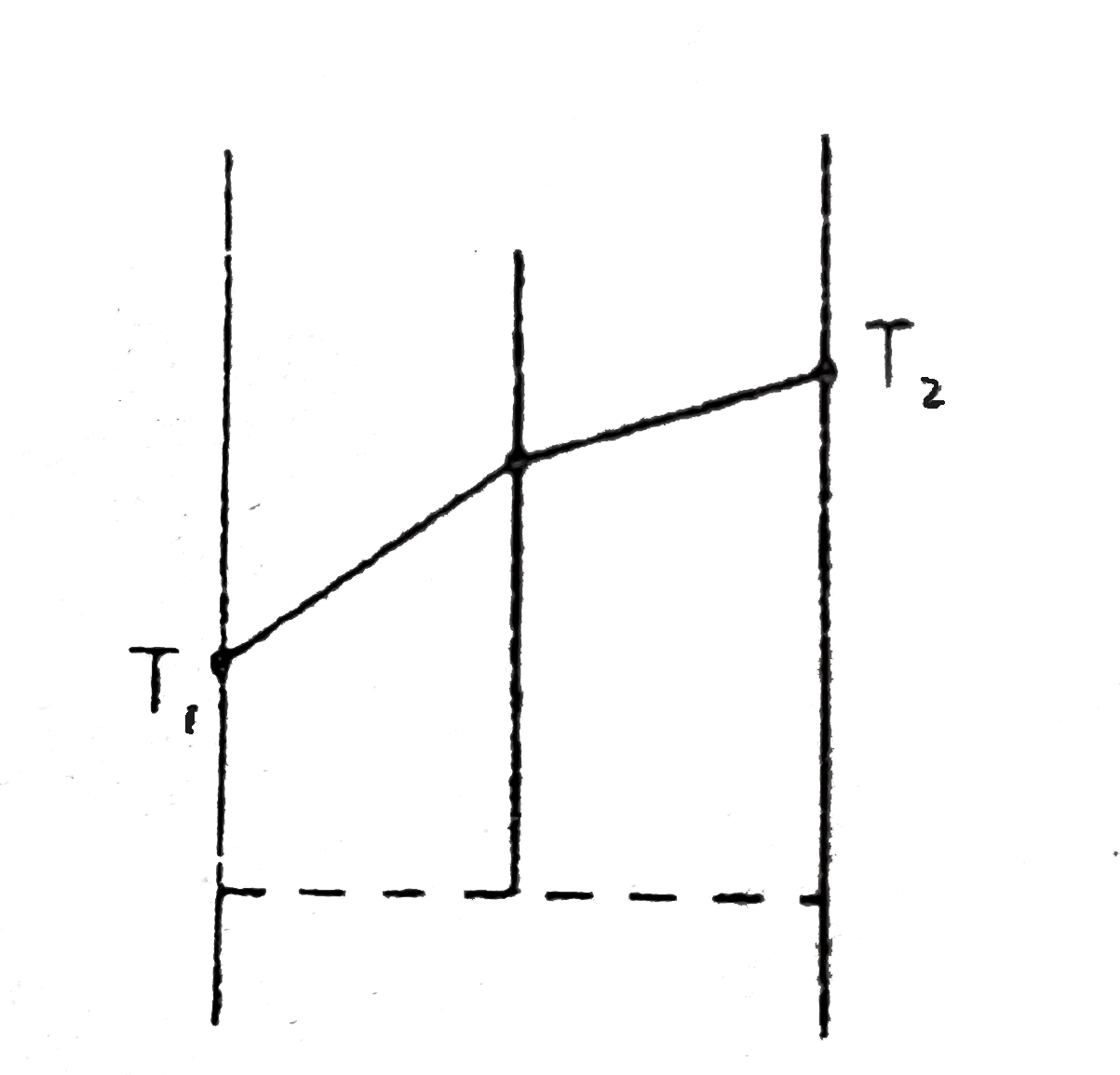
The wall of a house is made of two different materials of same thickness. The temperatures of the outer wall is `T_(2)` and that of inner wall is `T_(1) lt T_(2)`. The temperature variation inside the wall as shown in the figure. Then :

A

thermal conductivity of inner wall is greater than that of outer

B

thermal conductivity of outer wall is greater than that of inner

C

thermal conductivities of the two equal

D

no conclusion can be drawn about thermal conductivities

Text Solution

Verified by Experts

The correct Answer is:

B

The slope of temperature variation is more in inner
`(dQ)/(dt)=(KA)/(l).DeltaT`
`Delta T=(l)/(KA).(dQ)/(dt)`
Slope `alpha (1)/(K)`
Larger the conductivity, smaller is the slope.
Promotional Banner

Topper's Solved these Questions

  • DAILY PRACTICE PROBLEM

    RESONANCE ENGLISH|Exercise DPP No.50|9 Videos
  • DAILY PRACTICE PROBLEM

    RESONANCE ENGLISH|Exercise DPP No.51|20 Videos
  • DAILY PRACTICE PROBLEM

    RESONANCE ENGLISH|Exercise DPP No.48|9 Videos
  • CURRENT ELECTRICITY

    RESONANCE ENGLISH|Exercise High Level Problems (HIP)|19 Videos
  • ELECTRO MAGNETIC WAVES

    RESONANCE ENGLISH|Exercise Exercise 3|27 Videos

Similar Questions

Explore conceptually related problems

A wall has two layers A and B, each made of different materials. Both the layers have the same thickness. The thermal conductivity of the material of A is twice that of B. Under thermal equilibrium , the temperature differeence across the wall is 36^(@)C . The temperature difference across the layer A is

A wall has two layers A and B, each made of different material. Both the layers have the same thickness. The thermal conductivity of the material of A is twice that of B . Under thermal equilibrium, the temperature difference across the wall is 36^@C. The temperature difference across the layer A is

A wall has two layers A and B, each made of different material. Both the layers have the same thickness. The thermal conductivity of the material of A is twice that of B . Under thermal equilibrium, the temperature difference across the wall is 36^@C. The temperature difference across the layer A is

A wall has two layers A and B made of two different materials thermal conductivities K_A and K_B ( K_A = 3K_B ). The thickness of both the layers is same. The temperature across the wall is 20^@C in thermal equilibrium. Then

The wall of arteries and veins differ from each other mainly w.r.t.

A wall has two layers X and Y each made of different materials. Both layers have same thickness. Thermal conductivity of X is twice that of Y. At steady state the temperature difference of opposite faces of wall is 54°C . The temperature difference across Y layer is

Three rods of the same length and the same area of the cross-section are joined. The temperature of two ends one T_(1) and T_(2) as shown in the figure. As we move along the rod the variation of temperature are as shown in the following [Rods are insulated from the surrounding except at the faces]

The figure shows the cross-section of the outer wall of a house buit in a hill-resort to keep the house insulated from the freezing temperature of outside. The wall consists of teak wood of thickness L_(1) and brick of thickness (L_(2) = 5L_(1)) , sandwitching two layers of an unknown material with identical thermal conductivites and thickness. The thermal conductivity of teak wood is K_(1) and that of brick is (K_(2) = 5K_(1)) . Heat conducion through the wall has reached a steady state with the temperature of three surfaces being known. (T_(1) = 25^(@)C, T_(2) = 20^(@)C and T_(5) = - 20^(@)C) . Find the interface temperature T_(4) and T_(3) .

Three rods of same cross-section but different length and conductivity are joined in series . If the temperature of the two extreme ends are T_(1) and T_(2) (T_(1)gtT_(2)) find the rate of heat transfer H.

A wall has two layers A and B each made of different materials. The layer A is 10cm thick and B is 20 cm thick. The thermal conductivity of A is thrice that of B. Under thermal equilibrium temperature difference across the wall is 35^@C . The difference of temperature across the layer A is

RESONANCE ENGLISH-DAILY PRACTICE PROBLEM-DPP No.49
  1. A loop having negligible self inductance but a constant resistance is ...

    Text Solution

    |

  2. The figure shows a meter bridge circuit with AB=100 cm, X=12 Omega and...

    Text Solution

    |

  3. The straight infinite long wire carries a constant current i to the ri...

    Text Solution

    |

  4. In the figure shown, a charged particle of mass 2 g and charge 5 mu C ...

    Text Solution

    |

  5. A circular loop of wire is in the same plane as an infinitely long wir...

    Text Solution

    |

  6. Charges +q and -q are placed at points A and B respectively which are ...

    Text Solution

    |

  7. A uniform magnetic field of magnitude 1T exists in region yge0 along h...

    Text Solution

    |

  8. Two identical conducting rings A and B of radius R are rolling over a ...

    Text Solution

    |

  9. The rest mass of an electron as well as that of positron is 0.51 MeV. ...

    Text Solution

    |

  10. A hydrogen like atom of atomic number Z is in an excited state of qua...

    Text Solution

    |

  11. Half lives of two isotpers X and Y are know to be 2xx10^(9) years and ...

    Text Solution

    |

  12. A partical of mass m oscillates along the horizontal diameter AB insi...

    Text Solution

    |

  13. Initially capacitor is uncharged at t = 0 switch is closed. Charge on ...

    Text Solution

    |

  14. The wall of a house is made of two different materials of same thickne...

    Text Solution

    |

  15. When an small object is placed at a distance x(1) and x(2) from a lens...

    Text Solution

    |

  16. A particle is moving in x-y plane. At an instant, it has velocity (4 h...

    Text Solution

    |

  17. The magnetic induction and the intensity of magnetic field inside an i...

    Text Solution

    |

  18. A large cylindrical vessel contains water to a height of 10 m. If is f...

    Text Solution

    |

  19. N (lt 100) molecules of a gas have velocities 1,2,3….N km/s respective...

    Text Solution

    |

  20. Find the equivalent capacitance between terminals A and B.

    Text Solution

    |
