Home
Class 12
PHYSICS
A particle of charge = 1 muC and mass m=...

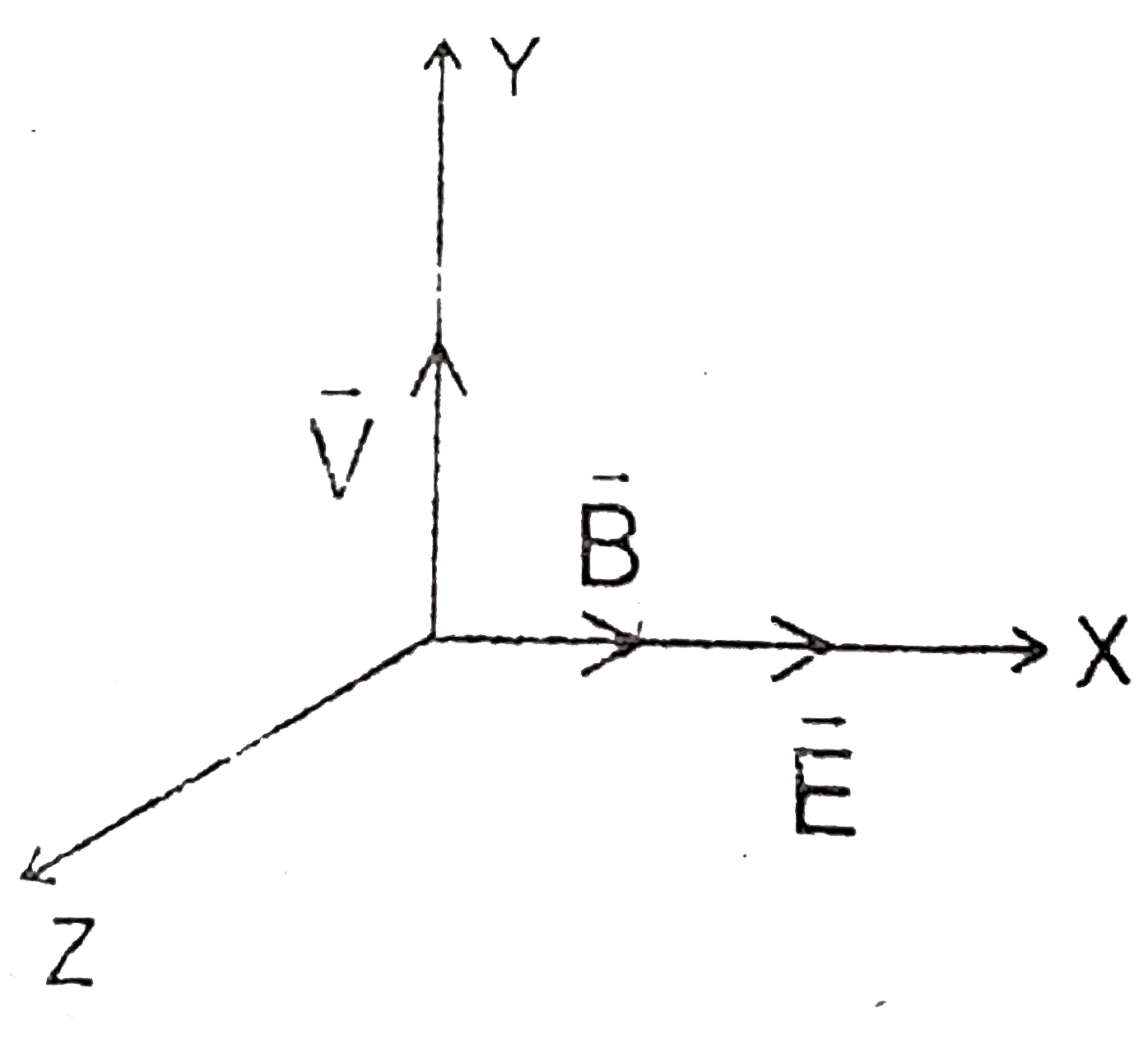
A particle of charge `= 1 muC` and mass m=1 gm starts moving from origin at t = 0 under an electric field of `10^(3) N//C` along x-axis and magnetic field of 10 tesla along the same axis with the velocity of `vec(v) = 20 hat(j)` m/sec as shown, the speed of the particle at the time of `20 sqrt(3)sec` will be :

A

20 m/sec

B

40 m/sec

C

10 m/sec

D

None

Text Solution

Verified by Experts

The correct Answer is:

B

As `V^(2)=V_(x)^(2)V_(y)^(2)=((qE)/(m)t)^(2)+(20)^(2)`
`=((10^(-6)10^(3))/(10^(-3))20 sqrt(3))^(2)+(20)^(2)=1600`
`V = 40 m//sec`
Promotional Banner

Topper's Solved these Questions

  • DAILY PRACTICE PROBLEM

    RESONANCE ENGLISH|Exercise DPP No.52|9 Videos
  • DAILY PRACTICE PROBLEM

    RESONANCE ENGLISH|Exercise DPP No.53|20 Videos
  • DAILY PRACTICE PROBLEM

    RESONANCE ENGLISH|Exercise DPP No.50|9 Videos
  • CURRENT ELECTRICITY

    RESONANCE ENGLISH|Exercise High Level Problems (HIP)|19 Videos
  • ELECTRO MAGNETIC WAVES

    RESONANCE ENGLISH|Exercise Exercise 3|27 Videos

Similar Questions

Explore conceptually related problems

A particle of charge q and mass m starts moving from the origin under the action of an electric field vec E = E_0 hat i and vec B = B_0 hat i with a velocity vec v = v_0 hat j . The speed of the particle will become 2v_0 after a time.

A particle of charge q and mass m starts moving from the origin under the action of an electric field vec E = E_0 hat i and vec B = B_0 hat i with a velocity vec v = v_0 hat j . The speed of the particle will become 2v_0 after a time.

A particle of charge q and mass m starts moving from the origin under the action of an electric field vec E = E_0 hat i and vec B = B_0 hat i with a velocity vec v = v_0 hat j . The speed of the particle will become 2v_0 after a time.

A particle of charge q and mass m released from origin with velocity vec(v) = v_(0) hat(i) into a region of uniform electric and magnetic fields parallel to y-axis. i.e., vec(E) = E_(0) hat(j) and vec(B) = B_(0) hat(j) . Find out the position of the particle as a functions of time Strategy : Here vec(E) || vec(B) The electric field accelerates the particle in y-direction i.e., component of velocity goes on increasing with acceleration a_(y) = (F_(y))/(m) = (F_(e))/(m) = (qE_(0))/(m) The magnetic field rotates the particle in a circle in x-z plane (perpendicular to magnetic field) The resultant path of the particle is a helix with increasing pitch. Velocity of the particle at time t would be vec(v) (t) = v_(x) hat(i) + v_(y) hat(j) + v_(z) hat(k)

A particle of charge q_(0) and of mass m_(0) is projected along the y -axis at t=0 from origin with a velocity V_(0) . If a uniform electric field E_(0) also exist along the x -axis, then the time at which debroglie wavelength of the particle becomes half of the initial value is:

A particle of charge 1 mu C & mass 1 g moving with a velocity of 4 m//s is subjected to a uniform electric field of magnitude 300 V m for 10 sec . Then it's final speed cannot be :

1 charge of 1C in a magnetic field of 0.5 Tesla with a velocity of 10m//sec Perpendicular to the field. Force experienced is

A particle starts from the origin at time t = 0 and moves along the positive x-axis. The graph of velocity with respect to time is shown in figure. What is the position of the particle at time t = 5s ?

A charge particle is moving with a velocity 3hat(i) + 4 hat(j) m//sec and it has electric field E = 10hat(k) N//C at a given point. Find the magnitude of magneitc field at the same point due to the motion of the charge particle.

Three particles start from the origin at the same time, one with a velocity v_(1) along the x-axis, second along the y-axis with a velocity v_(2) and third particle moves along the line x = y. The velocity of third particle, so that three may always lie on the same line is:

RESONANCE ENGLISH-DAILY PRACTICE PROBLEM-DPP No.51
  1. The secondary coil of an ideal step down transformer is delivering 500...

    Text Solution

    |

  2. An inductor (L = (1)/(100 pi) H), a capacitor (C = (1)/(500 pi) F) and...

    Text Solution

    |

  3. Consider a L-R circuit shown in figure. There is no current in circuit...

    Text Solution

    |

  4. Consider a L-C oscillation circuit. Circuit elements has zero resistan...

    Text Solution

    |

  5. A particle of charge = 1 muC and mass m=1 gm starts moving from origin...

    Text Solution

    |

  6. Consider atoms H, He^(+), Li^(++) in their ground states. Suppose E(1)...

    Text Solution

    |

  7. A potentiometer circuit has been setup for finding. The internal resis...

    Text Solution

    |

  8. If the kinetic energy of the particle is increased to 16 times its pre...

    Text Solution

    |

  9. A small sized mass m is attached by a massless string (of length L) to...

    Text Solution

    |

  10. One end of light inelastic string is tied to a helium filled ballloon ...

    Text Solution

    |

  11. The SI unit of inductance the Henry can not be written as :

    Text Solution

    |

  12. When a perosn throws a meter stivk it is found that the centre of the ...

    Text Solution

    |

  13. A particle of positive charge q and mass m enters with velocity Vhati ...

    Text Solution

    |

  14. The radius of a metal sphere at room temperature T is R and the coeffi...

    Text Solution

    |

  15. Direction : Resistive force proportional to object velocity At low...

    Text Solution

    |

  16. Direction : Resistive force proportional to object velocity At low...

    Text Solution

    |

  17. Direction : Resistive force proportional to object velocity At low...

    Text Solution

    |

  18. Direction : Resistive force proportional to object velocity At low...

    Text Solution

    |

  19. Direction : Resistive force proportional to object velocity At low...

    Text Solution

    |

  20. Direction : Resistive force proportional to object velocity At low...

    Text Solution

    |
