
Home
Class 12
PHYSICS
The time periods - hence the frequencies...

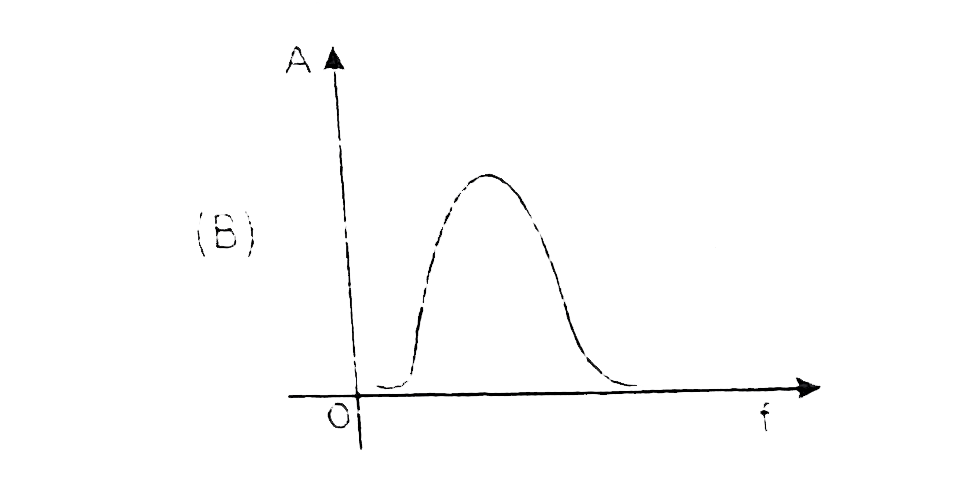
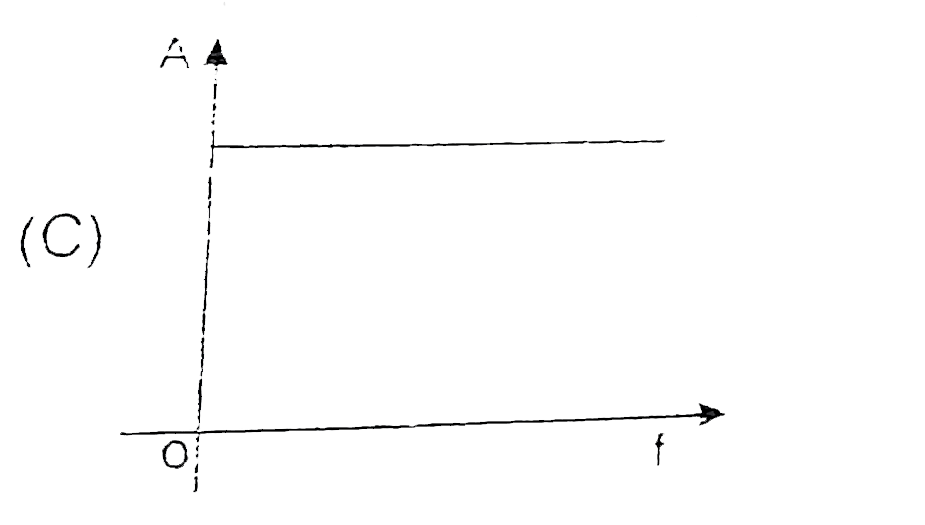
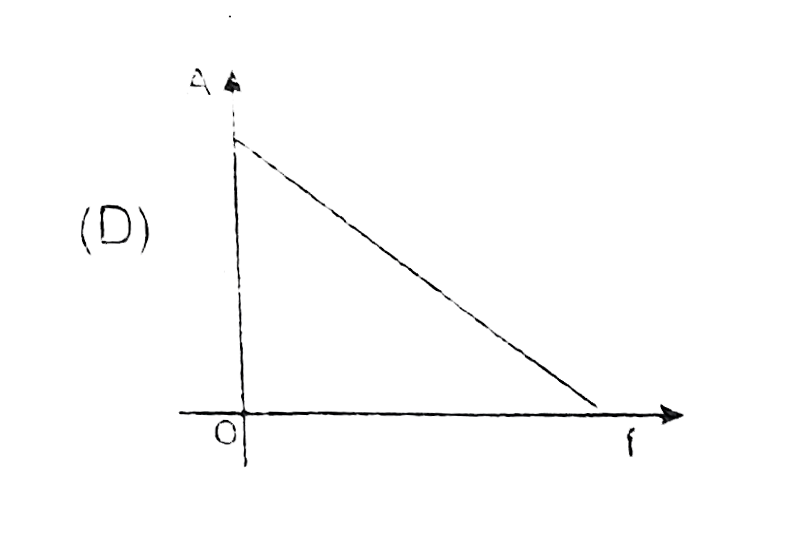
The time periods - hence the frequencies (f) and the amplitudes (A) of the driven pendulums in steady state are measured. The variation of A with f is correctly shown by the graph.

A

B

C

D

Text Solution

AI Generated Solution

The correct Answer is:

To solve the problem regarding the variation of amplitude (A) with frequency (f) for driven pendulums in steady state, we need to analyze the behavior of the system as frequency changes. Here’s a step-by-step breakdown of the solution: ### Step 1: Understanding the System In a driven pendulum, the amplitude of oscillation depends on the frequency of the driving force. As the frequency approaches the natural frequency of the pendulum, resonance occurs, leading to a significant increase in amplitude. **Hint:** Consider how resonance affects the amplitude of oscillation in a driven system. ### Step 2: Analyzing the Options We have four options that describe the relationship between amplitude and frequency. We need to evaluate each option based on the expected behavior of a driven pendulum. **Hint:** Look for patterns in the graphs that indicate how amplitude changes as frequency is varied. ### Step 3: Evaluating Option 1 Option 1 suggests a linear increase in amplitude with frequency. This implies that as frequency increases, amplitude continuously increases without any limit. **Hint:** Think about whether amplitude can increase indefinitely with frequency in a real system. ### Step 4: Evaluating Option 2 Option 2 shows a curve that increases with frequency until it reaches a maximum (resonance) and then decreases. This is characteristic of a driven oscillator where amplitude peaks at resonance. **Hint:** Recall the concept of resonance and how it affects amplitude in oscillatory systems. ### Step 5: Evaluating Option 3 Option 3 indicates that amplitude remains constant regardless of frequency. This scenario does not reflect the behavior of a driven pendulum, especially near resonance. **Hint:** Consider if it's physically plausible for amplitude to remain unchanged with varying frequency. ### Step 6: Evaluating Option 4 Option 4 suggests that amplitude decreases linearly as frequency increases. This is contrary to the expected behavior of a driven pendulum. **Hint:** Think about the relationship between frequency and amplitude in the context of resonance. ### Step 7: Conclusion After evaluating all options, Option 2 is the correct representation of the relationship between amplitude and frequency for a driven pendulum in steady state. The graph shows that amplitude increases with frequency until it reaches a maximum at the resonant frequency, after which it decreases. **Final Answer:** The correct option is Option 2.

To solve the problem regarding the variation of amplitude (A) with frequency (f) for driven pendulums in steady state, we need to analyze the behavior of the system as frequency changes. Here’s a step-by-step breakdown of the solution: ### Step 1: Understanding the System In a driven pendulum, the amplitude of oscillation depends on the frequency of the driving force. As the frequency approaches the natural frequency of the pendulum, resonance occurs, leading to a significant increase in amplitude. **Hint:** Consider how resonance affects the amplitude of oscillation in a driven system. ### Step 2: Analyzing the Options ...
Promotional Banner

Topper's Solved these Questions

  • DAILY PRACTICE PROBLEM

    RESONANCE ENGLISH|Exercise DPP No.57|9 Videos
  • DAILY PRACTICE PROBLEM

    RESONANCE ENGLISH|Exercise DPP No.58|20 Videos
  • DAILY PRACTICE PROBLEM

    RESONANCE ENGLISH|Exercise DPP No.55|9 Videos
  • CURRENT ELECTRICITY

    RESONANCE ENGLISH|Exercise High Level Problems (HIP)|19 Videos
  • ELECTRO MAGNETIC WAVES

    RESONANCE ENGLISH|Exercise Exercise 3|27 Videos

Similar Questions

Explore conceptually related problems

The period of the function f(x)=k cos kx is (pi)/(2) . The amplitude of f is

The time period and frequency are related according to the formula f =1+T

What are wavelength, frequency, time period and amplitude of a sound wave ?

The correct variation of resistance R with frequency f is given by

The graph between time period ( T ) and length ( l ) of a simple pendulum is

A large number of pendulums with identical bobs (mass m) but varying lengths are suspended from a thick thread. Another pendulum of a heavier bob (mass M) is also suspended from the same thred as shown. This pendulum with the heavier bob is used as a 'driver' to drive the other pendulums called as 'driven' pendulums. Assume that the amplitude of the driver is maintained constant (by some suitable mechanism). Let the frequency of the driver be f_(0) The variation of amplitude A with respect to time t is shown as

A large number of pendulums with identical bobs (mass m) but varying lengths are suspended from a thick thread. Another pendulum of a heavier bob (mass M) is also suspended from the same thred as shown. This pendulum with the heavier bob is used as a 'driver' to drive the other pendulums called as 'driven' pendulums. Assume that the amplitude of the driver is maintained constant (by some suitable mechanism). Let the frequency of the driver be f_(0) Which of the following will give a straight line graph ?

A large number of pendulums with identical bobs (mass m) but varying lengths are suspended from a thick thread. Another pendulum of a heavier bob (mass M) is also suspended from the same thred as shown. This pendulum with the heavier bob is used as a 'driver' to drive the other pendulums called as 'driven' pendulums. Assume that the amplitude of the driver is maintained constant (by some suitable mechanism). Let the frequency of the driver be f_(0) The above pendulum is set into oscillation with an initial amplitude of 10.0 cm. Soon this pendulum comes to rest momentarily and the driver is seen to oscillate with an amplitude of 8.16 cm. Then mass M equals

The time period of a simple pendulum is 2 s. Find its frequency .

A large number of pendulums with identical bobs (mass m) but varying lengths are suspended from a thick thread. Another pendulum of a heavier bob (mass M) is also suspended from the same thred as shown. This pendulum with the heavier bob is used as a 'driver' to drive the other pendulums called as 'driven' pendulums. Assume that the amplitude of the driver is maintained constant (by some suitable mechanism). Let the frequency of the driver be f_(0) It is observed that

RESONANCE ENGLISH-DAILY PRACTICE PROBLEM-DPP No.56
  1. If E denotes of electric field, the dimension of a quantity in(0)(dE)/...

    Text Solution

    |

  2. A particle moves in a plane with a constant speed along a path y=2x^(2...

    Text Solution

    |

  3. Two particles A and B are moving in XY plane. Particle A moves along a...

    Text Solution

    |

  4. Two identical thin metal strips one of aluminium and the other of iron...

    Text Solution

    |

  5. A long straight wire carries a charge with linear density lamda. A par...

    Text Solution

    |

  6. Temperature of 100 g of water in a thermoflask remains fixed for a pre...

    Text Solution

    |

  7. A fresh dry cell of 1.5 volt and two resistors of 10 k Omega each are ...

    Text Solution

    |

  8. Two simple pendulum with heavy bobs-one using iron wire and the other ...

    Text Solution

    |

  9. A short bar magnet is placed along N-S direction with N pole pointing ...

    Text Solution

    |

  10. A plane mirror coincides with a plane having equation x = 3. A particl...

    Text Solution

    |

  11. An unpolarized light is travelling along Z axis through three polarizi...

    Text Solution

    |

  12. On face of a glass (mu = 1.50) lens is coated with a thin film of magn...

    Text Solution

    |

  13. The time periods - hence the frequencies (f) and the amplitudes (A) of...

    Text Solution

    |

  14. A large number of pendulums with identical bobs (mass m) but varying l...

    Text Solution

    |

  15. A large number of pendulums with identical bobs (mass m) but varying l...

    Text Solution

    |

  16. A large number of pendulums with identical bobs (mass m) but varying l...

    Text Solution

    |

  17. A simple pendulum of length L has a period T. If length is changed by ...

    Text Solution

    |

  18. A large number of pendulums with identical bobs (mass m) but varying l...

    Text Solution

    |

  19. A large number of pendulums with identical bobs (mass m) but varying l...

    Text Solution

    |

  20. If v is the velocity of the bob the force that is responsible for decr...

    Text Solution

    |
