
Home
Class 12
PHYSICS
Two parallel fixed conducting rails are ...

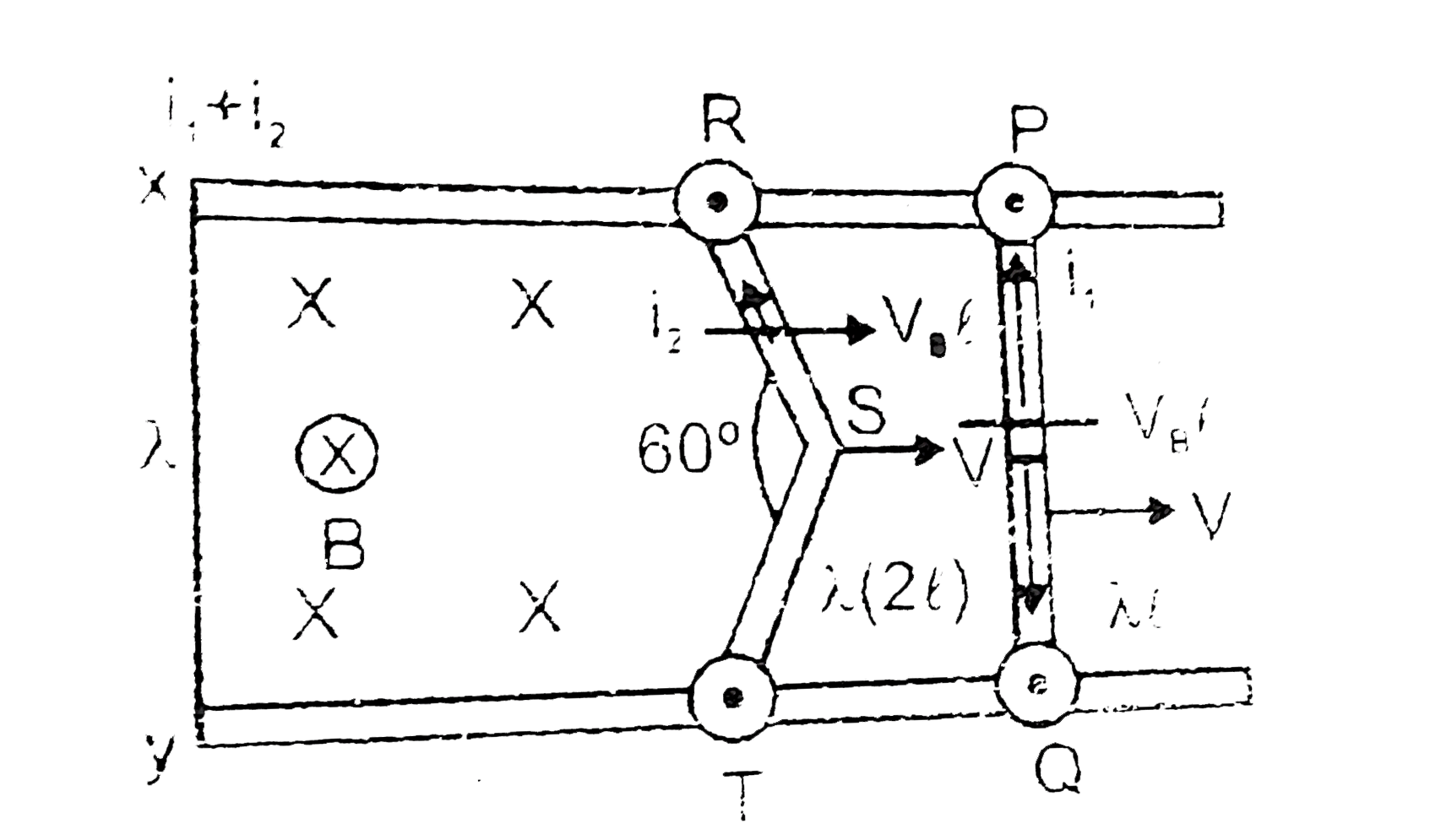
Two parallel fixed conducting rails are `l` distance apart. They are connected by a conducting wire xy. A uniform magnetic field B is applied normal to its plane. Two other rods PQ and RT(RS = ST) are moved with a constant velocity v. Resistance/ length of these two rods are `lamda` no other wire has resistance. Then :

A

a. current in the conducting wire xy is `(2vB)/(lamda)`

B

b. current in the conducting wire xy is `(3)/(2)(vB)/(lamda)`

C

c. To maintain constant velocity of rod RST force required in forward direction is `(B^(2) l v)/(2 lamda)`

D

d. To maintain constant velocity of rod RST force required in forward direction is `(B^(2) l v)/(lamda)`

Text Solution

Verified by Experts

The correct Answer is:
B, C


Current in PQ wire is `(VB lamda)/(2 lamda) = (VB)/(lamda)`
Current in RST wire `(i_(2)) = (VB lamda)/(2 lamda l) = (VB)/(2 lamda)`
Current in xy wire `= i_(1)+i_(2) = (3)/(2) (V_(B))/(lamda)`
For required to maintain the velocity of RST wire constant
`F=i lamda_(eq)B=((VB)/(2 lamda))(lamda)B-(B^(2)lamdav)/(2 lamda)`.
Promotional Banner

Topper's Solved these Questions

  • DAILY PRACTICE PROBLEM

    RESONANCE ENGLISH|Exercise DPP No.58|20 Videos
  • DAILY PRACTICE PROBLEM

    RESONANCE ENGLISH|Exercise DPP No.59|9 Videos
  • DAILY PRACTICE PROBLEM

    RESONANCE ENGLISH|Exercise DPP No.56|20 Videos
  • CURRENT ELECTRICITY

    RESONANCE ENGLISH|Exercise High Level Problems (HIP)|19 Videos
  • ELECTRO MAGNETIC WAVES

    RESONANCE ENGLISH|Exercise Exercise 3|27 Videos

Similar Questions

Explore conceptually related problems

A conducting wire xy of lentgh l and mass m is sliding without friction on vertical conduction rails ab and cd as shown in figure. A uniform magnetic field B exists perpendicular to the plane of the rails, x moves with a constant velocity of

A conducting wire xy of lentgh l and mass m is sliding without friction on vertical conduction rails ab and cd as shown in figure. A uniform magnetic field B exists perpendicular to the plane of the rails, x moves with a constant velocity of

Shows a rod of length l and resistance r moving on two rails shorted by a resistance R . A uniform magnetic field B is present normal to the plane of rod and rails. Show the electrical equivalence of each branch.

Shows a rod of length l and resistance r moving on two rails shorted by a resistance R . A uniform magnetic field B is present normal to the plane of rod and rails. Show the electrical equivalence of each branch.

PQ and MN are two parallel conductors at a distance l apart and connected by a resistance R as shown in figure. They are placed in a magnetic field B which is perpendicular to the plane of the conductors. A wire XY is placed over PQ and MN and then made to slide over PQ and MN with a velocity v. Neglecting the resistance of PQ, MN and wire XY, calculate the work done per second to slide the wire XY.

Two long parallel conducting horizontal rails are connected by a conducting wire at one end. A uniform magnetic field B (directed vertically downwards) exists in the region of space. A light uniform ring of diameter d which is practically equal to separation between the rails is placed over the rails as shown in Fig. If resistance of ring be (lambda) per unit length The force required to pull the ring with uniform velocity v is

Two long parallel conducting horizontal rails are connected by a conducting wire at one end. A uniform magnetic field B (directed vertically downwards) exists in the region of space. A light uniform ring of diameter d which is practically equal to separation between the rails is placed over the rails as shown in Fig. If resistance of ring be (lambda) per unit length The current in the wire MN is

Figure shows a wire of resistance R sliding on two parallel, conducting fixed thick rails placed at a separation l. A magnetic fild B exist in a direction perpendicular to the plane of the rails. The wire is moving with a constant velocity v. Find current through the wire

Shows a wire sliding on two parallel, conducting rails placed at a separaton l. A magnetic feld B exists in a direction perpendicular to the plane of the rails. What force is necessary to keep the wire moving at a constatn velocity v ?

A conducting rod MN of mass m and length 'l' is placed on parallel smooth conducting rails connected to an uncharged capacitor of capacitance C and a battery of emf epsilon as shown. A uniform magnetic field B is existing perpendicular to the plane of the rails. The steady state velocity acquired by the conducting rod MN after closing switch S is (neglect the resistance of the parallel rails and the conducting rod)

