Home
Class 12
PHYSICS
Two similar bulbs of wattage 100 W//50 s...

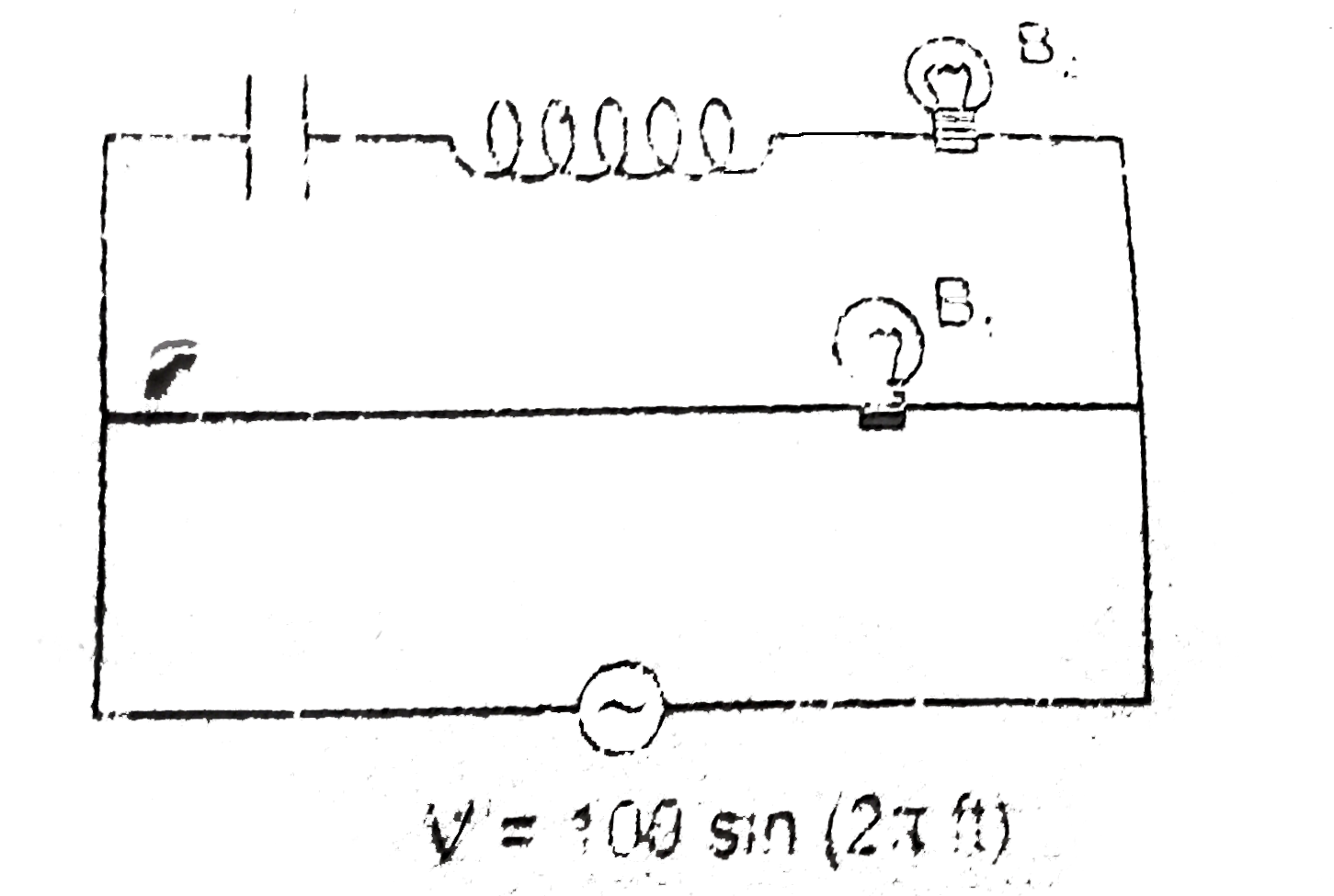
Two similar bulbs of wattage `100 W//50 sqrt(2)V` are connected in circuit as shown when frequency of source is varies, brightness of `B_(2)` changes it is observed that at 50 Hz frequency both the bulbs have same brightness. Select correct alternative/s

A

a. Current in both the bulbs will be in same phase when both have same brightness

B

b. Current through source will be 2A when both the bulbs have same brightness

C

c. Current through source will be `2 sqrt(2)A` when both the bulbs have same brightness

D

d. `B_(1)` will be more brighter for all frequencies axcept 50 Hz

Text Solution

Verified by Experts

The correct Answer is:

A, C, D
Promotional Banner

Topper's Solved these Questions

  • DAILY PRACTICE PROBLEM

    RESONANCE ENGLISH|Exercise DPP No.60|8 Videos
  • DAILY PRACTICE PROBLEM

    RESONANCE ENGLISH|Exercise DPP No.61|20 Videos
  • DAILY PRACTICE PROBLEM

    RESONANCE ENGLISH|Exercise DPP No.58|20 Videos
  • CURRENT ELECTRICITY

    RESONANCE ENGLISH|Exercise High Level Problems (HIP)|19 Videos
  • ELECTRO MAGNETIC WAVES

    RESONANCE ENGLISH|Exercise Exercise 3|27 Videos

Similar Questions

Explore conceptually related problems

Two bulbs 25W, 100 V (upper bulb in figure) and 100 W, 200 V (lower bulb in figure) are connected in the circuit as shown in figure. Choose the correct answer.

The tension in a stretch string fixed at both ends is changed by 2% , the fundarmental frequency is founder to get changed by 1.5 Hz . Select the correct statement(s).

Three bulbs B_(1), B_(2) and B_(3) are connected to the mains as shown in Fig. 7.28 . How will the brightness of bulb B_(1) be affected B_(2) or B_(3) are disconnected from the circuit?

Three incandecent bulbs of 100 W each are connected in series in an electric circuit. In another circuit another set of three bulbs of the same wattage are connected in parallel to the same source. (a) Will the bulbs in the two circuits glow with the same brightness ? Justify your answer. (b) Now let one bulb in both the circuits get fused. Will the rest of the bulbs continue to glow in each circuit ? Give reason.

A tube light of 60 V, 60 W rating is connected across an AC source of 100 V and 50 Hz frequency. Then,

An AC voltage source is applied across an R-C circuit. Angular frequency of the source is omega , resistance is R and capacitance is C. The current registered is I. If now the frequency of source is changed to omega/2 (but maintaining the same voltage), the current in the circuit is found to be two third. calculate the ratio of reactance to resistance at the original frequency omega .

Two electric bulbs , rated at (25W,220V) and (100W,220V), are connected in series across a 220 V voltage source , if the 25W and 100W bulbs draw powers P_(1) and P_(2) Respectively , then :

A capacitor C, a variable resistor R and a bulb B are connected in series to the ac mains in circuits as shown if Fig. The bulb glows with some brightness. How will the glow of the bulb change if (i) a dielectric slab is introduced between the plates of the capacitor, keeping resistance T to be the same, (ii) the resistance R to be the same, (ii) the resistance R is increased keeping the same capacitance.

A capacitor of capacitance 10muF is connected to an AC source and an AC Ammeter. If the source voltage varies as V=50sqrt(2)sin100t , the reading of the ammeter is

Two identical incandescent light bulbs are connected as shown in figure. When the circuit is an AC voltage source of frequency f, which of the following observations will be correct.
