Home
Class 12
PHYSICS
With two hands you hold a cone motionles...

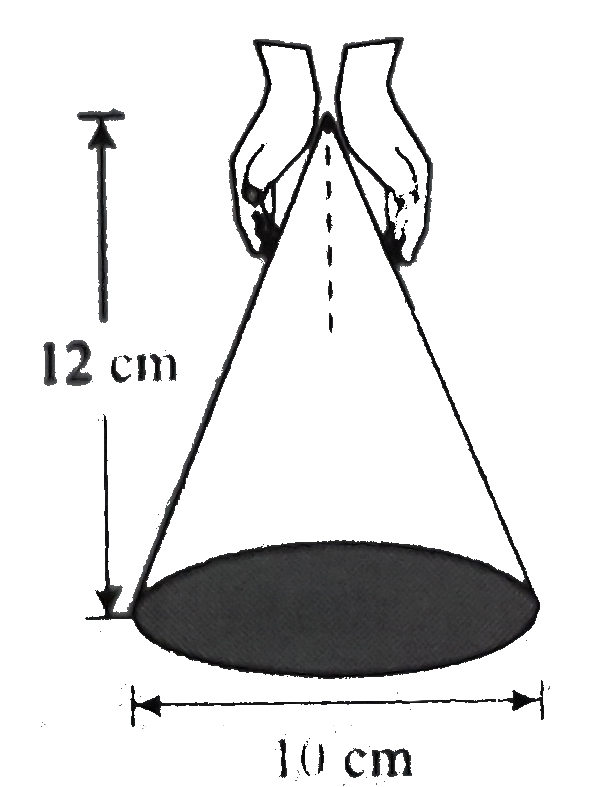
With two hands you hold a cone motionless upside doen , as shown in figure The mass of the cone is `(m = 1 kg)` and the coefficient of static friction between you fingers and the cone is `(mu = 0.5)` what is the minimum normal force you must applywith each hand in order to hold up the cone? Consider only translational equilibruim

Text Solution

Verified by Experts

The correct Answer is:
50 N


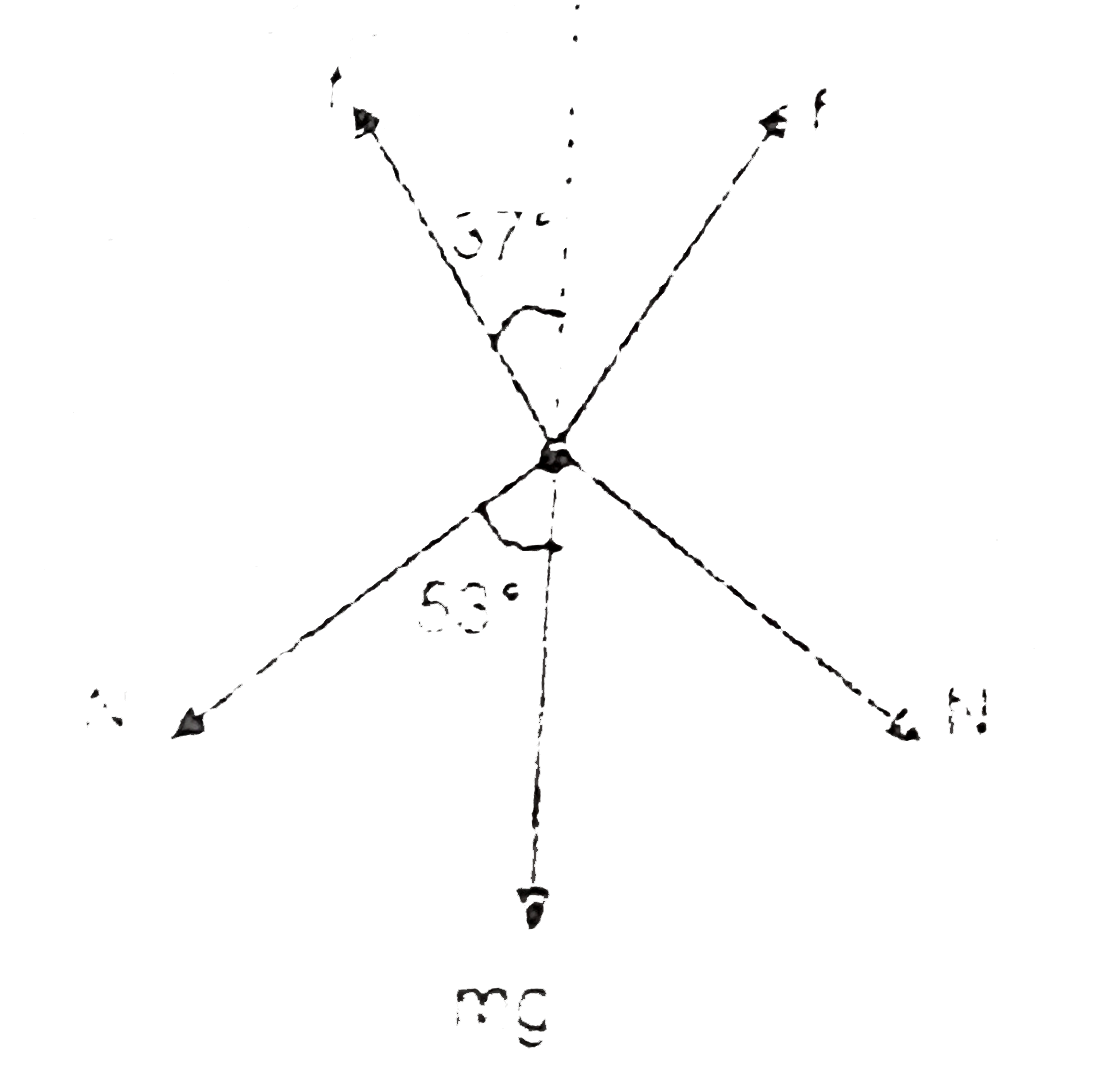
`mg+2Ncos 53^(@)=2muN cos 37^(@)`
`mg +2N(3)/(5)=2mu(4)/(5)N`
`rArr mg =((8)/(5)-(6)/(5))N" "N=50` newton
Promotional Banner

Topper's Solved these Questions

  • DAILY PRACTICE PROBLEM

    RESONANCE ENGLISH|Exercise DPP No.68|9 Videos
  • DAILY PRACTICE PROBLEM

    RESONANCE ENGLISH|Exercise DPP No.69|20 Videos
  • DAILY PRACTICE PROBLEM

    RESONANCE ENGLISH|Exercise DPP No.66|20 Videos
  • CURRENT ELECTRICITY

    RESONANCE ENGLISH|Exercise High Level Problems (HIP)|19 Videos
  • ELECTRO MAGNETIC WAVES

    RESONANCE ENGLISH|Exercise Exercise 3|27 Videos

Similar Questions

Explore conceptually related problems

The coefficient of static friction between the two blocks shown in figure is mu and the table is smooth. What maximum horizontal forced F can be applied to he block of mass M so that the block move together?

The coefficient of static friction between the two blocks shown in figure is mu and the table is smooth. What maximum horizontal forced F can be applied to he block of mass M so that the block move together?

A block of mass 10 kg is kept on a rough inclined plane as shown in the figure. A force of 3 N is applied on the block. The coefficient of static friction between the plane and the block is 0.6 What should be the minimum value of force P, such that the block doesnot move downward? (take g=10ms^(-2) )

A block of mass 10 kg is kept on a rough inclined plane as shown in the figure. A force of 3 N is applied on the block. The coefficient of static friction between the plane and the block is 0.6 What should be the minimum value of force P, such that the block doesnot move downward? (take g=10ms^(-2) )

A block of mass m = 2kg is resting on a inclined plane of inclination 30^(@) The coefficient of friction between the block and the plane is mu = 0.5 what minimum force F (in newton) should be applied perpendicular to the plane on the block so that the does not slip on the plane?

A block of mass m = 2kg is resting on a inclined plane of inclination 30^(@) as shown in figure The coefficient of friction between the block and the plane is mu = 0.5 what minimum force F (in newton) should be applied perpendicular to the plane on the block so that the does not slip on the plane?

A fireman of mass 60 kg slides down a pole. He is pressing the pole with a force of 600N. The coefficient of friction between the hands and the pole is 0.5, with what acceleration will the fireman slide down (g=10(m)/(s^2) )

A man holds a 2 kg book between his palms. so that each hand exerts the same horizontal force on the book. The coefficient of static friction between the palms and the book is 0.4 and g = 10ms^(-2) . If the book is prevented from falling, the least force exerted by each hand on the book is

A block of mass m=2kg is resting on a rough inclined plane of inclination of 30^(@) as shown in figure. The coefficient of friction between the block and the plane is mu=0.5 . What minimum force F should be applied perpendicular to the plane on the block, so that blocks does not slip on the plane? (g=10m//s^(2))

On a smooth table two blocks of masses 2.5kg and 1.5kg are placed one over the other as shown in figure. If the coefficient of static friction between two blocks is 0.2, the maximum horizontal force to be applied on the lower block so that the two blocks move together is (g = ms^(-2) )

