Home
Class 12
PHYSICS
A heavy homogeneous cylinder has mass m ...


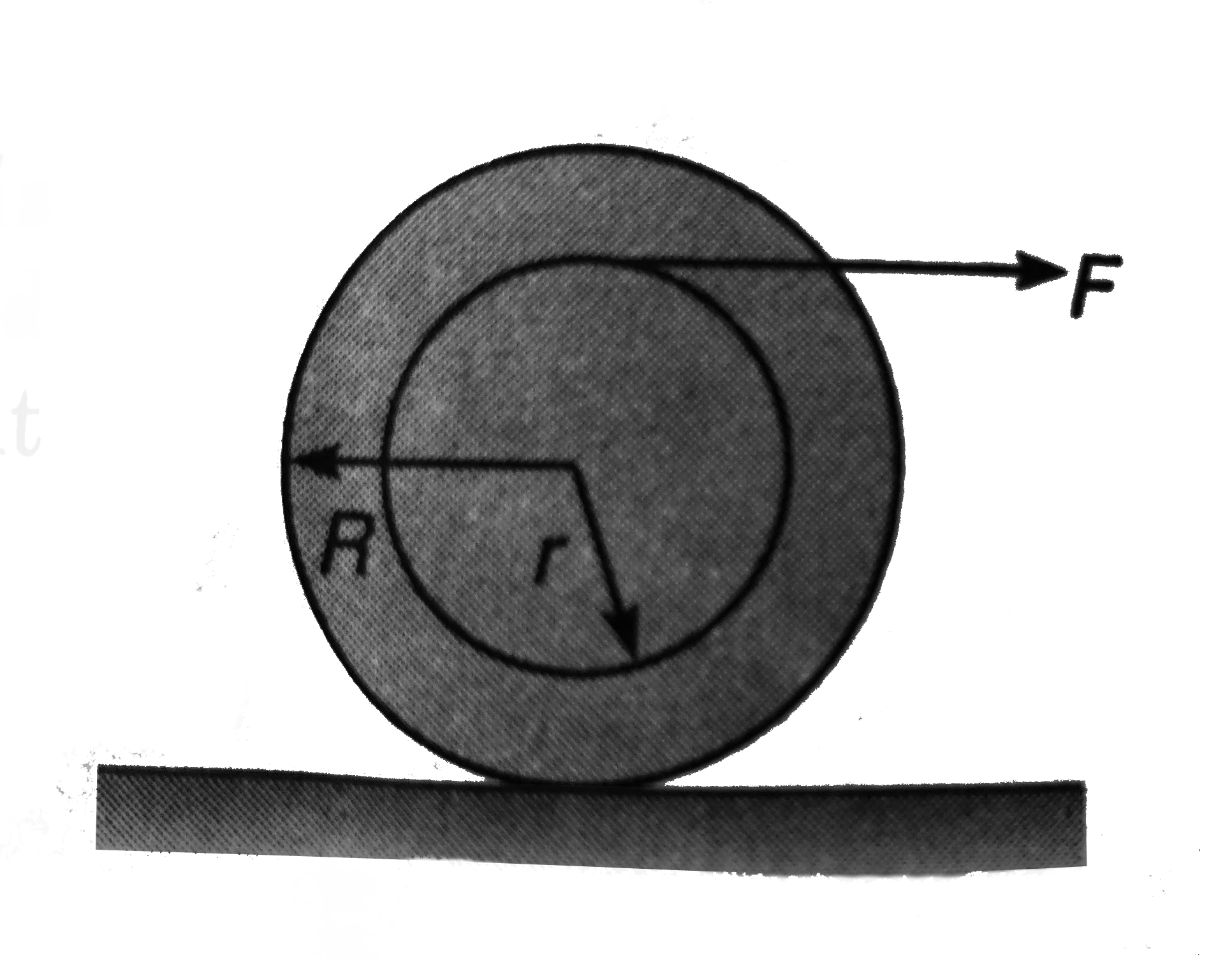
A heavy homogeneous cylinder has mass `m` and radius `R`. It is accelerated by a force `F` which is applied through a rope wound around a light drum of radius r attached to the cylinder (figure) the coefficient of static friction is sufficient for the cylinder to roll without slipping.

A

acceleration of centre of cylinder is `a = (2F)/(2mR) (R+r)`

B

friction assumed to be in the opposite direction of F is `f =(2)/(3)((1)/(2)-(r)/(R))F`

C

If `((r)/(R)) lt (1)/(2)` a will be greater than `(F)/(m)`

D

Friction assumed to be in the direction of F is `f = (2)/(3) ((1)/(2) -(r)/(R))F`

Text Solution

Verified by Experts

The correct Answer is:
A, B


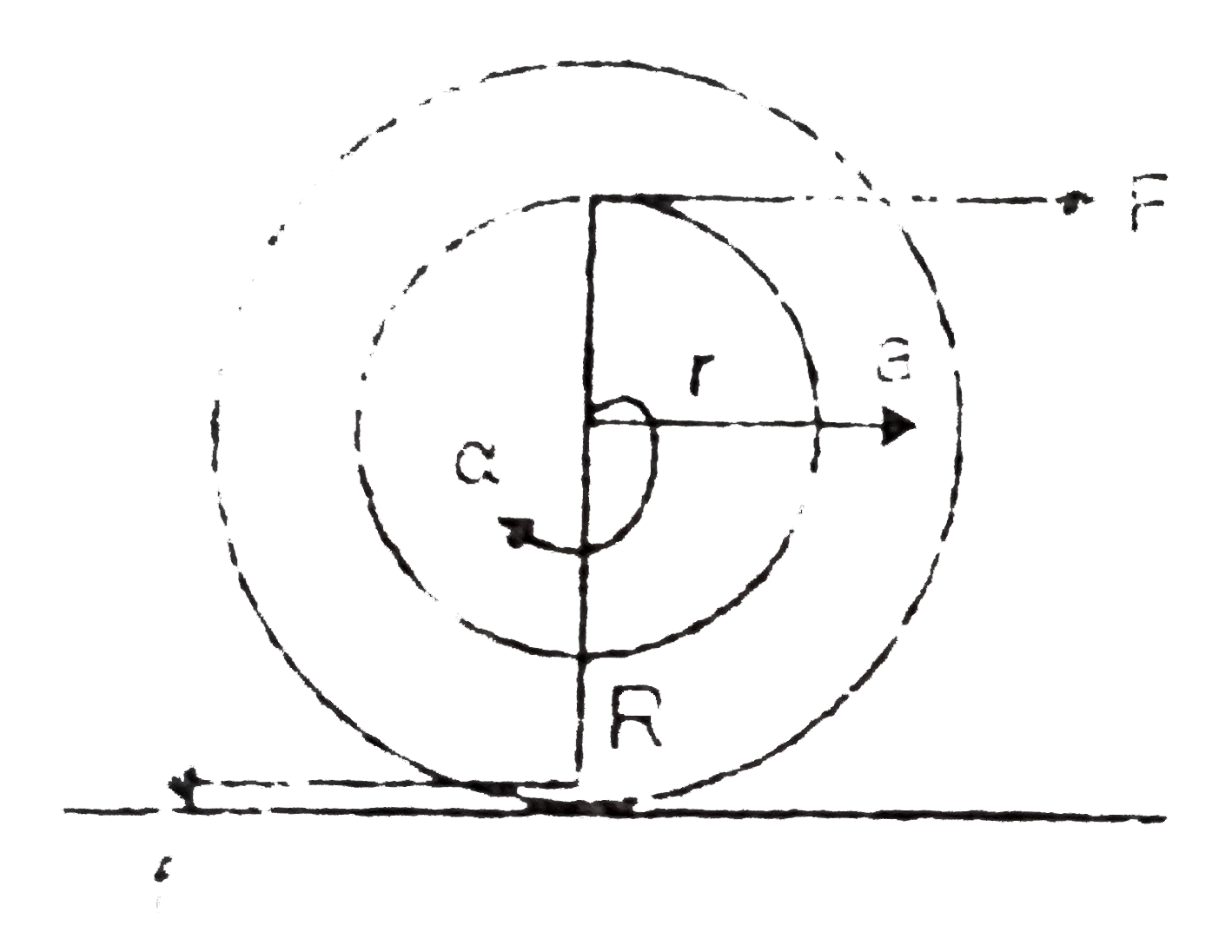
`F=f=ma Fr+fR=(mR^(2))/(2)alpha" "a=Ralpha`
Solving `a=(2F)/(2mR) (R+r)f=(2)/(3)((1)/(2)-(r)/(R))F`
If `((r)/(R))gt (1)/(2)`
f will be forward
`r F + f = ma" "a gt (F)/(m)`
Promotional Banner

Topper's Solved these Questions

  • DAILY PRACTICE PROBLEM

    RESONANCE ENGLISH|Exercise DPP No.71|10 Videos
  • DAILY PRACTICE PROBLEM

    RESONANCE ENGLISH|Exercise DPP No.72|20 Videos
  • DAILY PRACTICE PROBLEM

    RESONANCE ENGLISH|Exercise DPP No.69|20 Videos
  • CURRENT ELECTRICITY

    RESONANCE ENGLISH|Exercise High Level Problems (HIP)|19 Videos
  • ELECTRO MAGNETIC WAVES

    RESONANCE ENGLISH|Exercise Exercise 3|27 Videos

Similar Questions

Explore conceptually related problems

A uniform solid cylinder having mass M and radius R is pulled by a horiozntal force F acting through the center as shown. The cylinder rolls to the right without slipping. What is the magnitude of the force of friction between the cylinder and the ground?

Uniform solid cylinder of mass m and radius R is placed on a rough horizontal surface. A horizontal constant force is applied at the top point P of the cylinder so that it start pure rolling .In the above question, the frictional force on the cylinder is

A uniform solid cylinder of mass m and radius 2R rests on a horizontal table. A string attached to it passes over a pulley (disc) of mass m and radius R that is mounted on a fricitonaless axle through its centre . A block of mass m is suspended from the free end of the spring . The string does not slip over the pulley surface and the cylinder rolls without slipping on the table. Force of friction acting on the cylinder is

A uniform solid cylinder of mass m and radius 2R rests on a horizontal table. A string attached to it passes over a pulley (disc) of mass m and radius R that is mounted on a fricitonaless axle through its centre . A block of mass m is suspended from the free end of the spring . The string does not slip over the pulley surface and the cylinder rolls without slipping on the table. Angular acceleration of the cylinder is

A uniform solid cylinder of mass m and radius 2R rests on a horizontal table. A string attached to it passes over a pulley (disc) of mass m and radius R that is mounted on a fricitonaless axle through its centre . A block of mass m is suspended from the free end of the spring . The string does not slip over the pulley surface and the cylinder rolls without slipping on the table. Acceleration of the block is

A force F is applied at the top of a ring of mass M and radius R placed on a rough horizontal surface as shown in figure. Friction is sufficient to prevent slipping. The friction force acting on the ring is:

A cylinder of mass M and radius R rolls on an inclined plane. The gain in kinetic energy is

A homogeneous cylinder of mass Mand radius r is pulled on a horizontal plane by a horizontal force F acting through its centre of mass. Assuming rolling without slipping, find the angular acceleration of the cylinder,

A homogeneous cylinder of mass Mand radius r is pulled on a horizontal plane by a horizontal force F acting through its centre of mass. Assuming rolling without slipping, find the angular acceleration of the cylinder,

A load of mass m is attached to the end of a string wound on a cylinder of mass M and radius R . The string passes round a pulley. a. Find the acceleration of the cylinder M when it rolls. b. If the coefficient of friction is mu . Find the accelerative of the cylinder when it slips and rolls. c. Find the minimum value of coefficient of friction for which the cylinder rolls always

