

Home
Class 11
PHYSICS
In a cyclic process, a gas is taken from...

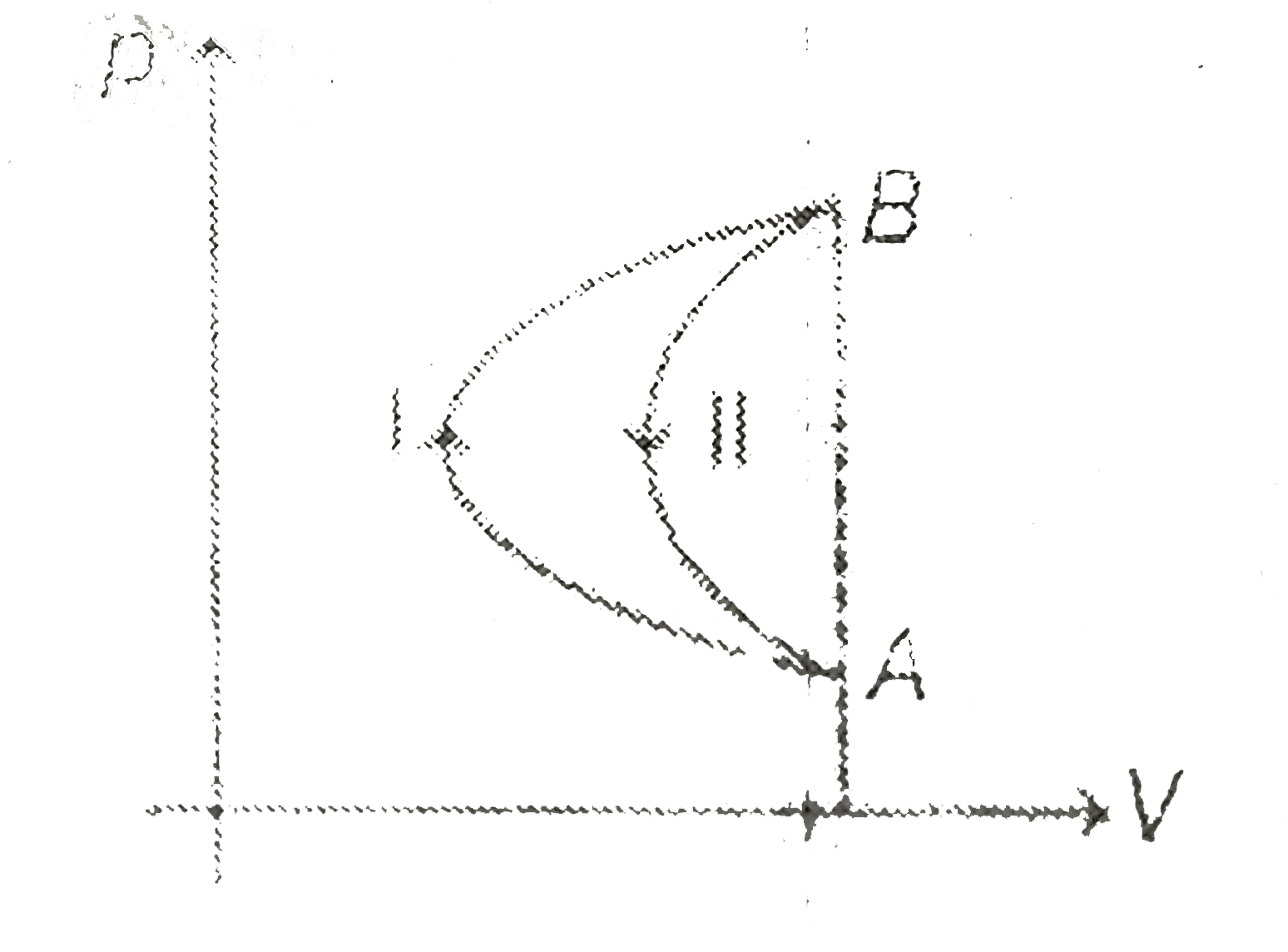
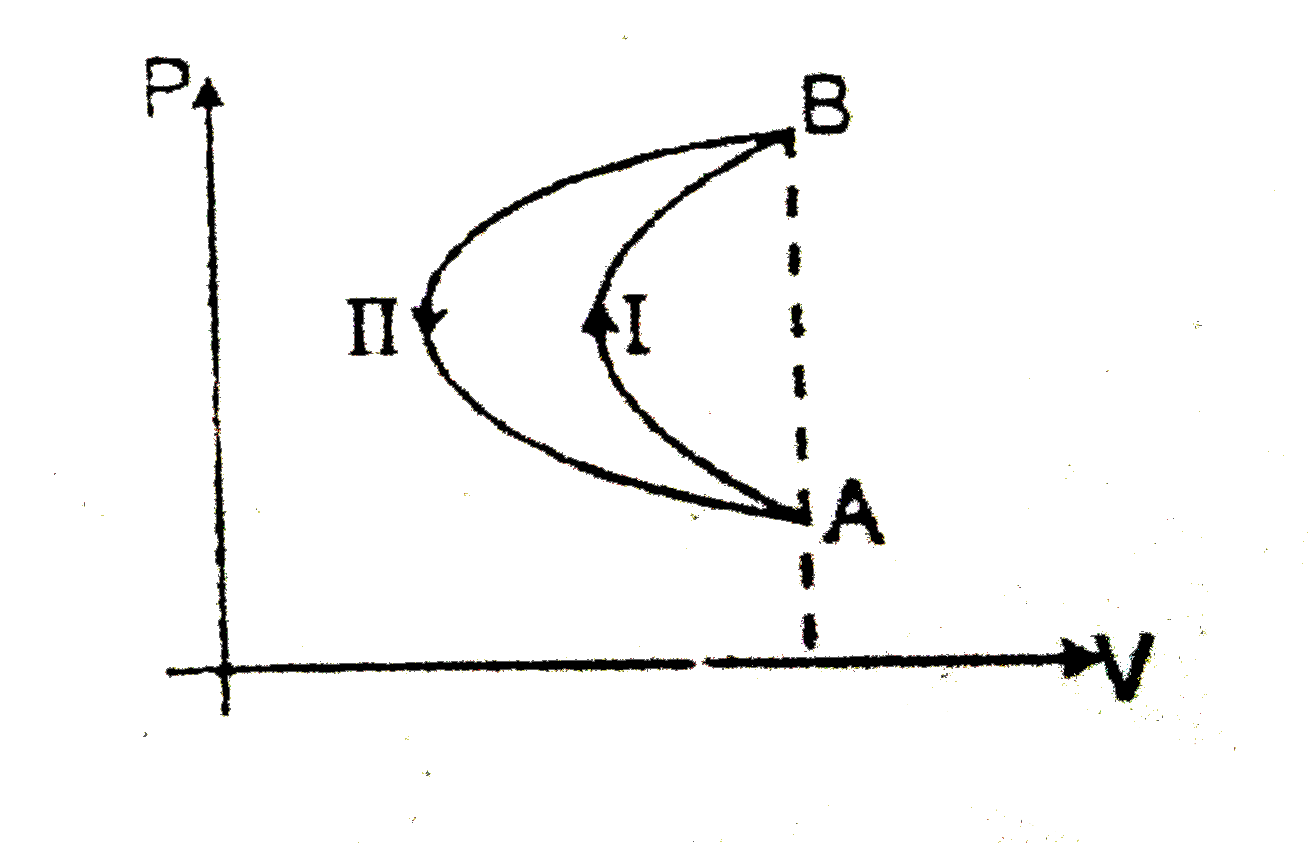
In a cyclic process, a gas is taken from state A to E via path - I as shown in the indicator diagram and taken back to state A from state B via path-II. In the complete cycle

A

work is done by the gas

B

heat is rejected by the gas

C

no work is done by the gas.

D

nothing can be said about work as data is insufficient

Text Solution

Verified by Experts

The correct Answer is:
B

As work done in state (II) is more than in state (I)
Promotional Banner

Topper's Solved these Questions

  • KINEMATICS

    RESONANCE ENGLISH|Exercise Exercise|65 Videos
  • KTG & THERMODYNAMICS

    RESONANCE ENGLISH|Exercise SUBJECTIVE QUESTIONS|27 Videos

Similar Questions

Explore conceptually related problems

In a cyclic process, a gas is taken from state A and B via path -I as shown in the indicator diagram and taken back to state A from state B via path-II. In the complete cycle

A thermodynamic system is taken from state A to B along ACB and is brought back to A along BDA as shown in the PV diagram. The net work done during the complete cycle is given by the area

An ideal gas goes from the state i to the state int as shown in .the work done by the gas during the process

An ideal gas change from state a to state b as shown in Fig. what is the work done by the gas in the process?

In given figure, when a thermodynamic system is taken from state A to state B via path ACB,100 cal of heat given to the system and 60cal work is done by the gas. Along the path ADB , the work done by the gas is 20cal . Find the heat flowing into the system in this case?

calculate the work done by a gas as it is taken from the state a to b, b to c and c to a as shown in

An ideal gas undergoing a change of state from A to B through four different paths I, II,III and IV as shown in the P-V diagram that lead to the same change of state tyhen the change in internal energy is

An ideal gas is taken from state 1 to state 2 through optional path A, B, C and D as shown in the PV diagram. Let Q, W and U represent the heat supplied, work done and change in internal energy of the gas respectively. Then,

In changing the state of a gas adiabatically from an equilibrium state A to another equilibrium state B an amount of work equal to 22.3 J is done on the system.If the gas is taken from state A to B via a process in which the net heat absorbed by the system is 9.35 cal then the net work done by the system in latter case is (Take 1 case =4.2 J)

An ideal gas is taken from state A to state B via three different processes as shown in the pressure volume (P-V) diagram. If Q_1 , Q_2 & Q_3 indicates the heat absorbed by the gas and Delta U_1 , Delta U_2 & Delta U_3 indicate change in internal energy in three processes, then

RESONANCE ENGLISH-KINETIC THEORY OF GASES AND THERMODYNAMICS-Exercise
  1. Heat is supplied to a certain homogeneous sample of matter, at a unifo...

    Text Solution

    |

  2. An ideal gas can be expended from an initial state to a certain volume...

    Text Solution

    |

  3. In a cyclic process, a gas is taken from state A to E via path - I as ...

    Text Solution

    |

  4. The kinetic molecular theory of gases predicts that at a given tempera...

    Text Solution

    |

  5. On increasing the temperature, the root mean square speed of molecules...

    Text Solution

    |

  6. One of the two vessels of same capacity is filled with oxygen and oth...

    Text Solution

    |

  7. A container has N molecules at absolute temperature T. If the number o...

    Text Solution

    |

  8. From the molecular theory of gases, the velocity of molecules at absol...

    Text Solution

    |

  9. If the velocities of three gas molecules are sqrt(7), 4 and 5 m/s, the...

    Text Solution

    |

  10. A monoatomic gas at a temperature T has pressure P and heat energy per...

    Text Solution

    |

  11. The energy associated with each degree of freedom of a molecule

    Text Solution

    |

  12. Why does Moon have no atmosphere?

    Text Solution

    |

  13. In kinetic theory of gases, which of the following statements regardin...

    Text Solution

    |

  14. The gases carbon monoxide (CO) and nitrogen at the same temperaturehav...

    Text Solution

    |

  15. The equation of state for 5 g of oxygen at a pressure P and temperatur...

    Text Solution

    |

  16. Average kinetic energy of H2 molecules at 300 K is E. At the same temp...

    Text Solution

    |

  17. Which of the following statements is incorrect to assumption of kineti...

    Text Solution

    |

  18. The absolute temperature of the gas is increased 3 times. What will be...

    Text Solution

    |

  19. The degree of freedom of a stationary rigid body about its axis will b...

    Text Solution

    |

  20. If an electric fan be switched on in a closed room, will the air of th...

    Text Solution

    |