

Home
Class 11
PHYSICS
A ray of light travelling in air is inci...

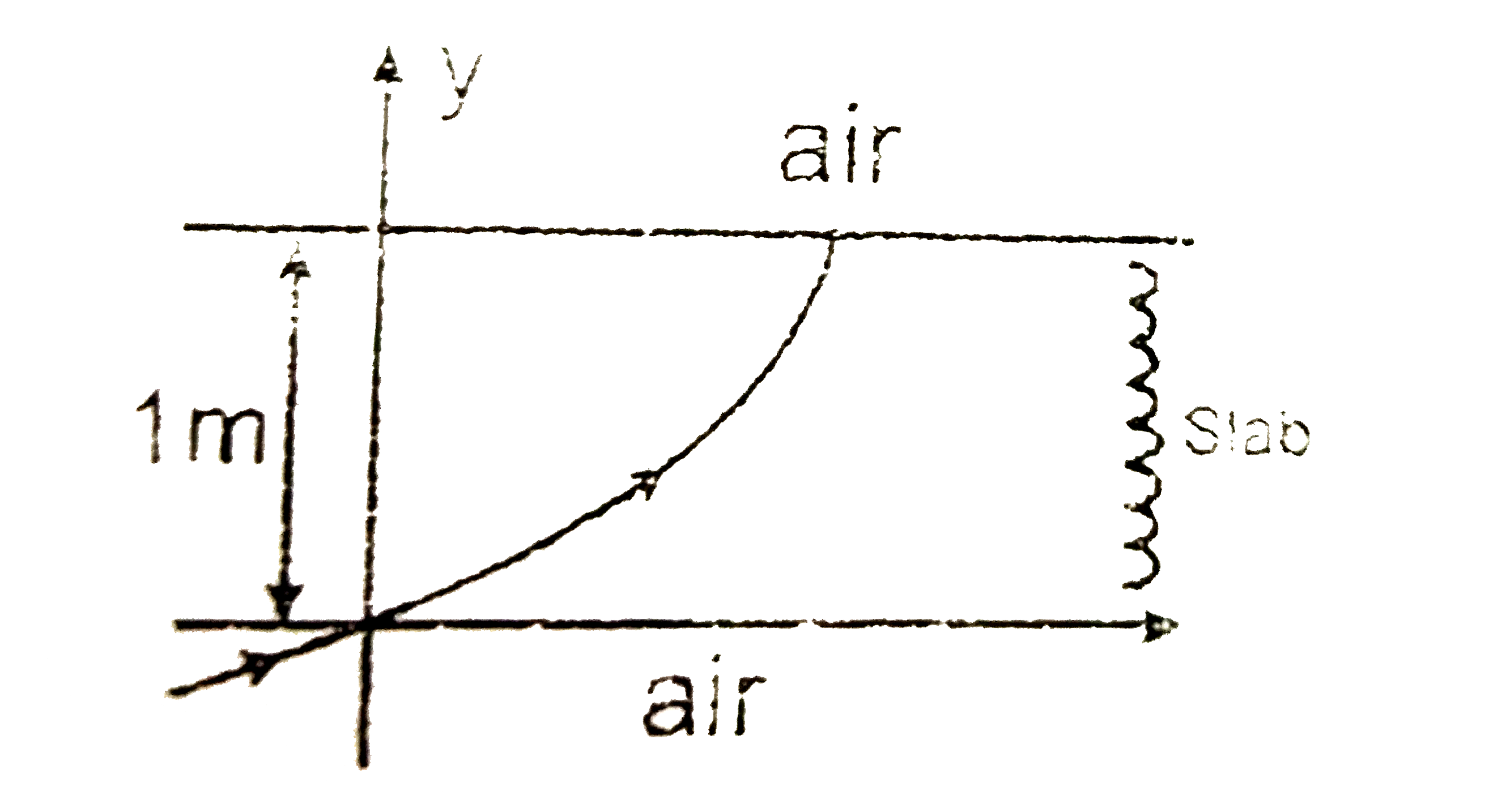
A ray of light travelling in air is incident at grazing incidence on a slab with variable refractive index, n `(y)` `=[k y^(3//2)+1]^(1//2)` where `k=1 m^(-3//2)` and follows path as shown in the figure. What is the total deviation produced by slab when the ray comes out.

A

`60^(@)`

B

`53^(@)`

C

`sin^(-1)(4//9)`

D

no deviation at all

Text Solution

Verified by Experts

The correct Answer is:
D

As n varies 'y', parallel slabs can be taken, and we know in parallel slabs
`n_(r) sin i_(r)`=constant, as `n_(1) sin i_(1) =1xxsin 90^(@) =1`=constant
`n_("final")=n_(air)=1`
`rArr 1=1xxsin r_("Final")`
`rArr r_("final") =90^(@)`
`:.` Deviation is zero.
Promotional Banner

Topper's Solved these Questions

  • FULL TEST 3

    RESONANCE ENGLISH|Exercise Exercise|30 Videos
  • GRAVITATION

    RESONANCE ENGLISH|Exercise Exercise|21 Videos

Similar Questions

Explore conceptually related problems

A ray of light travelling in air is inciden at angle of inciden 30^@ on one surface of slab in which refractive index varies with y. The light travels along the curve y =4x^(2) ( y and x are in meter) in the slab. Find out the refractive index of the slab at y=1//2m in the slab.

A ray of light travelling in air is incident at angle of incidence I~~90^(@) on a long rectangular slab of a transparent medium of thickness y_(0) . The medium has a variable refractive index of mu(x)=sqrt(1+ke^(2x//a),xge0 wher a is a positive constant

A ray of light travelling in air is incident at grazing angle (incident angle= 90^(@)) on a long rectangular slab of a transparent medium of thickness t=1.0 (see figure). The point of incidence is the origin A(O,O) .The medium has a variable index of refraction n(y) given by : n(y)=[ky^(3//2)+1]^(1//2) ,where k= 1.0m^(-3//2) .the refractive index of air is 1.0 (i) Obtain a relation between the slope of the trajectory of the ray at a point B(x,y) in the medium and the incident angle at that point (ii) obtain an equation for the trajectory y(x) of the ray in the medium. (ii) Determine the coordinates ( x_(1),y_(1)) of the point P .where the ray the ray intersects upper surface of the slab -air boundary. Indicate the path of the ray subsequently.

A ray of light suffers a minimum deviation when incident on equilateral prism of refractive index sqrt2 The angle of deviation is

Two parts of long cylinder having refractive index sqrt(3) and (3)/(2) are arranged as shown in figure. When a light ray is incident an one plane surface as shown, total deviation produced in the path of light ray is (pi)/(3x)rad . Then calculate x . .

There is a equilateral prism of refractive index 3 on which a light ray is incident normally on one face as shown in the figure. Find the length of the path traveled by the light ray inside the prism.

A light ray is incident on a glass sphere of reflective index mu = sqrt3 at an angle of incidence 60^(@) as shown in Fig. Find the angles r, r^(') e and the total deviation after two refractions.

A ray of light is incident on the surface of a transparent sphere of R.I. mu = (sqrt(7))/(2) . After refraction is is internally reflected and refracted out of the sphere as shown in the figure. Find the angle of incidence 'I' so that the total deviation produced is minimum. 'C' is the centre of the sphere. .

A ray of light is incident on a glass slab at grazing incidence. The refractive index of the material of the slab is given by mu=sqrt((1+y) . If the thickness of the slab is d=2m , determing the equation of the trajectory of the ray inside the slab and the coordinates of the point where the ray exits from the slab. Take the origin to be at the point of entry of the ray.

A ray of light is incident normally on one face of an equilateral prism of refractive index 1.5 . The angle of deviation is: (Given sin^-1.(2)/(3)=42^@ )

RESONANCE ENGLISH-GEOMETRICAL OPTICS-Exercise
  1. The angle of incidence at which reflected light is totally polarised f...

    Text Solution

    |

  2. An astronomucal telescope has an eyepiece of focal-length 5 cm If the ...

    Text Solution

    |

  3. A ray of light travelling in air is incident at grazing incidence on a...

    Text Solution

    |

  4. A beam of light is converging towards a point I on a screen. A plane g...

    Text Solution

    |

  5. A prism having an apex angle 4^(@) and refraction index 1.5 is located...

    Text Solution

    |

  6. A plano-concave lens is placed on a paper on which a flower is drawn. ...

    Text Solution

    |

  7. A beam of diameter 'd' is incident on a glass hemisphere as shown. If ...

    Text Solution

    |

  8. A light ray I is incident on a plane mirror M. The mirror is rotated i...

    Text Solution

    |

  9. The image formed by a concave mirror is twice the size of the object. ...

    Text Solution

    |

  10. For the system as shown in the figure, the image formed by the concave...

    Text Solution

    |

  11. In Figure, light is incident at an angle theta which is slightly great...

    Text Solution

    |

  12. An equilateral prism deviates a ray through 45^(@) for the two angles ...

    Text Solution

    |

  13. A man is sitting in a room at 2m from a wall W1, wants to see the full...

    Text Solution

    |

  14. A flint glass prism and a crown glass prism are to be combined in such...

    Text Solution

    |

  15. A plane mirror is moving with velocity 4 (hat i) + 4 (hat j) + 8 (hat ...

    Text Solution

    |

  16. A light waves travels from glass to water. The refractive index for gl...

    Text Solution

    |

  17. When a beam of light goes from denser medium (m(d)) to rarer medium (m...

    Text Solution

    |

  18. The image for the converging beam after refraction through the curved ...

    Text Solution

    |

  19. A thin linear object of size 1mm is kept along the principal axis of a...

    Text Solution

    |

  20. A medium has nv = 1.56, nr=1.44. Then its dispersive power is:

    Text Solution

    |