Home
Class 11
PHYSICS
A particle of charge -q and mass m moves...

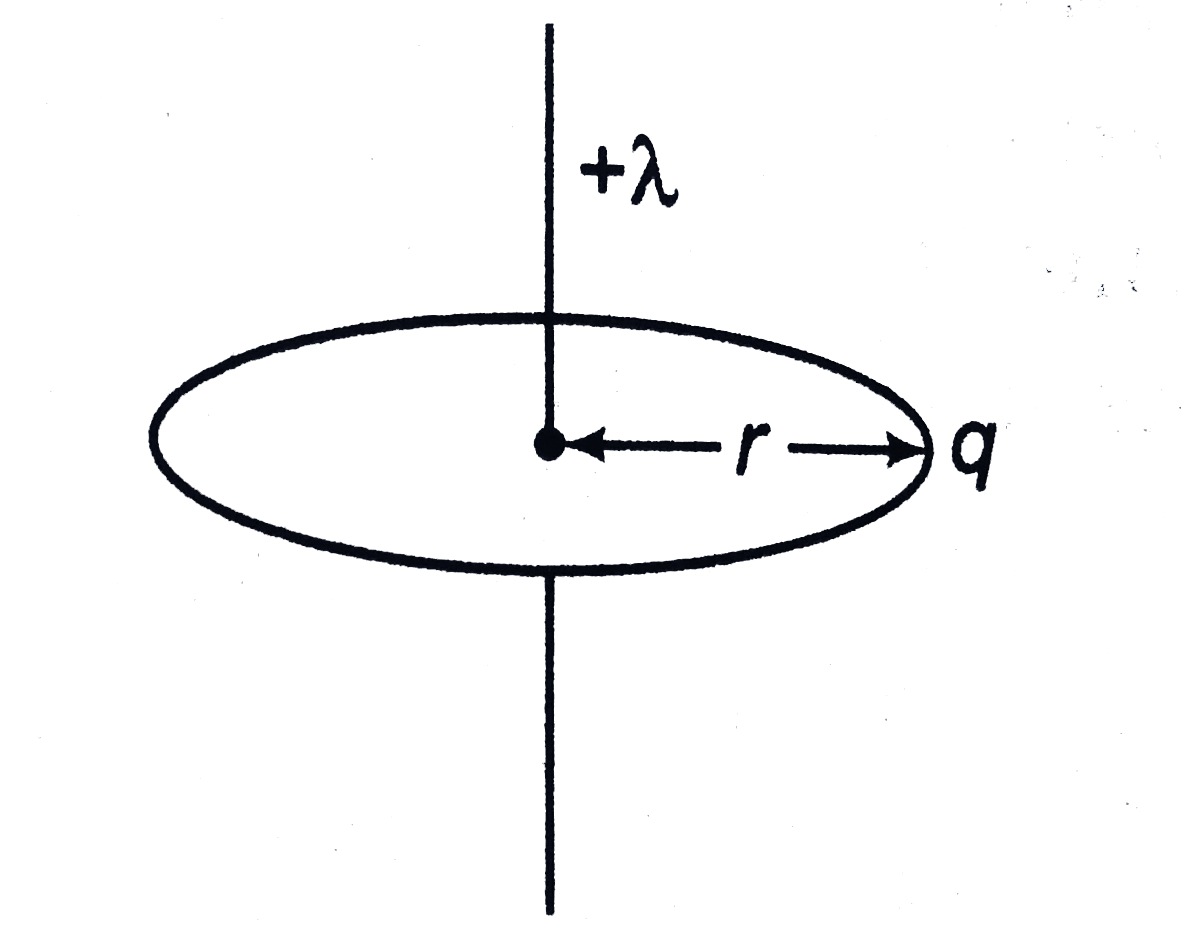
A particle of charge `-q` and mass m moves in a circle of radius r around an infinitely long line charge of linear charge density `+lamda`. Then, time period will be
where , `k=1/4piepsilon_0)`

A

`T=2pir sqrt(m/(2k lambdaq))`

B

`T^(2)=(4pi^(2) m)/(2k lambda q)`

C

`T=1/(2pir)sqrt((2klambdaq)/m)`

D

`T=1/(2pir) sqrt(m/(2k lambdaq))`

Text Solution

Verified by Experts

The correct Answer is:

A

We have centripetal force equation
`q=((2klambda)/r)=(mv^(2))/r`
So, `v=sqrt((2kq lambda)/m)` Now, `T=(2pir)/v=2pirsqrt(m/(2klambdaq))`
where, `k=1/(4piepsilon_(0))`
Promotional Banner

Topper's Solved these Questions

  • ELECTROMAGNETIC INDUCTION

    RESONANCE ENGLISH|Exercise Exercise|43 Videos
  • FLUID MECHANICS

    RESONANCE ENGLISH|Exercise Advanced Level Problems|8 Videos

Similar Questions

Explore conceptually related problems

The electric field at distance .r. from infinte line of charge ("having linear charge density" lambda) is

A particle of charge 'q' and mass 'm' move in a circular orbit of radius 'r' with frequency 'v' the ratio of the magnetic moment to angular momentum is:

Intensity of electric field at a point at a perpendicular distance .r. from an infinite line charge, having linear charge density .lambda. is given by :

A charged particle q of mass m is in wquilibrium at a height h from a horizontal infinite line charge wit uniform linear charge density lambda . The charge lies in the vertical plane containing the line charge. If the particle is displaced slightly (vertically) prove that the motion of the charged particle will be simple harmonic. Also find its time period.

A charge particle q is released at a distance R_(@) from the infinite long wire of linear charge density lambda . Then velocity will be proportional to (At distance R from the wire)

A particle of charge -q and mass m moves in a circular orbit about a fixed charge +Q. Show that the r^(3) alpha T^(2) law, is satisfied, where r is the radius of orbit and T is time period.

Consider an infinite line charge having uniform linear charge density and passing through the axis of a cylinder is removed.

A charged particle (charge q ) is moving in a circle of radius R with unifrom speed v . The associated magnetic moment mu is given by

For an infinite line of charge having linear charge density lambda lying along x-axis the work done in moving a charge q form C to A along CA is

Intensity of electric field at a perpendicular distance of 0.5 m from an infinitely long line charge having linear charge density (lamda) is 3.6 xx 10^(3) Vm^(-1) . Find the value of lamda

RESONANCE ENGLISH-ELECTROSTATICS-Exercise
  1. Figure, shown above, shows three situations involving a charged partic...

    Text Solution

    |

  2. There are three concentric thin spheres of radius a,b,c (agtbgtc). The...

    Text Solution

    |

  3. A particle of charge -q and mass m moves in a circle of radius r aroun...

    Text Solution

    |

  4. The figure shown represents the electric field between two large metal...

    Text Solution

    |

  5. The variation of electric field on the y-axis as a function of 'y' is ...

    Text Solution

    |

  6. A ring carries a uniform linear charge density on one half and the lin...

    Text Solution

    |

  7. Two very large thin conducting plates having same cross sectional are...

    Text Solution

    |

  8. Two semicircular rings lying in same plane, of uniform linear charge d...

    Text Solution

    |

  9. A nonuniformly charged ring is kept near an uncharged conducting solid...

    Text Solution

    |

  10. A mercury drop of water has potential 'V' on its surface. 1000 such dr...

    Text Solution

    |

  11. A point charge of 5C is placed at point P (as shown in figure). A unit...

    Text Solution

    |

  12. An electron is revolving around a proton. The total work done in one r...

    Text Solution

    |

  13. Three equal charges Q are placed at the three vertices of an equilater...

    Text Solution

    |

  14. Total electric force on an electric dipole placed in an electric field...

    Text Solution

    |

  15. Electric potential due to a dipole at a position vec r from its centre...

    Text Solution

    |

  16. The magnitude of electric field intensity at point B (2 , 0, 0) due to...

    Text Solution

    |

  17. Consider the four field patterns shown. Assuming there are no charges ...

    Text Solution

    |

  18. If the net electric field flux passing through a closed surface is zer...

    Text Solution

    |

  19. Eight point charges (can be assumed as small spheres uniformly charged...

    Text Solution

    |

  20. Figure above shows a closed Gaussian surface in the shape of a cube of...

    Text Solution

    |
