Home
Class 11
PHYSICS
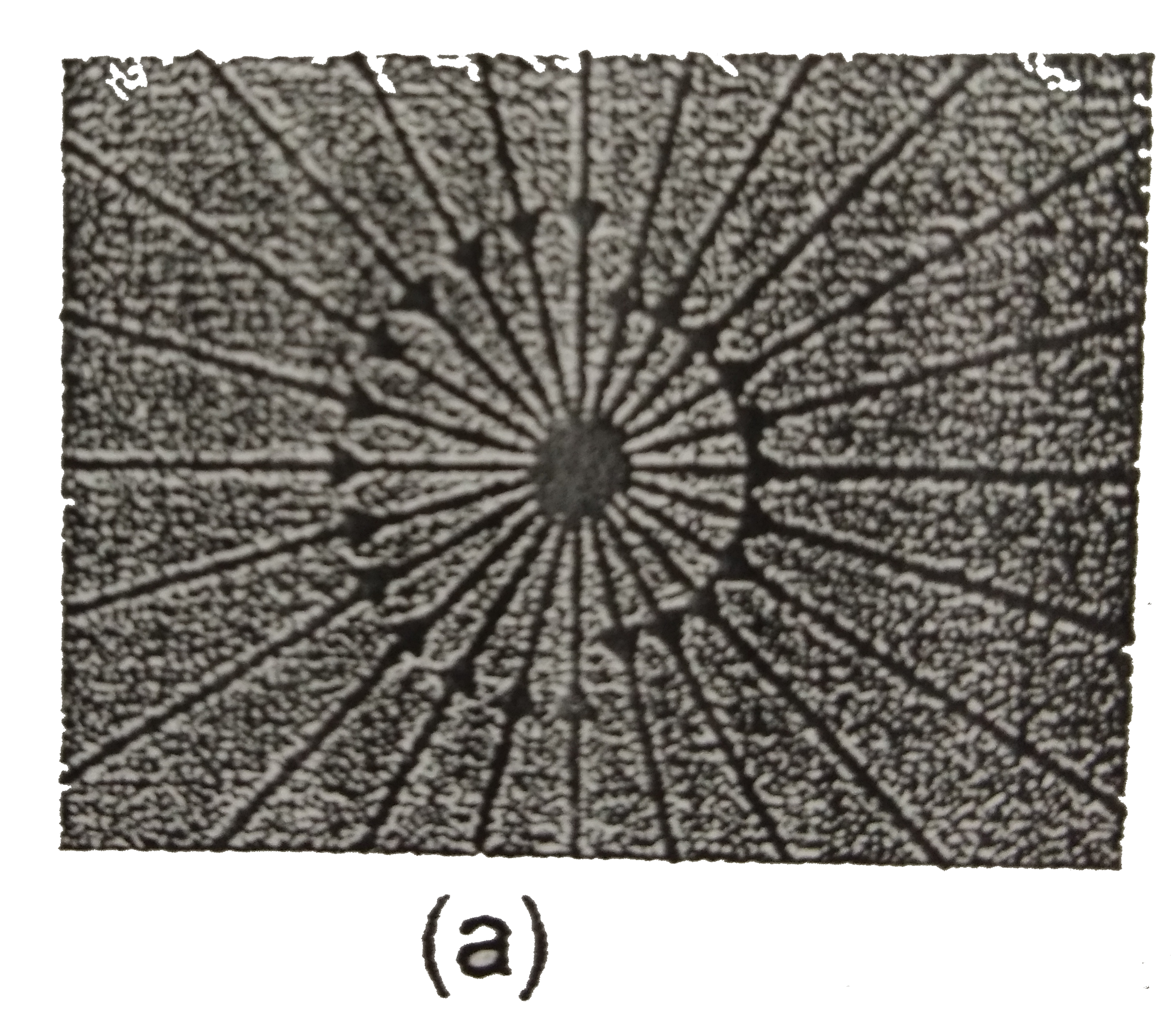
Consider the four field patterns shown. ...

Consider the four field patterns shown. Assuming there are no charges in the regions shown, which of the patterns represents a possible electrostatic field:

A

a

B

b

C

c

D

d

Text Solution

Verified by Experts

The correct Answer is:

B

B.Pattern (a) can be eliminated because filed lines cannot simultaneously orignate from and converge at a single point (c) can be eliminated because there are so charges in the region, and so there are no sources of field lines. (d) can be eliminated because electrostatic field lines do not close on themselves.
Promotional Banner

Topper's Solved these Questions

  • ELECTROMAGNETIC INDUCTION

    RESONANCE ENGLISH|Exercise Exercise|43 Videos
  • FLUID MECHANICS

    RESONANCE ENGLISH|Exercise Advanced Level Problems|8 Videos

Similar Questions

Explore conceptually related problems

Consider the four field patterns shown. Assuming there are no charge in the regions shown, which of the patterns represent a possible electrostatic field?

Consider the four field patterns shown. Assuming there are no charge in the regions shown, which of the patterns represent a possible electrostatic field?

Which of the following curves shown below cannot possibly represent electrostatic field lines?

Which of the following curves represent electrostatic field lines correctly?

Which of the following field lines pattern could represent a magnetic field?

What is the example of inheritacne pattern shown

Consider the uniform magnetic field shown: Starting from point P and without leaving the region of magnetic field, is it possible to choose a closed path (that is, a path that returns to P) for which the line integral of the magnetic field is nonzero?

shown a network of four resistance and three batteries Which of the batteries is getting charged.

Which of these is/are representing electrostatic field? ( x and y are space coordinates)

Which expression represents the pattern in the table ?

RESONANCE ENGLISH-ELECTROSTATICS-Exercise
  1. Electric potential due to a dipole at a position vec r from its centre...

    Text Solution

    |

  2. The magnitude of electric field intensity at point B (2 , 0, 0) due to...

    Text Solution

    |

  3. Consider the four field patterns shown. Assuming there are no charges ...

    Text Solution

    |

  4. If the net electric field flux passing through a closed surface is zer...

    Text Solution

    |

  5. Eight point charges (can be assumed as small spheres uniformly charged...

    Text Solution

    |

  6. Figure above shows a closed Gaussian surface in the shape of a cube of...

    Text Solution

    |

  7. Electrical potential V in space as a function of co-ordinates is given...

    Text Solution

    |

  8. S1: In a metallic body total number of electrons is very large in comp...

    Text Solution

    |

  9. S1: When a positively charged particle is released in an electric fiel...

    Text Solution

    |

  10. A point charge q is located at the centre fo a thin ring of radius R ...

    Text Solution

    |

  11. Two small balls having equal positive charge Q (coulumb) on each suspe...

    Text Solution

    |

  12. A point charge q moves from point P to pont S along the path PQRS (fig...

    Text Solution

    |

  13. A large nonconducting sheet M is given a uniform charge density. Two u...

    Text Solution

    |

  14. At a distance of 5cm and 10 cm from surface of a uniformly charge soli...

    Text Solution

    |

  15. An electric dipole is kept in the electric field produced by a point c...

    Text Solution

    |

  16. The electric potential decreases uniformly from 180V to 20V as one mov...

    Text Solution

    |

  17. Two positive point charges each of magnitude 10 C are fixed at positio...

    Text Solution

    |

  18. A square loop of side 'l' having uniform linear charge density 'lambda...

    Text Solution

    |

  19. In the following figure an isolated charged conductor is shown. The co...

    Text Solution

    |

  20. If the above question, the potential has correct relations as given= ...

    Text Solution

    |
