Home
Class 11
PHYSICS
Two positive point charges each of magni...

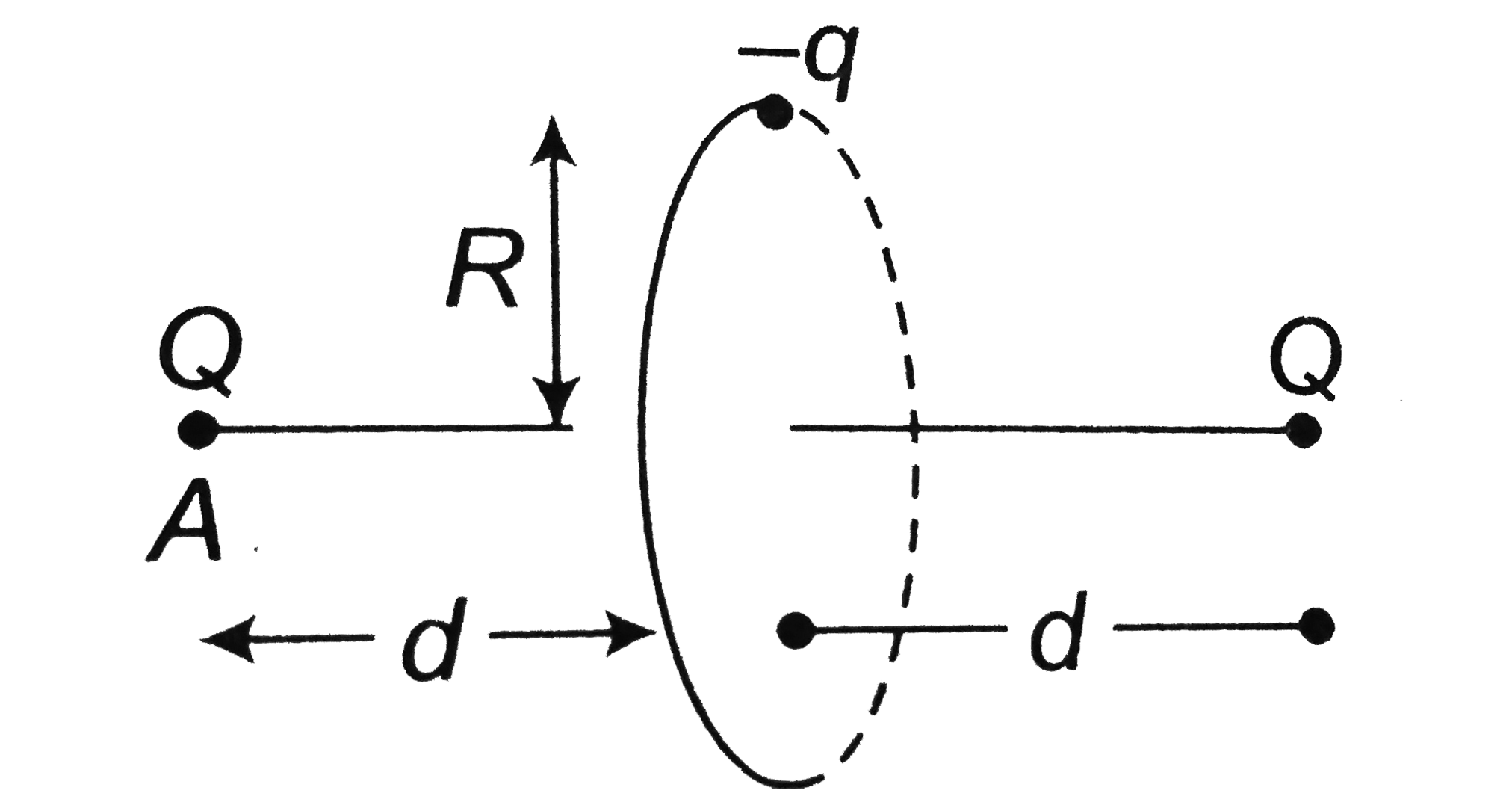
Two positive point charges each of magnitude `10 C` are fixed at positions `A` &`B` at a seperation `2d= 6m`. A negatively charged particle of mass `m= 90gm` and charge of magnitude `10xx10^(-6)C` is revolving in a circular path of radius `4m` in the plane perpendicular to the line `AB` and bisecting the line `AB`. Neglect the effect of gravity. Find the angular velocity of the particle

A

100

B

200

C

300

D

400

Text Solution

Verified by Experts

The correct Answer is:
D

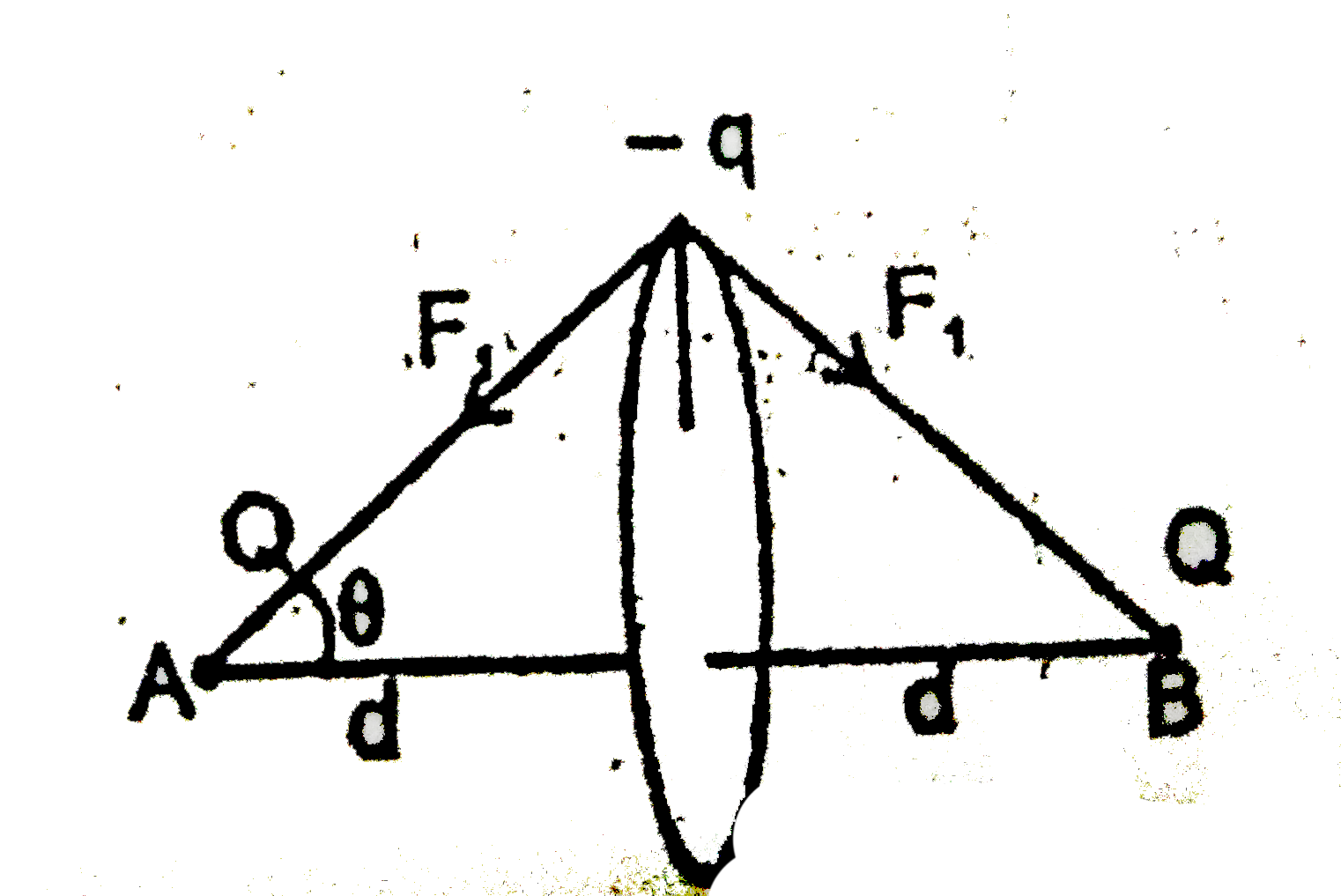
Net force on -q towards the centre.
`F=(2F_(1).sin theta)=2.(KQq)/(d^(2)+d^(2))xxR/(sqrt(d^(2)+d^(2)))`
For particle to move in circle
`F=m omega^(2)R`
`rArr (2KQ qR)/((d^(2)+R^(2))^(3//2))=m omega^(2)R`
`rArr W=sqrt((2KQq)/(m(d^(2)+R^(2))^(3//2)))`
`= sqrt((2xx9xx10^(9)xx10xx10xx10^(-6))/(90xx10^(-3)xx(3^(2)+4^(2))^(3//2))) rad//s` =400 rad/s , no
Promotional Banner

Topper's Solved these Questions

  • ELECTROMAGNETIC INDUCTION

    RESONANCE ENGLISH|Exercise Exercise|43 Videos
  • FLUID MECHANICS

    RESONANCE ENGLISH|Exercise Advanced Level Problems|8 Videos

Similar Questions

Explore conceptually related problems

A particle of mass m carrying charge '+q_(1)' is revolving around a fixed charge '-q_(2)' in a circular path of radius r. Calculate the period of revolution.

A particle of mass m carrying a charge -q_(1) starts moving around a fixed charge +q_(2) along a circulare path of radius r. Find the time period of revolution T of charge -q_(1) .

A water particle of mass 10.0 mg and having a charge of 1.50 xx 10^(-6)C stays suspended in a room. What is the magnitude of electric field in the room ? What is its direction?

A positive charge .Q. is fixed at a point, A negatively charged of mass .m. and charge .q. is revolving in a circular path of radius radius r_(1) with .Q. as the centre. The change in potential energy to change the radius of the circular path from r_(1) and r_(2) in joule is

Consider two positive point charges, each of magnitude q, placed on the y-axis at the points (0, a) and (0, -a). A positively charged particle of charge q' and mass m is displaced slightly from the origin in the direction of the positive x-axis. Speed of charge q' at infinity is

Consider two positive point charges, each of magnitude q, placed on the y-axis at the points (0, a) and (0, -a). A positively charged particle of charge q' and mass m is displaced slightly from the origin in the direction of the positive x-axis. At the origin, charge q' will be in

Two infinitely long line charges having charge density lamda each are parallel to each other and separated by distance d. A charge particle of mass m and charge q is placed at mid point between them. This charge displaced slightly along a line AB which is perpendicular to the line charges and in the plane of the charges. prove that the motion of the particle will be SHM for small displacement and lamda q gt 0 Neglect gravity. Find the time period.

Two identical charges, 5 muC each are fixed at a distance 8 cm and a charged particle of mass 9 xx 10^(-6) kg and charge -10 muC is placed at a distance 5 cm from each of them and is released. Find the speed of the particle when it is nearest to the two charges.

Two positively charge particles each of mass 1.7 xx 10^(-27) kg and carrying a charge of 1.6 xx 10^(-19)C are placed r distance apart. If each one experience a repulsive force equal to its weight. Find the distance between them

A particle of mass m having a charge q enters into a circular region of radius R with velocity v directed towards the centre. The strength of magnetic field is B . Find the deviation in the path of the particle.

RESONANCE ENGLISH-ELECTROSTATICS-Exercise
  1. S1: When a positively charged particle is released in an electric fiel...

    Text Solution

    |

  2. A point charge q is located at the centre fo a thin ring of radius R ...

    Text Solution

    |

  3. Two small balls having equal positive charge Q (coulumb) on each suspe...

    Text Solution

    |

  4. A point charge q moves from point P to pont S along the path PQRS (fig...

    Text Solution

    |

  5. A large nonconducting sheet M is given a uniform charge density. Two u...

    Text Solution

    |

  6. At a distance of 5cm and 10 cm from surface of a uniformly charge soli...

    Text Solution

    |

  7. An electric dipole is kept in the electric field produced by a point c...

    Text Solution

    |

  8. The electric potential decreases uniformly from 180V to 20V as one mov...

    Text Solution

    |

  9. Two positive point charges each of magnitude 10 C are fixed at positio...

    Text Solution

    |

  10. A square loop of side 'l' having uniform linear charge density 'lambda...

    Text Solution

    |

  11. In the following figure an isolated charged conductor is shown. The co...

    Text Solution

    |

  12. If the above question, the potential has correct relations as given= ...

    Text Solution

    |

  13. In the above question, the surface charge densities have the correct r...

    Text Solution

    |

  14. A family of equipotential surface are shown. The direction of the elec...

    Text Solution

    |

  15. A and B are two concentric spherical shells. If A is given a charge +q...

    Text Solution

    |

  16. Mark the wrong statement-

    Text Solution

    |

  17. A hollow conducting sphere is placed in an electric field produced by ...

    Text Solution

    |

  18. A point charge is kept at the centre of a metallic insulated spherical...

    Text Solution

    |

  19. STATEMENT 1: When a negative charge -q is released at a distance R fro...

    Text Solution

    |

  20. Assertion: A positively charged rod is held near a neutral conducting ...

    Text Solution

    |

