Home
Class 11
PHYSICS
A wall has two layers A and B, each made...

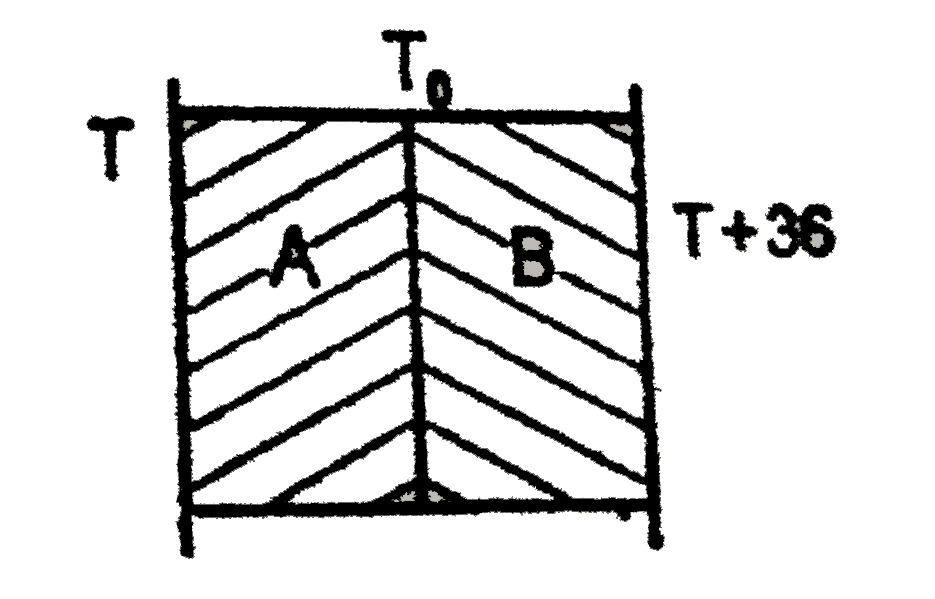
A wall has two layers A and B, each made od=f different material. Both the layers have the same thickness. The thermal conductivity for A is twice that B and, under steady condition, the temperature difference across the wall is `36^(@)`C. The temperature difference across the layer A is

A

`6^(@)C`

B

`9^(@)C`

C

`18^(@)C`

D

`27^(@)C`

Text Solution

Verified by Experts

The correct Answer is:
B

The two are in series.
`K_(A)=3K_(B)`
i.e., thermal resistance of A (say `R_(A)`) is one third that of B (say `R_(8)`)
i.e., `R_(B)=3R_(A)`
`:.` Thermal current =`36/(4R_(A))=9/(R_(A))`
`:.` Temperature difference across 'A' `=(9/(R_(A))).R_(A)=9^(@)C`
Promotional Banner

Topper's Solved these Questions

  • HEAT TRANSFER

    RESONANCE ENGLISH|Exercise Exercise-2|1 Videos
  • HEAT TRANSFER

    RESONANCE ENGLISH|Exercise Exercise-3|1 Videos
  • HEAT TRANSFER

    RESONANCE ENGLISH|Exercise Exercise-1|1 Videos
  • GRAVITATION

    RESONANCE ENGLISH|Exercise Exercise|21 Videos
  • KINEMATICS

    RESONANCE ENGLISH|Exercise Exercise|65 Videos

Similar Questions

Explore conceptually related problems

A wall has two layers A and B, each made of different material. Both the layers have the same thickness. The thermal conductivity of the material of A is twice that of B . Under thermal equilibrium, the temperature difference across the wall is 36^@C. The temperature difference across the layer A is

A wall has two layers A and B, each made of different material. Both the layers have the same thickness. The thermal conductivity of the material of A is twice that of B . Under thermal equilibrium, the temperature difference across the wall is 36^@C. The temperature difference across the layer A is

A wall has two layers A and B, each made of different materials. Both the layers have the same thickness. The thermal conductivity of the material of A is twice that of B. Under thermal equilibrium , the temperature differeence across the wall is 36^(@)C . The temperature difference across the layer A is

A wall has two layers X and Y each made of different materials. Both layers have same thickness. Thermal conductivity of X is twice that of Y. At steady state the temperature difference of opposite faces of wall is 54°C . The temperature difference across Y layer is

A wall has two layers A and B each made of different materials. The layer A is 10cm thick and B is 20 cm thick. The thermal conductivity of A is thrice that of B. Under thermal equilibrium temperature difference across the wall is 35^@C . The difference of temperature across the layer A is

A partition wall has two layers of different materials A and B in contact with each other. They have the same thickness but the thermal conductivity of layer A is twice that of layer B. At steady state the temperature difference across the layer B is 50 K, then the corresponding difference across the layer A is

Two rods A and B of different materials are welded together as shown in figure. Their thermal conductivities are K_(1) and K_(2) . The thermal conductivity of the composite rod will be

A slab consists of two layers of different materials of the same thickness and having thermal conductivities K_(1) and K_(2) . The equivalent thermal conductivity of the slab is

A wall has two layers A and B made of two different materials thermal conductivities K_A and K_B ( K_A = 3K_B ). The thickness of both the layers is same. The temperature across the wall is 20^@C in thermal equilibrium. Then

Two slabs A and B of different materials but of the same thicknesss are joined end to end to form a composite slab. The thermal conductivities of A and B are K_(1) and K_(2) respectively. A steady temperature difference of 12^(@) C is maintained across the composite slab. If K_(1) = K_(2)/2 , the temperature difference across slabs A is

RESONANCE ENGLISH-HEAT TRANSFER-Exercise
  1. The two ends of a rod of length L and a uniform cross -secontional are...

    Text Solution

    |

  2. A cylindrical rod having temperature T1 and T2 at its end. The rate of...

    Text Solution

    |

  3. A wall has two layers A and B, each made od=f different material. Both...

    Text Solution

    |

  4. All the rods have same conductance K and same area of cross section A....

    Text Solution

    |

  5. Consider two rods of same length and different specific heats (S1, S2)...

    Text Solution

    |

  6. Two plates each of area A, thickness L1 and L2 thermal conductivities ...

    Text Solution

    |

  7. Consider a composite slab consisting of two different materials having...

    Text Solution

    |

  8. A square is made of four rods of same material one of the diagonal of ...

    Text Solution

    |

  9. If the temperature difference on the two sides of a wall increases fro...

    Text Solution

    |

  10. The colour of a star indicates its

    Text Solution

    |

  11. The means of energy transfer in vacuum is:

    Text Solution

    |

  12. Which of the following is nearest to blackbody-

    Text Solution

    |

  13. Which of the following is true statement?

    Text Solution

    |

  14. For a black body at temperature 727^(@)C. If the temperature of the bl...

    Text Solution

    |

  15. According to Wien's law

    Text Solution

    |

  16. If lambda(m) denotes the wavelength at which the radiative emission fr...

    Text Solution

    |

  17. A black body at 1227^(@)C emits radiations with maximum intensity at a...

    Text Solution

    |

  18. The energy radiated by a black body is directly proportional to :

    Text Solution

    |

  19. If temperature becomes double, the emitted radiation will be :

    Text Solution

    |

  20. Prevost's theory of heat exchange tells that a body radiates thermal e...

    Text Solution

    |

