Home
Class 11
PHYSICS
Two circular disc A and B with equal rad...

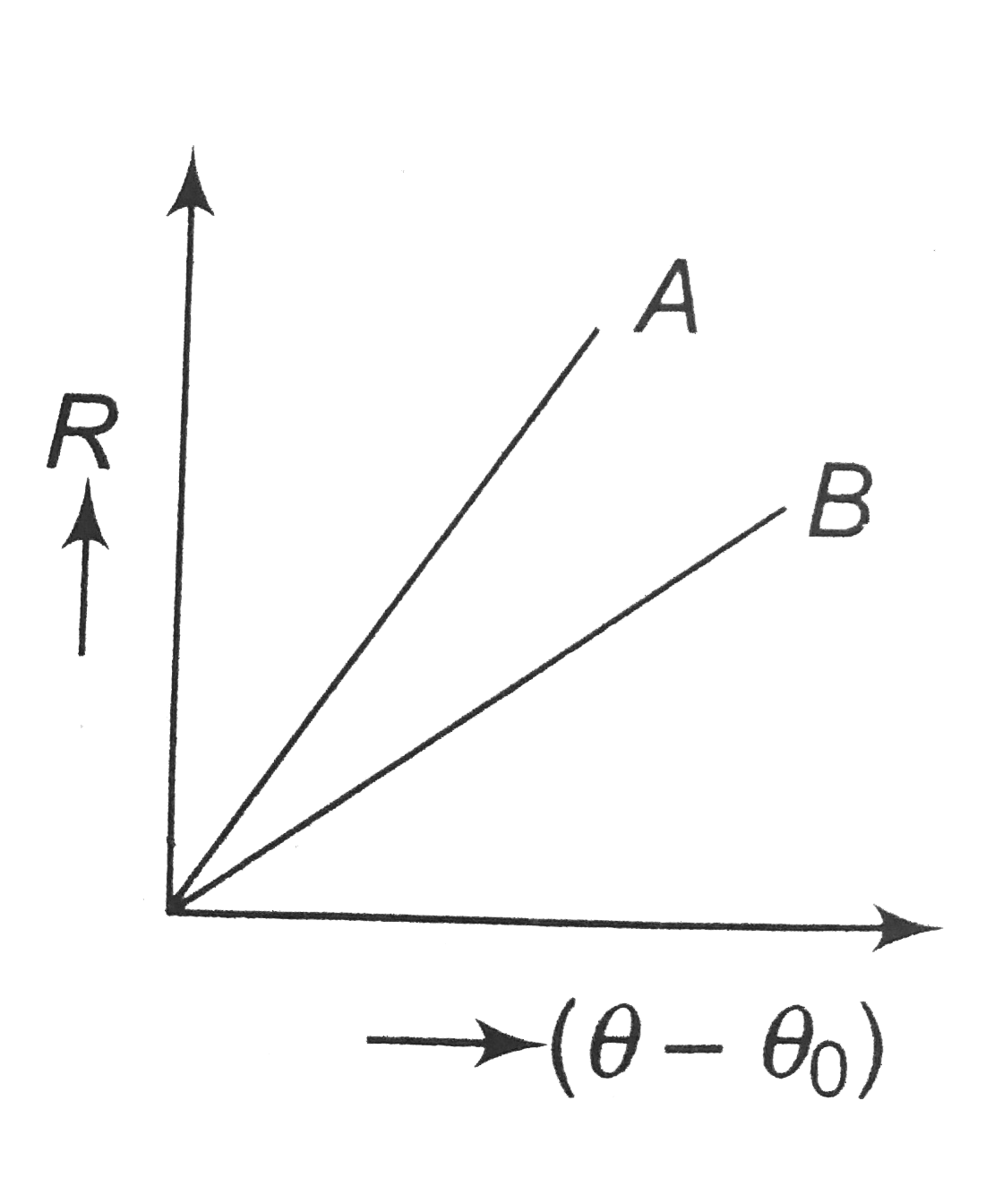
Two circular disc `A` and `B` with equal radii are blackened. They are heated to same temperature and are cooled under identical conditions. What inference do your draw from their cooling curves?

A

A and B have same specific heats

B

specific heat of A is less

C

Specific heat of B is less

D

Nothing can be said

Text Solution

Verified by Experts

The correct Answer is:

B

According to Newton's law of cooling rate of cooling is given by `((-dT)/(dt))=(eA sigma)/(mc)(T^(4)-T_(0)^(4))`
Where C is specific heat of material or `((-dT)/(dt)) prop 1/c`
i.e., rate of cooling varies inversely as specific heat, from the graph, for A rate of cooling is larger. therefore, specific heat of A is smaller.
Promotional Banner

Topper's Solved these Questions

  • HEAT TRANSFER

    RESONANCE ENGLISH|Exercise Exercise-2|1 Videos
  • HEAT TRANSFER

    RESONANCE ENGLISH|Exercise Exercise-3|1 Videos
  • HEAT TRANSFER

    RESONANCE ENGLISH|Exercise Exercise-1|1 Videos
  • GRAVITATION

    RESONANCE ENGLISH|Exercise Exercise|21 Videos
  • KINEMATICS

    RESONANCE ENGLISH|Exercise Exercise|65 Videos

Similar Questions

Explore conceptually related problems

Two solid spheres of radii R_(1) and R_(2) are made of the same material and have similar surfaces. These are raised to the same temperature and then allowed to cool under identical conditions. The ratio of their initial rates of loss of heat are

A cube and a sphere of equal edge and radius, made of the same substance are allowed to cool under identical conditions. Determine which of the two will cool at a faster rate.

A cube, sphere and a cylinder made of same material shown in figure are allowed to cool under identical conditions. Determine which of these will cool at a faster rate? .

Statement-1: There are two spheres made of same amount of material, one of them is hollow and other is solid. They are heated to same temperature and left in identical surroundigs. The initial rate of cooling will be greater for hollow sphere. Statement-2: The rate of heat loss depends on surface area and temperature.

A solid aluminium sphere and a solid copper sphere of twice the radius are heated to the same temperature and are allowed to cool under identical surrounding temperatures. Assume that the emisssivity of both the spheres is the same. Find ratio of (a) the rate of heat loss from the aluminium sphere to the rate of heat loss from the copper sphere and (b) the rate of fall of temperature of the aluminium sphere to the rate of fall of temperature of copper sphere. The specific heat capacity of aluminium =900Jkg^(-1)C^(-1) . and that of copper =390Jkg^(-1)C^(-1) . The density of copper =3.4 times the density of aluminium.

Two unifrom brass rod A and B of length l and 2l and radii 2r respectively are heated to the same temperature. The ratio of the increase in the volume of A to that of B is

If two circular discs A and B are of same mass but of radii r and 2r respectively, then the moment of inertia of A is

Two balls of same material and same surface finish have their diameters in the ratio 1:2. They are heated to the same temperature and are left in a room to cool by radiation, then the initial rate of loss of heat

Two rods A and B are of equal length. Each rod has its ends at temperatures T_1 and T_2 . What is the condition that will ensure equal rate of flow of heat through the rods A and B ?

Two bodies of equal masses are heated at a uniform rate under identical conditions. The change in temperature in the two cases in shown graphically. What are their melting points? Find the ratio of their specific heats and latent heats.

RESONANCE ENGLISH-HEAT TRANSFER-Exercise
  1. Two plates each of area A, thickness L1 and L2 thermal conductivities ...

    Text Solution

    |

  2. Consider a composite slab consisting of two different materials having...

    Text Solution

    |

  3. A square is made of four rods of same material one of the diagonal of ...

    Text Solution

    |

  4. If the temperature difference on the two sides of a wall increases fro...

    Text Solution

    |

  5. The colour of a star indicates its

    Text Solution

    |

  6. The means of energy transfer in vacuum is:

    Text Solution

    |

  7. Which of the following is nearest to blackbody-

    Text Solution

    |

  8. Which of the following is true statement?

    Text Solution

    |

  9. For a black body at temperature 727^(@)C. If the temperature of the bl...

    Text Solution

    |

  10. According to Wien's law

    Text Solution

    |

  11. If lambda(m) denotes the wavelength at which the radiative emission fr...

    Text Solution

    |

  12. A black body at 1227^(@)C emits radiations with maximum intensity at a...

    Text Solution

    |

  13. The energy radiated by a black body is directly proportional to :

    Text Solution

    |

  14. If temperature becomes double, the emitted radiation will be :

    Text Solution

    |

  15. Prevost's theory of heat exchange tells that a body radiates thermal e...

    Text Solution

    |

  16. Reflection and absorption coefficient of a given surface at 0^@C for a...

    Text Solution

    |

  17. A black metal foil is warmed by radiation from a small sphere at tempe...

    Text Solution

    |

  18. A body takes 10 min to cool douwn from 62^@C to 50^@C. If the temperat...

    Text Solution

    |

  19. Two circular disc A and B with equal radii are blackened. They are hea...

    Text Solution

    |

  20. According to Newton’s law of cooling, the rate of cooling of a body is...

    Text Solution

    |
