Home
Class 11
PHYSICS
In the photoelectric experiment, if we u...

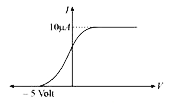
In the photoelectric experiment, if we use a monochromatic light, the I – V curve is as shown. If work function of the metal is 2 eV, estimate the power of light used. (Assume efficiency of photo emission `=10^(-3)` i.e. number of photoelectrons emitted are `10^(-3)` times of number of photons incident on metal).

A

2W

B

5W

C

7W

D

10 W

Text Solution

Verified by Experts

The correct Answer is:

C

The energy of incident photons is given by
`hv=eV_(s)+phi_(0)=2+5=7 eV` (`V_(s)` is stopping potential and `phi_(0)` is work function)
Saturation current `=10^(-5) A =(etaP)/(hv)e=(10^(-5)P)/(7xxe) e` (`eta` is photo emission efficiency)
`:.P=7 W`
Promotional Banner

Topper's Solved these Questions

  • ALTERNATING CURRENT

    RESONANCE ENGLISH|Exercise Exercise|19 Videos
  • CALORIMETRY

    RESONANCE ENGLISH|Exercise Exercise|19 Videos

Similar Questions

Explore conceptually related problems

A photon of wavelength 4 xx 10^(-7) m strikes on metal surface , the work function of the metal being 2. 13 eV Calculate : (i) the energy of the photon (ev) (ii) the kinetic energy fo the emission and the velocity of the photoelectron ( 1 eV = 1 , 6020 xx 10^(-19) J) ,

In a photoelectric experiment a parallel beam of monochromatic light with power of 200W is incident on a perfectly absorbing cathode of work function 6.25. The frequency of light is just above the threshold frequency so that the photoelectrons are emitted with negligible kinetic energy. Assume that the photoelectron emission efficiency is 100%. A potential difference of 500V is applied between the cathode and the anode. All the emitted electrons are incident normally on the anode and are absorbed. The anode experiences a force n xx 10^(-4) N due to the impact of the electrons. The value of n is __________. Mass of the electron 9.1 xx 10^(-31) Kg and charge is 1.6 xx 10^(-19) C

A photon of wavelength 4xx10^(-7)m strikes on metal surface, the work function of the metal being 2.13 eV. Calculate (1) the energy of the photon (eV). (2) The kinetic energy of the emission.

A photon of wavelenth 3000 A strikes a metal surface, the work function of the metal being 2.20eV . Calculate (i) the energy of the photon in eV(ii) the kinetic energy of the emitted photo electron and (iii) the velocity of the photo electron.

A photon of wavelength 4 xx 10^(-7)m strikes on metal surface, The work function of the metal is 2.13eV . The velocity of the photo electron is

A monochromatic light of wavelength lambda is incident on an isolated metallic sphere of radius a. The threshold wavelength is lambda_0 which is larger than lambda . Find the number of photoelectrons emitted before the emission of photoelectrons will stop.

Work function of a metal is 3.0 eV. It is illuminated by a light of wavelength 3 xx 10^(-7) m. Calculate the maximum energy of the electron.

A light of intensity 16 mW and energy of each photon 10 eV incident on a metal plate of work function 5 eV and area 10^(-4)m^(2) then find the maximum kinetic energy of emitted electrons and the number of photoelectrons emitted per second if photon efficiency is 10% .

Two metallic plate A and B , each of area 5 xx 10^(-4)m^(2) , are placed parallel to each at a separation of 1 cm plate B carries a positive charge of 33.7 xx 10^(-12) C A monocharonatic beam of light , with photoes of energy 5 eV each , starts falling on plate A at t = 0 so that 10^(16) photons fall on it per square meter per second. Assume that one photoelectron is emitted for every 10^(6) incident photons fall on it per square meter per second. Also assume that all the emitted photoelectrons are collected by plate B and the work function of plate A remain constant at the value 2 eV Determine (a) the number of photoelectrons emitted up to i = 10s, (b) the magnitude of the electron field between the plate A and B at i = 10 s, and (c ) the kinetic energy of the most energotic photoelectrons emitted at i = 10 s whenit reaches plate B Negilect the time taken by the photoelectrons to reach plate B Take epsilon_(0) = 8.85 xx 10^(-12)C^(2)N- m^(2)

Calculate the velocity of a photo-electron if the work function of the target material is 1.24eV and the wavelength of incident light is 4.36xx10^(-7) m. What retarding potential is necessary to stop the emission of the electrons?

RESONANCE ENGLISH-ATOMIC PHYSICS-Exercise
  1. In the figure six lines of emission spectrum are shown. Which of them ...

    Text Solution

    |

  2. Consider atoms H, He^(+), Li^(++) in their ground states. If L(1), L(2...

    Text Solution

    |

  3. In the photoelectric experiment, if we use a monochromatic light, the ...

    Text Solution

    |

  4. A parallel beam of uniform, monochromatic light of wavelength 6600 Å h...

    Text Solution

    |

  5. Yellow light of 557 nm wavelength is incident on a cesium surface. It ...

    Text Solution

    |

  6. A point source causes photoelectric effect from a small metal plate. W...

    Text Solution

    |

  7. If n(r) and n(b) are respectively, the number of photons emitted by a ...

    Text Solution

    |

  8. When light of intensity 1W//m^2 and wavelength 5xx10^(-7)m is incident...

    Text Solution

    |

  9. Light of wavelength 5000Å falls on a sensitive plate with photoelectri...

    Text Solution

    |

  10. The photoelectric work function for a metal surface is 4.125eV. The cu...

    Text Solution

    |

  11. The wavelength of a photon and the deBroglie wavelength of an electron...

    Text Solution

    |

  12. A proton and an alpha-particle are accelerated through the same potent...

    Text Solution

    |

  13. Linear momenta of a proton and an electrons are euqal. Relative to an...

    Text Solution

    |

  14. Momentumof gamma - ray proton of energy 3 keV in kg-m/s will be

    Text Solution

    |

  15. Wrong statement in connection with Davisson-Germer experiment is

    Text Solution

    |

  16. The correct relation betweeen the angle of diffraction phi and the gla...

    Text Solution

    |

  17. Object are exposed to the X-rays in a dark room. They will appear

    Text Solution

    |

  18. The intensity of an X-ray beam reduces to 36.8% of its initial intensi...

    Text Solution

    |

  19. An X-ray tube operating at 50kV converts 1% energy in the form of X-ra...

    Text Solution

    |

  20. A beam of electron accelerated by a large potential difference V is ...

    Text Solution

    |
