Home
Class 11
PHYSICS
S(1) and S(2) are two coherent sources o...


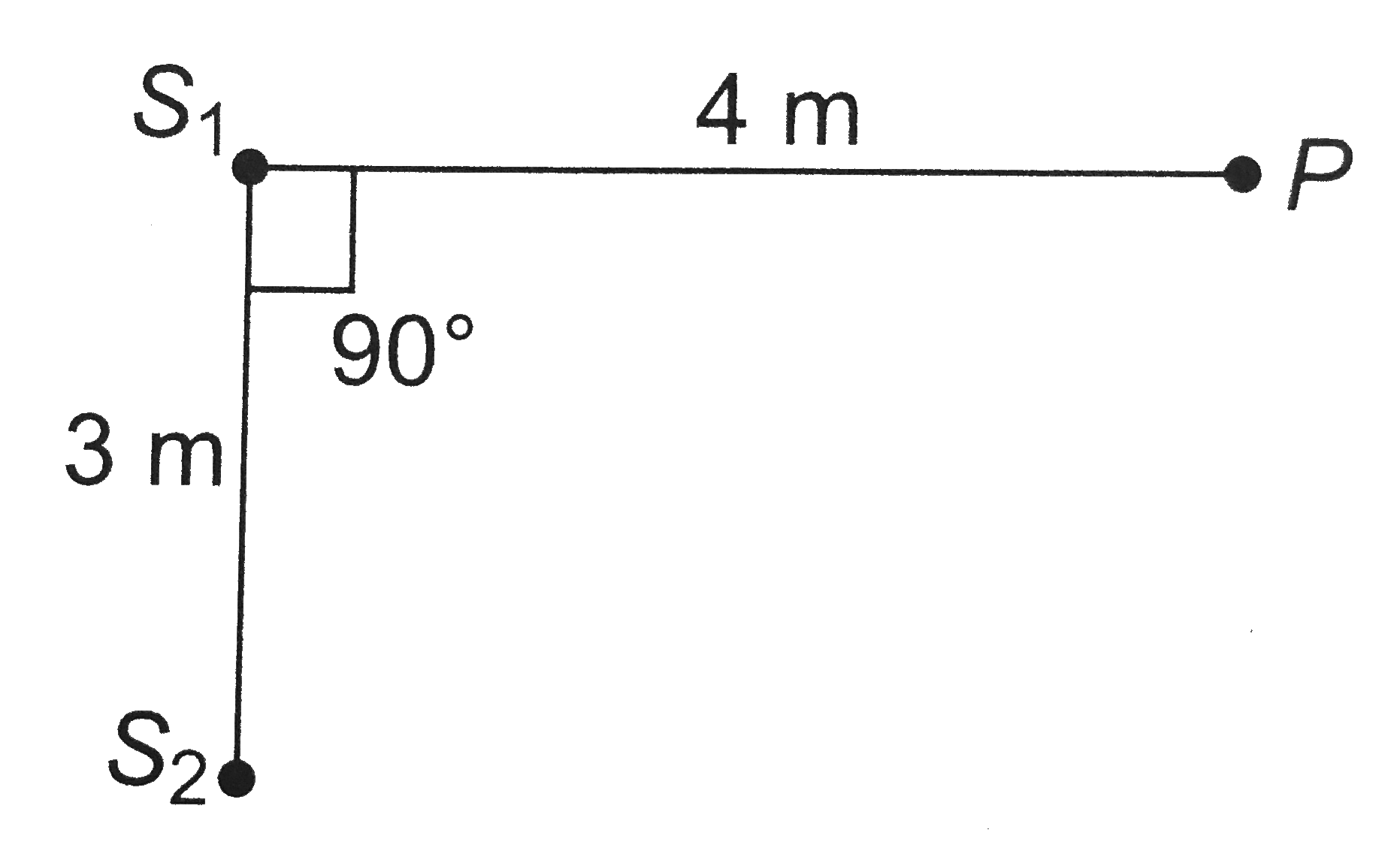
`S_(1)` and `S_(2)` are two coherent sources of sound of frequency `110Hz` each they have no initial phase difference. The intensity at a point P due to `S_(1)` is `I_0` and due to `S_2` is `4I_0`. If the velocity of sound is `330m//s` then the resultant intensity at P is

A

`I_(0)`

B

`9I_(0)`

C

`3I_(0)`

D

`8I_(0)`

Text Solution

Verified by Experts

The correct Answer is:

C

The wavelength of sound source `=330/110=3` meter.
The phase difference between interferring waves at P is
`=Deltaphi=(2pi)/(lambda) (S_(2)P-S_(1)P)=(2pi)/3 (5-4) =(2pi)/3`
`:.` Resultant intensity at `P=I_(0) +4I_(0) +2sqrt(I_(0)) sqrt(4I_(0)) cos .(2pi)/(3) =3I_(0)`
Promotional Banner

Topper's Solved these Questions

  • PART TEST 2

    RESONANCE ENGLISH|Exercise Exercise|30 Videos
  • PART TEST 4

    RESONANCE ENGLISH|Exercise Exercise|30 Videos

Similar Questions

Explore conceptually related problems

S_(1) and S_(2) are two coherent sources of sound having no intial phase difference. The velocity of sound is 330 m//s . No maximum will be formed on the line passing through S_(2) and prependicular to the line joining S_(1) and S_(2) . If the frequency of both the sources is

Consider an interference arrangement similar to YDSE. Slits S_(1) and S_(2) are illuminated with coherent microwave sources each of frequency 2 MHz The sources are synchronized to have zero phase difference. The slits are separated by distance d= 75m. The intensity I_((theta)) is measured as a function of theta where theta is defined as shown in figure. if I_(0) is maximum intensity then calculated I_((theta)) for (i) theta= 0^(@), (ii) theta=pi//6 and (iii) theta = pi//2

In the figure , the intensity of waves arriving at D from two coherent soucrces s_(1) and s_(2) is I_(0) . The wavelength of the wave is lambda = 4 m . Resultant intensity at D will be

In an interference arrangement similar to Young's double-slit experiment, the slits S_1 and S_2 are illuminated with coherent microwave sources, each of frequency 10^6 Hz. The sources are synchronized to have zero phase difference. The slits are separated by a distance d=150.0 m. The intensity I (theta) is measured as a function of theta, where theta is defined as shown. If I_0 is the maximum intensity, then I (theta) for 0lethetale90degree is given by

S_(1) and S_(2) are two coherent sources of frequency f each. (theta _(1)=theta_(2)=0^(@)) V_(sound)=330m//s. (i) so that constructive interfence at 'p' (ii) so that destructive interfrece at 'p'

S_(1) and S_(2) are two sources of sound emitting sine waves. The two sources are in phase. The sound emitted by the two sources interfers at point F . The waves of wavelength :

S_(1) and S_(2) are two equally intense coherent point second sources vibrating in phase. The resultant intensity at P_(1) is 80 SI units then resultant intensity at P_(2) in SI units will be

Two sources of sound S_(1) and S_(2) produce sound waves of same frequency 660 Hz . A listener is moving from source S_(1) towards S_(2) with a constant speed u m//s and he hears 10 beats/s. The velocity of sound is 330 m//s . Then, u equals :

Intensity due to line source S_(1) at a distance of r is I_(0) and intensity due to other line source S_(2) at a distance of r is 4I_(0) and frequency of both source are equal. If interference occurs at a point P as shown in the figure and wavelength of both sources is r , find the resultant intensity (in watt//m^(2) ) at P . (where I_(0)=2 "watt"//m^(2) )

Consider two coherent, monochromatic (wavelength lambda ) sources S_(1) and S_(2) , separated by a distance d. The ratio of intensities of S_(1) and that of S_(2) (which is responsible for interference at point P, where detector is located) is 4. The distance of point P from S_(1) is (if the resultant intensity at point P is equal to (9)/(4) times of intensity of S_(1) ) ("Given : "angleS_(2)S_(1)P=90^(@), d gt0 and n" is a positive integer")

RESONANCE ENGLISH-PART TEST 3-Exercise
  1. Figure shows a rectangular pulse and triangular pulse approaching towa...

    Text Solution

    |

  2. A stationary observer receives sonic oscillations from two tuning for...

    Text Solution

    |

  3. When two mutually perpendicular simple harmonic motions of same freque...

    Text Solution

    |

  4. When two waves of the same amplitude and frequency but having a phase ...

    Text Solution

    |

  5. A simple pendulum , a physical pendulum, a torsional pendulum and a sp...

    Text Solution

    |

  6. S(1) and S(2) are two coherent sources of sound of frequency 110Hz eac...

    Text Solution

    |

  7. A transverse wave of amplitude 5 mm and frequency 10Hz is produced on ...

    Text Solution

    |

  8. When a composite wire is made by joining tow wires as shown in figure ...

    Text Solution

    |

  9. When the net force F acting on the particle varies as its position al...

    Text Solution

    |

  10. The time period of a particle in simple harmonic motion is T. Assume p...

    Text Solution

    |

  11. m(1) & m(2)are connected with a light inextensible string with m(1) ly...

    Text Solution

    |

  12. A particle is subjected to two simple harmonic motions along x and y d...

    Text Solution

    |

  13. A wire of length 'l' having tension T and radius 'r' vibrates with fun...

    Text Solution

    |

  14. In a standing wave on a string.

    Text Solution

    |

  15. Which of the following statements is correct:

    Text Solution

    |

  16. The displacement time graph of a particle executing S.H.M. (in straigh...

    Text Solution

    |

  17. The length of the wire shown in figure between the pulley is 1.5 m and...

    Text Solution

    |

  18. A force of 6.4 N stretches a vertical spring by 0.1 m. The mass (in kg...

    Text Solution

    |

  19. Statement 1: A tuning fork of constant frequency sends sound waves in ...

    Text Solution

    |

  20. Statement 1: Sound waves can not propagate through vacuum but light wa...

    Text Solution

    |
