Home
Class 11
PHYSICS
When the net force F acting on the part...

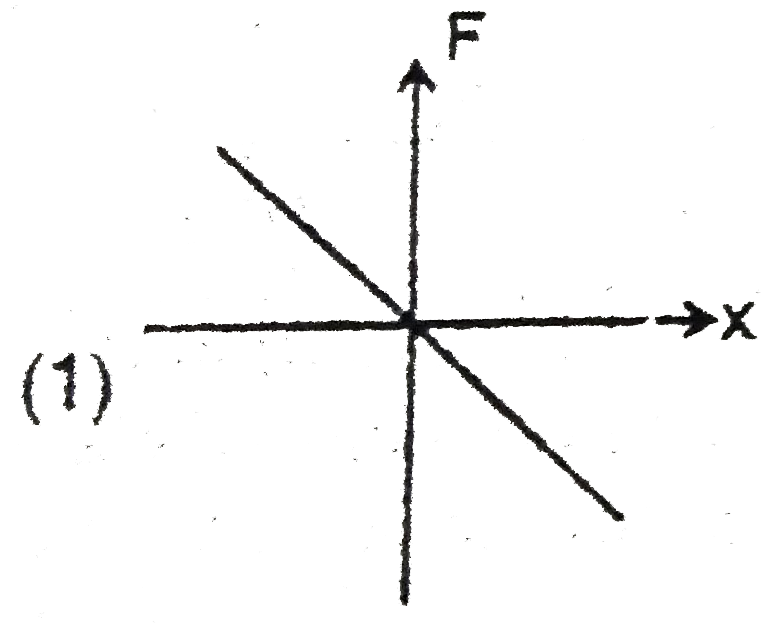
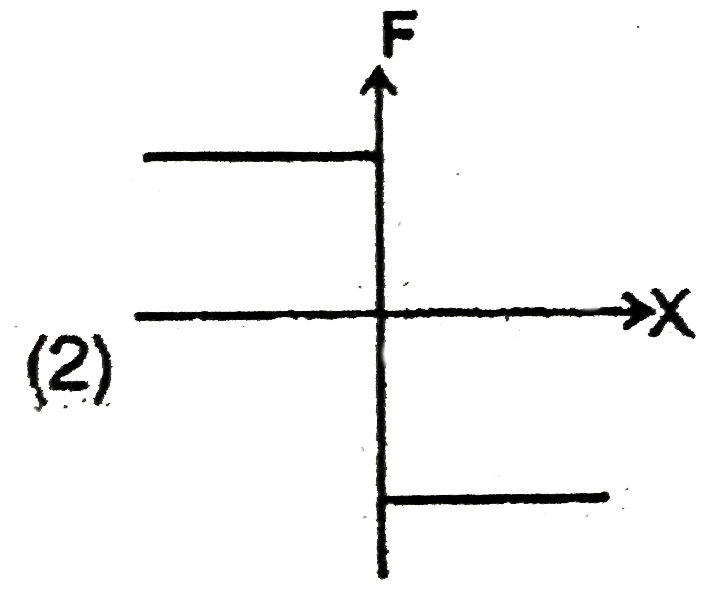
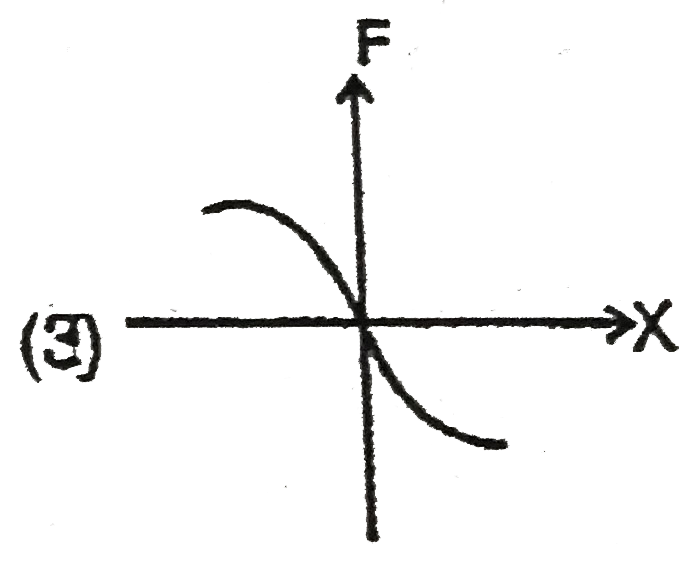
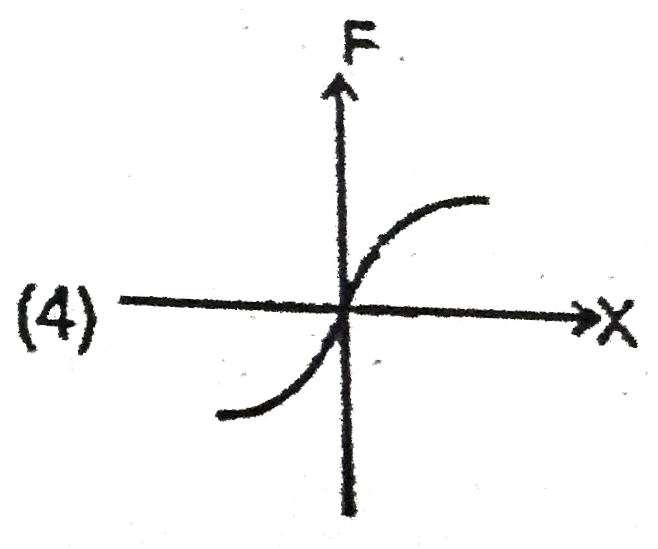
When the net force F acting on the particle varies as its position along x-axis shown in the figure, which of the following cannot be oscillatory motion. (where x is the position of the particle)

A

B

C

D

Text Solution

AI Generated Solution

The correct Answer is:

To determine which of the given force vs. position graphs cannot represent oscillatory motion, we need to analyze the relationship between force and displacement for each graph. In oscillatory motion, the force acting on the particle must always act in the opposite direction to the displacement from the equilibrium position. This means that when the displacement (x) is positive, the force (F) should be negative, and when the displacement is negative, the force should be positive. ### Step-by-Step Solution: 1. **Understand the Condition for Oscillatory Motion**: - For a particle to be in oscillatory motion, the force must always act in the opposite direction to the displacement. Mathematically, this can be expressed as: \[ F = -kx \] - Here, \( k \) is a positive constant, and \( F \) and \( x \) must have opposite signs. 2. **Analyze Each Graph**: - **Graph 1**: Check the relationship between force and displacement. - If \( x < 0 \) (negative), then \( F > 0 \) (positive). - If \( x > 0 \) (positive), then \( F < 0 \) (negative). - This graph satisfies the condition for oscillatory motion. - **Graph 2**: Check the relationship. - If \( x < 0 \), then \( F > 0 \). - If \( x > 0 \), then \( F < 0 \). - This graph also satisfies the condition for oscillatory motion. - **Graph 3**: Check the relationship. - If \( x < 0 \), then \( F > 0 \). - If \( x > 0 \), then \( F < 0 \). - This graph satisfies the condition for oscillatory motion as well. - **Graph 4**: Check the relationship. - If \( x < 0 \), then \( F < 0 \) (negative). - If \( x > 0 \), then \( F > 0 \) (positive). - This graph does not satisfy the condition for oscillatory motion since the force and displacement are in the same direction for both positive and negative displacements. 3. **Conclusion**: - The graph that cannot represent oscillatory motion is **Graph 4** because the force does not act in the opposite direction to the displacement. ### Final Answer: The graph that cannot represent oscillatory motion is **Graph 4**.
Promotional Banner

Topper's Solved these Questions

  • PART TEST 2

    RESONANCE ENGLISH|Exercise Exercise|30 Videos
  • PART TEST 4

    RESONANCE ENGLISH|Exercise Exercise|30 Videos

Similar Questions

Explore conceptually related problems

A force F acting on a particle varies with the position x as shown in figure. Find the work done by this force in displacing the particle from

The variation of force (F) acting on a particle of mass 800 g with position (x) is as shown in figure. The time period of oscillation of the particles is

Force acting on a particle moving along x-axis as shown in figure. Find points of stable and unstable equlibrium. .

A position dependent force F acting on a particle and its force-position curve is shown in the figure. The work done by force from x = 1 m to x = 4 m is

A position dependent force F ia acting on a particle and its force-position curve is shown in the figure. Work done on the particle, when its displacement is from 0 to 5 m is

A particle is moving along the x-axis and its position-time graph is shown. Determine the sign of acceleration.

The acceleration of a particle which moves along the positive x-axis varies with its position as shown in figure. If the velocity of the particle is 0.8 ms^(-1) at x = 0, then velocity of the particle at x = 1.4 m is (in ms^(-1)) .

The net force acting on a particle moving along a straight line varies with time as shown in the diagram. Force is parallel to velocity. Which of the following graph is best representative of its speed with time? (Initial velocity of the particle is zero)

In the figure shown the potential energy U of a particle is plotted its position 'x' from origin. Then which of the following statement is correct A particle at :

A time varying force, F=2t is acting on a particle of mass 2kg moving along x-axis. velocity of the particle is 4m//s along negative x-axis at time t=0 . Find the velocity of the particle at the end of 4s.

RESONANCE ENGLISH-PART TEST 3-Exercise
  1. Figure shows a rectangular pulse and triangular pulse approaching towa...

    Text Solution

    |

  2. A stationary observer receives sonic oscillations from two tuning for...

    Text Solution

    |

  3. When two mutually perpendicular simple harmonic motions of same freque...

    Text Solution

    |

  4. When two waves of the same amplitude and frequency but having a phase ...

    Text Solution

    |

  5. A simple pendulum , a physical pendulum, a torsional pendulum and a sp...

    Text Solution

    |

  6. S(1) and S(2) are two coherent sources of sound of frequency 110Hz eac...

    Text Solution

    |

  7. A transverse wave of amplitude 5 mm and frequency 10Hz is produced on ...

    Text Solution

    |

  8. When a composite wire is made by joining tow wires as shown in figure ...

    Text Solution

    |

  9. When the net force F acting on the particle varies as its position al...

    Text Solution

    |

  10. The time period of a particle in simple harmonic motion is T. Assume p...

    Text Solution

    |

  11. m(1) & m(2)are connected with a light inextensible string with m(1) ly...

    Text Solution

    |

  12. A particle is subjected to two simple harmonic motions along x and y d...

    Text Solution

    |

  13. A wire of length 'l' having tension T and radius 'r' vibrates with fun...

    Text Solution

    |

  14. In a standing wave on a string.

    Text Solution

    |

  15. Which of the following statements is correct:

    Text Solution

    |

  16. The displacement time graph of a particle executing S.H.M. (in straigh...

    Text Solution

    |

  17. The length of the wire shown in figure between the pulley is 1.5 m and...

    Text Solution

    |

  18. A force of 6.4 N stretches a vertical spring by 0.1 m. The mass (in kg...

    Text Solution

    |

  19. Statement 1: A tuning fork of constant frequency sends sound waves in ...

    Text Solution

    |

  20. Statement 1: Sound waves can not propagate through vacuum but light wa...

    Text Solution

    |
