Home
Class 11
PHYSICS
A light is incident on face AB of an equ...

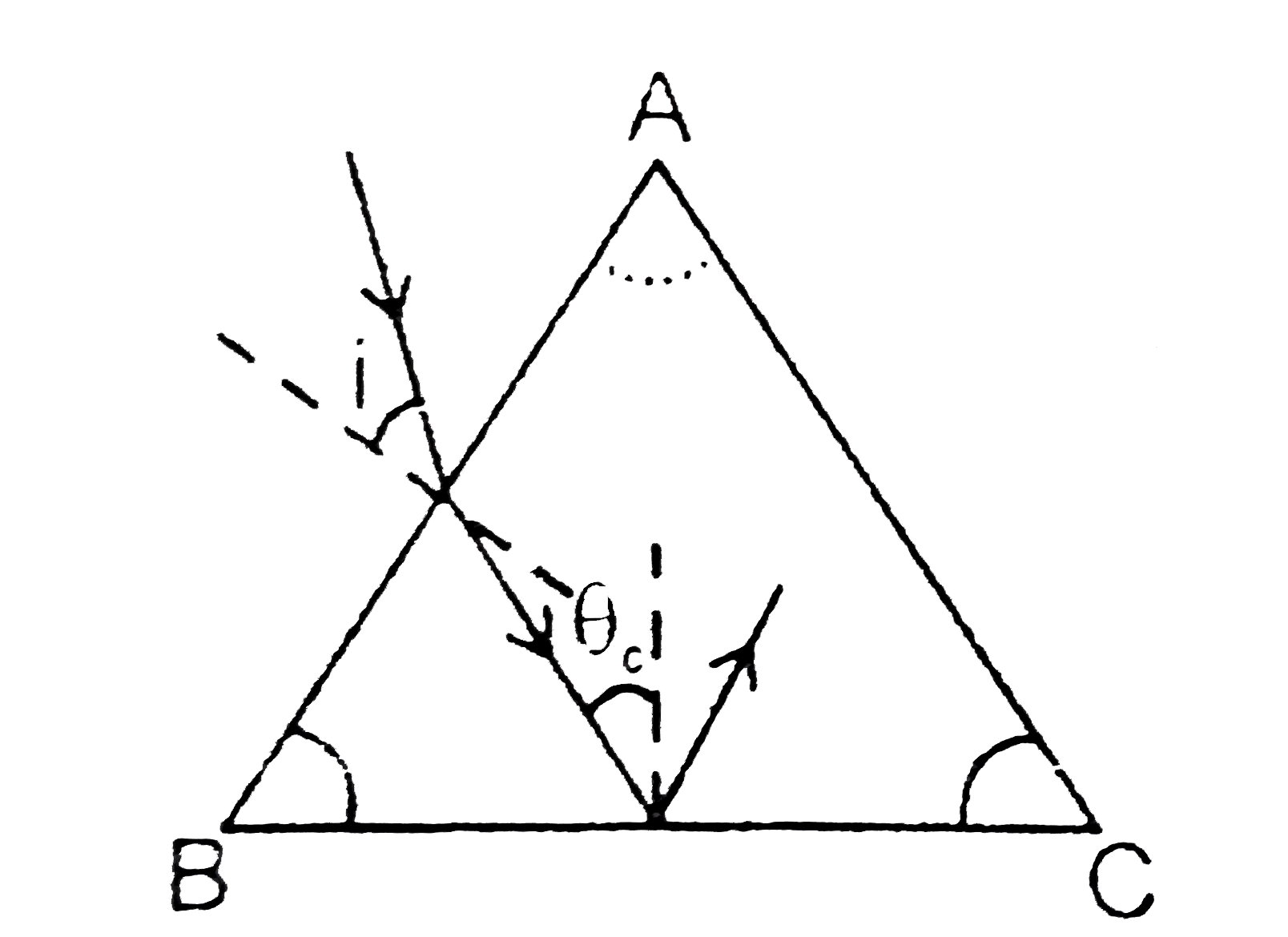
A light is incident on face `AB` of an equilateral glass prism `ABC`. After refraction at `AB`, the ray is incident on face `BC` at the angle slightly greater than critical angles so that it gets reflected from face `BC` and finally emerges out from face `AC`. Net deviation angle of the ray is `112^(@)` anticlockwise. The angle of incidence 'i' has value:
.

A

`22^(@)`

B

`24^(@)`

C

`26^(@)`

D

`28^(@)`

Text Solution

Verified by Experts

The correct Answer is:
C

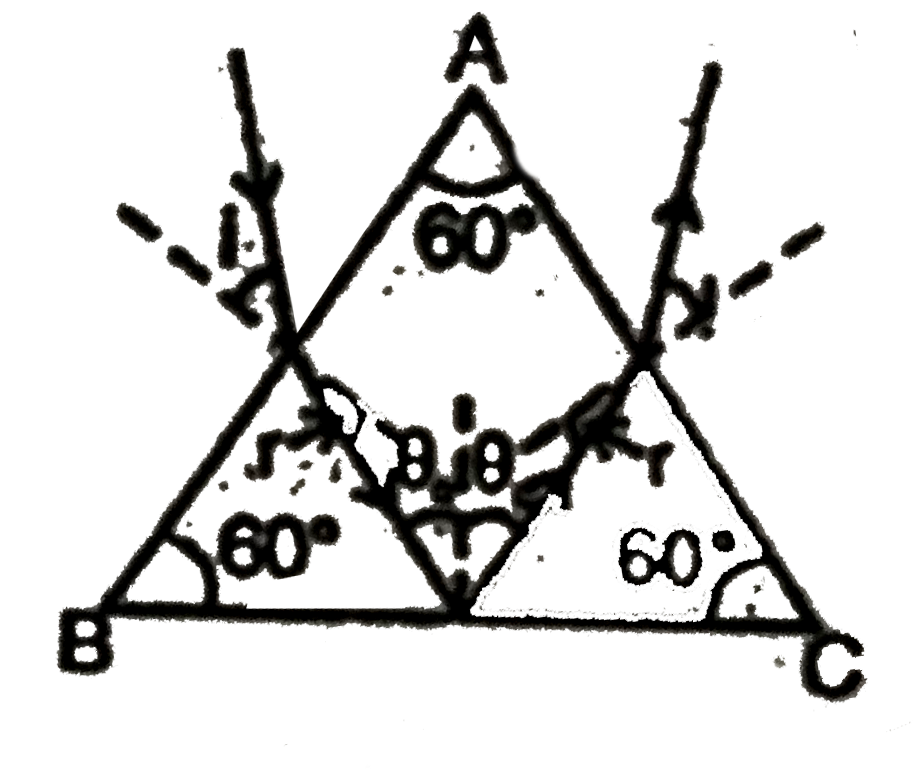
Total deviation =`(i-r)+(180-2 theta_(c))+(i-r)=112^(@)`
as `r=60- theta_(c)`
`2i-120+2 theta_(c) +180-2theta_(c) =112^(@)`
`rArr 2i=52^(@)`
`i=26^(@)`
Promotional Banner

Topper's Solved these Questions

  • PART TEST 3

    RESONANCE ENGLISH|Exercise Exercise|30 Videos
  • PART TEST 5

    RESONANCE ENGLISH|Exercise Exercise|30 Videos

Similar Questions

Explore conceptually related problems

A light ray is normally incident onone face of equilateral glass prism of refractive index sqrt(2) . The deviation of light ray is

A ray of light is incident normally on one face of an equilateral prism of refractive index 1.5 . The angle of deviation is: (Given sin^-1.(2)/(3)=42^@ )

The figure shows the path of a ray passing through an equiangular prism PQR. It is incident on face PR at angle slightly greater than the critical angle for total internal reflection . If the angle alpha shown in the figure is 30^(@) . Calculate the R.I. of the material of the prism.

At what angle, a ray of light should be incident on the first face AB of a regular glass prism ABC so that the emergent ray grazes the adjacent face AC ?

The path of a ray of light passing through an equilateral glass prism ABC is shown in figure. The ray of light is incident on face BC at the critical angle for just total internal reflection. The total internal reflection. The total angle of deviation after the refraction at face AC is 108^@ . Calculate the refractive index of the glass.

A ray of light is normally incident on one face of an equilateral glass prism. Answer the following : (a) What is the angle of incidence on the first face of the prism? (b) What is the angle of refraction from the first face of the prism ? (c) What will be the angle of incidence at the second face of the prism ? (d) Will the light ray suffer minimum deviation by the prism ?

A ray of light is incident on one face of a prism ( m= sqrt(3) ) at an angle of 60^@ . The refracting angle of the prism is also 60^@ . Find the angle of emergence .

A ray of light incident on one of the face of a prism as shown. After refraction through this surface ray is incident on base of the prism. The refractive index of the prism is sqrt(3) . The net deviation of the ray due to prism is

A ray of light incident at an angle theta on a refracting face of a prism emerges from the other face normally. If the angle of the prism is 5^@ and the prism is made of a material of refractive index 1.5 , the angle of incidence is.

A ray of light incident at an angle theta on a refracting face of a prism emerges from the other face normally. If the angle of the prism is 5^@ and the prism is made of a material of refractive index 1.5 , the angle of incidence is.

RESONANCE ENGLISH-PART TEST 4-Exercise
  1. The angular dispersion produced by a prism

    Text Solution

    |

  2. A cylinderical optical fibre (quarter circular shape) of refractive i...

    Text Solution

    |

  3. A light is incident on face AB of an equilateral glass prism ABC. Afte...

    Text Solution

    |

  4. A ray hits the y-axis making an angle theta with y-axis as shown in th...

    Text Solution

    |

  5. An isosceles trapezium of reflecting material of refractive index sqrt...

    Text Solution

    |

  6. A triangular medium has varying refracting index n = n(0) + ax, where ...

    Text Solution

    |

  7. An object AB is placed parallel and close to the optical axis between ...

    Text Solution

    |

  8. A ray of light travelling in a transparent medium falls on a surface s...

    Text Solution

    |

  9. Young's double-slit experiment is conducted in water (mu(1)) as shown ...

    Text Solution

    |

  10. Two coherent monochromatic light beams of intensities I and 4I are sup...

    Text Solution

    |

  11. If yellow light emitted by sodium lamp in Young's double - slit - expe...

    Text Solution

    |

  12. What happens by the use of white light in Young's double slit experime...

    Text Solution

    |

  13. The reflecting surface of a plane mirror is vertical. A particle is pr...

    Text Solution

    |

  14. Astronomial telescope has two lenses of focal power 0.5D and 20D. Then...

    Text Solution

    |

  15. The plane face of a plano convex lens is silvered.If mube the refrativ...

    Text Solution

    |

  16. A vessel of depth 2 d cm is half filled with a liquid of refractive in...

    Text Solution

    |

  17. A parallel beam of light is incident on a lens of focal length 10cm. A...

    Text Solution

    |

  18. Wavelength of light used in an optical instrument are lambda(1) = 4000...

    Text Solution

    |

  19. Statement I: Thin films such as soap bubble or a thin layer of oil on ...

    Text Solution

    |

  20. Statement 1: If two prisms of small apex angles are made of same mater...

    Text Solution

    |

