Home
Class 11
PHYSICS
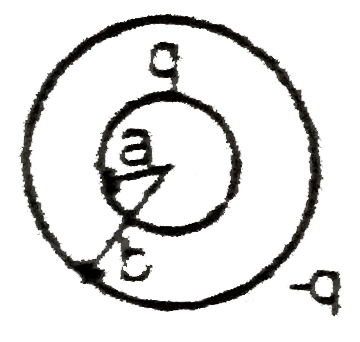
Figure shows two concentric shells of ra...

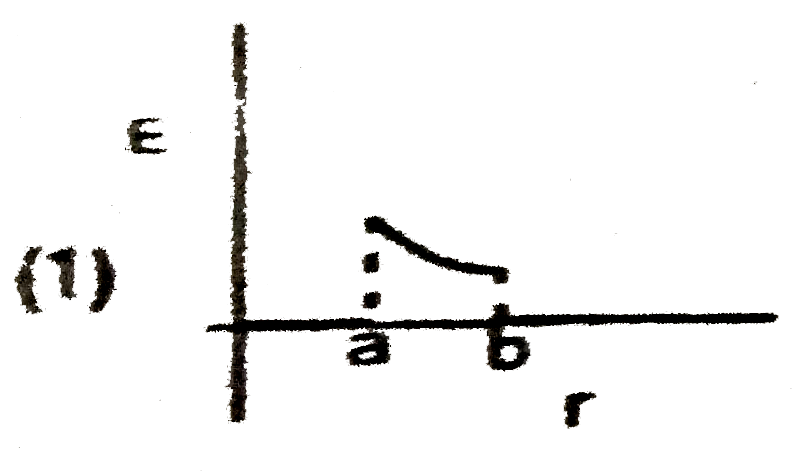
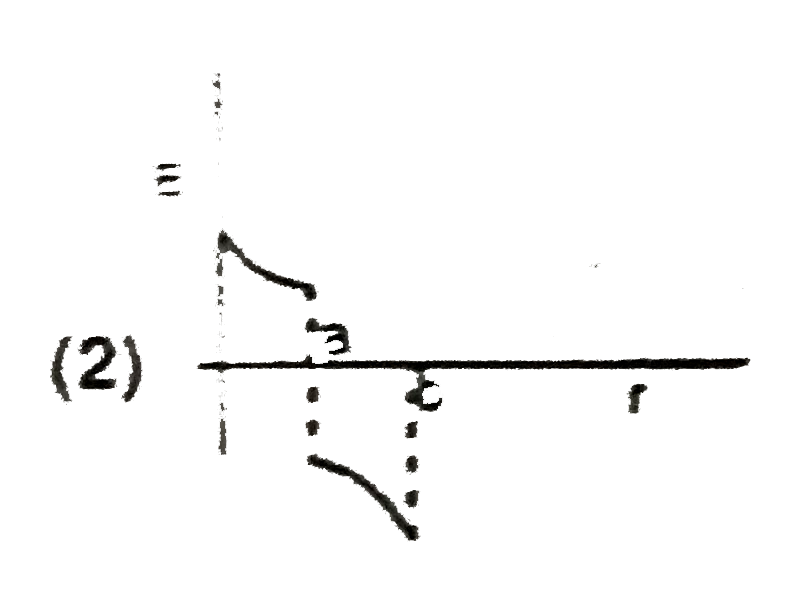
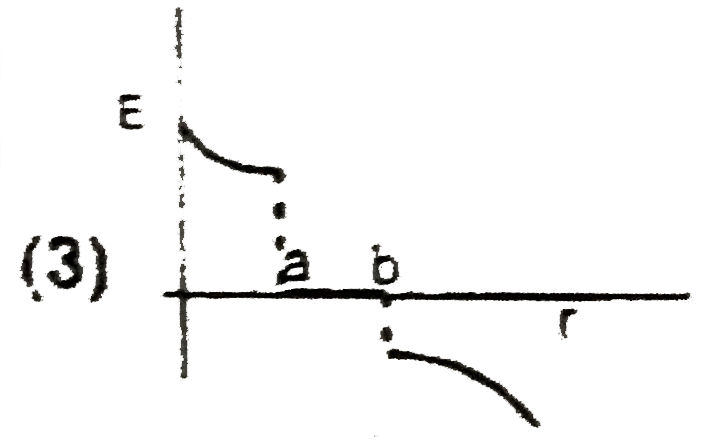
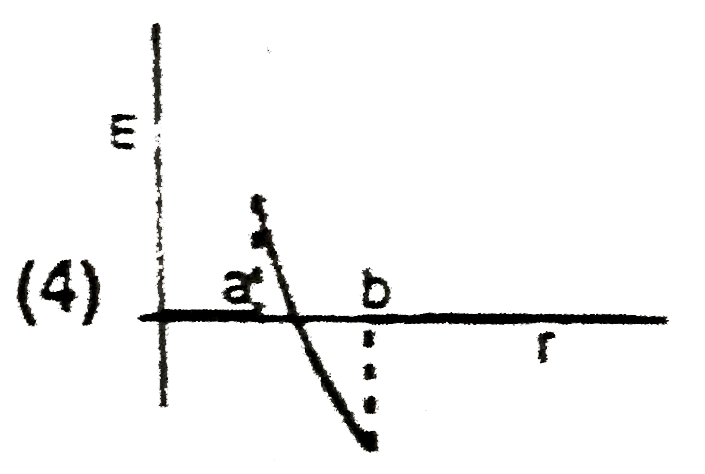
Figure shows two concentric shells of radii a and b uniformly distributed charges q and -q. Which of the following graphs gives correct variation of electric field intensity E with the distance r from the centre?

A

B

C

D

Text Solution

Verified by Experts

The correct Answer is:

A
Promotional Banner

Topper's Solved these Questions

  • PART TEST 4

    RESONANCE ENGLISH|Exercise Exercise|30 Videos
  • PART TEST 6

    RESONANCE ENGLISH|Exercise Exercise|30 Videos

Similar Questions

Explore conceptually related problems

A charge Q is uniformly distributed in a dielectric sphere of radius R (having dielectric constant unity). This dielectric sphere is enclosed by a concentric spherical shell of radius 2R and having uniformly distributed charge 2Q. Which of the following graph correctly represents variation of electric field with distance r from the common centre?

Which one of the following graphs represents the variation of electric field with distance r from the centre of a charged spherical conductor of radius R?

For a uniformly charged non conducting sphere of radius R which of following shows a correct graph between the electric field intensity and the distance from the centre of sphere –

A spherical insulator of radius R is charged uniformly with a charge Q throughout its volume and contains a point charge Q/16 located at its centre. Which of the following graphs best represents qualitatively, the variation of electric field intensity E with distance r from the centre?

Figure shows two concentric conducting shells of radii r_(1) and r_(2) carrying uniformly distributed charges q_(1) and q_(2) , respectively. Find an expression for the potential of each shell. .

There is a solid sphere of radius R having uniformly distributed charge throughout it. What is the relation between electric field E and distance r from the centre (r is less than R) ?

A metallic spherical shell of radius R has a charge -Q on it. A point charge +Q is placed at the centre of the shell. Which of the graphs shown below may correctly represent the variation of electric field E with distance r from the centre of shell ?

Using Gauss' law deduce the expression for the electric field due to a uniformly charged sperical conducting shell of radius R at a point (i) outside and (ii) inside the shell. Plot a graph showing variation of electric field as a function of r gt R and r lt R . (r being the distance from the centre of the shell)

A thin spherical shell of radius R has charge Q spread uniformly over its surface. Which of the following graphs most closely represents the electric field E(r) produced by the shell in the range 0lerltoo , where r is the distance from the centre of the shell?

A thin spherical shell of radius R has charge Q spread uniformly over its surface. Which of the following graphs most closely represents the electric field E(r) produced by the shell in the range 0lerltoo , where r is the distance from the centre of the shell?

RESONANCE ENGLISH-PART TEST 5-Exercise
  1. Two uniformly charged concentric spherical shells of radius R and r, a...

    Text Solution

    |

  2. Figure shows a solid hemisphere with a charge of 5 nC distributed unif...

    Text Solution

    |

  3. Figure shows two concentric shells of radii a and b uniformly distribu...

    Text Solution

    |

  4. Two particles of charge q(1) and q(2) are separated by distance d as s...

    Text Solution

    |

  5. A fixed ring of radius R is given a charge q. A charge q0 is brought s...

    Text Solution

    |

  6. In the figure two concentric conducting shells of radius R & 2R are sh...

    Text Solution

    |

  7. Two equipotential spherical surfaces having potential 20V and 0V are a...

    Text Solution

    |

  8. The electric field intensity at all points in space is given by vecE =...

    Text Solution

    |

  9. Two concentric conducting thin shells of radius R and 2 R carry charge...

    Text Solution

    |

  10. A uniformly charged non-conducting spherical shell is given +q charge ...

    Text Solution

    |

  11. Find out the potential of the junction S (in volts) if all the dark wi...

    Text Solution

    |

  12. In the figure shown R = 100 Omega, L = (2)/(pi) H and C = (8)/(pi) mu...

    Text Solution

    |

  13. A uniform field is exists in the region directed away from the page. A...

    Text Solution

    |

  14. When the number of turns in a solenoid are doubled without any change ...

    Text Solution

    |

  15. The potential difference across8Omega resistance is 48V as shown in t...

    Text Solution

    |

  16. In the given circuit, in steady state we may say: (capacitor are initi...

    Text Solution

    |

  17. Two circular rings of identical radii and resistance of 36 Omega each ...

    Text Solution

    |

  18. At distance r from a point charge the ratio (U)/(V^(2)) where U is ene...

    Text Solution

    |

  19. A graph between current and time during charging of a capacitor by a b...

    Text Solution

    |

  20. An electron passes between two parallel plate of a capacitor as shown ...

    Text Solution

    |
