

Home
Class 11
PHYSICS
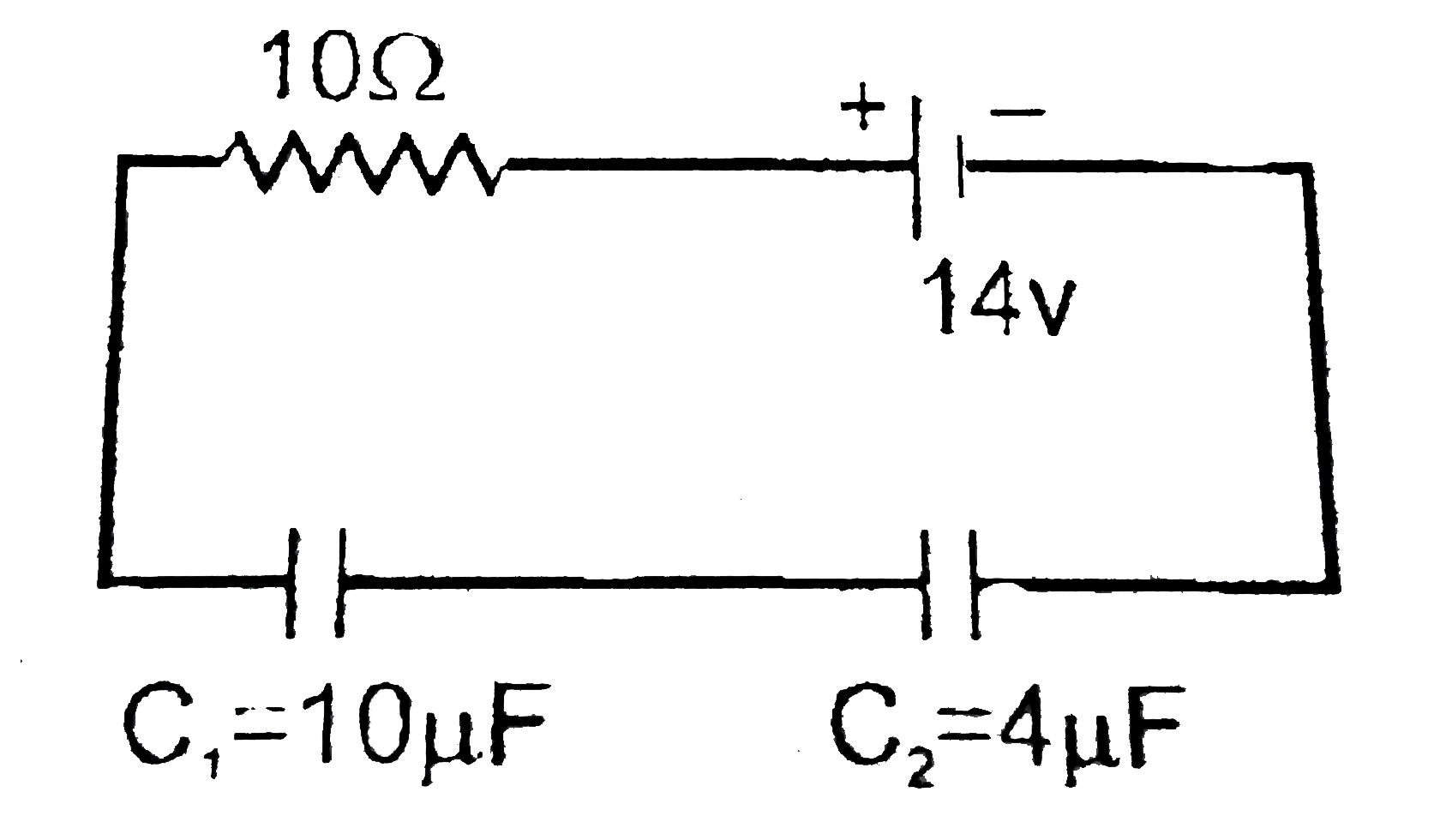
In the given circuit, in steady state we...


In the given circuit, in steady state we may say: (capacitor are initially uncharged)

A

potential drop across the capacitor `C_(1)` is 4v

B

potential drops across `10 Omega` resistance 10 V

C

charge on `C_(1)` and `C_(2)` is `20 muC`

D

ratio of charge on `C_(1)` and `C_(2)` is 10 :4

Text Solution

Verified by Experts

The correct Answer is:
A

`C_(eq)=(10xx4)/(10+4)=40/14`
`Q=C_(eq) V=40/14xx14 =40 mu C`
`V_(c_(1))=40/10 =4v`
`V_(c_(2))=40/4=10 v.`
Promotional Banner

Topper's Solved these Questions

  • PART TEST 4

    RESONANCE ENGLISH|Exercise Exercise|30 Videos
  • PART TEST 6

    RESONANCE ENGLISH|Exercise Exercise|30 Videos

Similar Questions

Explore conceptually related problems

In the given circuit, in steady state we may say: (capacitors are initially unchanged)

The circuit is in a steady state. The charge in capacitor C_1 is

The circuit is in a steady state. The charge in capacitor C_2 is

The circuit is in a steady state. The charge in capacitor C_3 is

In the given circuit diagram, both capacitors are initially uncharged. The capacitance C_(1)=2muF and C_(2)=4muF , emf of battery A and B are 2V and 4V respectively.

The following two questions refer to the circuit shown. Assume that the capacitors are initially uncharged. At time t = 0, the switch S in the circuit is closed. At that instant, what is the equivalent resistance of the circuit?

The following two questions refer to the circuit shown. Assume that the capacitors are initially uncharged. After the switch has been closed for a long time, how much charge is on the positive plate of the 3muF capacitor?

Find the charge on capacitor in steady state.

In the circuit shown key is closed at t=0 with capacitor initially uncharged.

In the circuit shown in figure, the capacitors are initially uncharged. The current through resistor PQ just after closing the switch is

RESONANCE ENGLISH-PART TEST 5-Exercise
  1. A uniformly charged non-conducting spherical shell is given +q charge ...

    Text Solution

    |

  2. Find out the potential of the junction S (in volts) if all the dark wi...

    Text Solution

    |

  3. In the figure shown R = 100 Omega, L = (2)/(pi) H and C = (8)/(pi) mu...

    Text Solution

    |

  4. A uniform field is exists in the region directed away from the page. A...

    Text Solution

    |

  5. When the number of turns in a solenoid are doubled without any change ...

    Text Solution

    |

  6. The potential difference across8Omega resistance is 48V as shown in t...

    Text Solution

    |

  7. In the given circuit, in steady state we may say: (capacitor are initi...

    Text Solution

    |

  8. Two circular rings of identical radii and resistance of 36 Omega each ...

    Text Solution

    |

  9. At distance r from a point charge the ratio (U)/(V^(2)) where U is ene...

    Text Solution

    |

  10. A graph between current and time during charging of a capacitor by a b...

    Text Solution

    |

  11. An electron passes between two parallel plate of a capacitor as shown ...

    Text Solution

    |

  12. Three distinct current carrying wires intersect a finite rectangular p...

    Text Solution

    |

  13. An alternating EMF of frequency (1)/(2pi sqrt(LC)) is applied to a ser...

    Text Solution

    |

  14. In an AC circuit , the power factor

    Text Solution

    |

  15. The instantaneous potential difference between points. A. 8 sin (5...

    Text Solution

    |

  16. A parallel plate capacitor is charged and the charging battery is then...

    Text Solution

    |

  17. The linear charge density on a ring of radius R is lambda=lambda0 sin ...

    Text Solution

    |

  18. Two small spheres of masses M(1) and M(2) are suspended by weightless ...

    Text Solution

    |

  19. Assertion:- A point charge q is placed near an arbitary shaped solid c...

    Text Solution

    |

  20. Statement 1: The circuits containing capacitor be handled cautiously e...

    Text Solution

    |