Home
Class 12
PHYSICS
Protons and singly ionized atoms of U^(2...

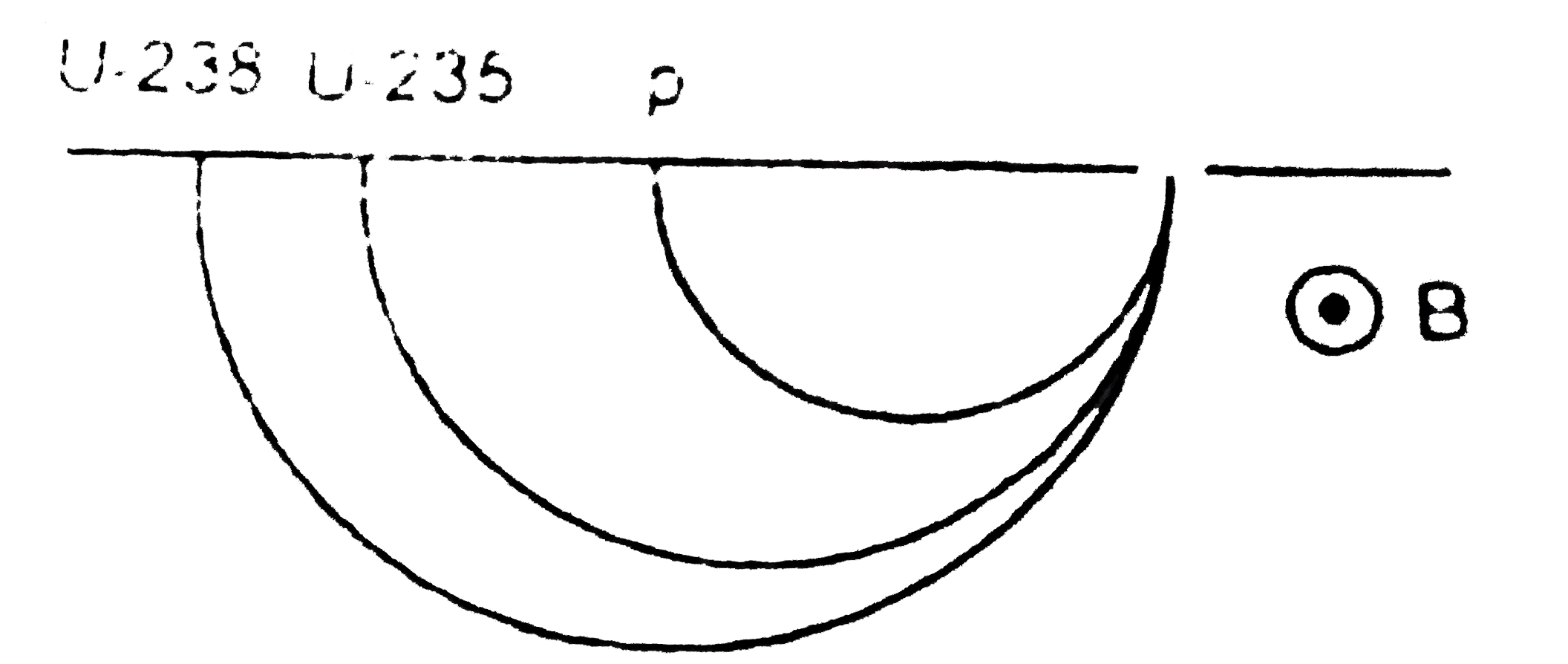
Protons and singly ionized atoms of `U^(235)` & `U^(238)` are passed in turn (which means one after the other and not at the same time) through a velocity selector and then enter a uniform magnetic field. The protons describe semicircles of radius `10 mm`. The separation between the ions of `U^(235)` and `U^(238)` after describing semicircle is given by

A

`60 mm`

B

`30 mm`

C

`2350 mm`

D

`2380 mm`

Text Solution

Verified by Experts

The correct Answer is:

A

`R=(mv)/(qB)`
`R_(P)=(m_(P)v)/(eB)`
`R_(235_(upsilon))=(m_(235_(upsilon).)v)/(eB)`
`Deltax=2xx(3M_(P)v)/(eB)=6xx10mm=60mm`.
Promotional Banner

Topper's Solved these Questions

  • NUCLEAR PHYSICS

    RESONANCE ENGLISH|Exercise Exercise-2 Part -2 Single and double value interger type|15 Videos
  • NUCLEAR PHYSICS

    RESONANCE ENGLISH|Exercise Exercise-2 Part-3 One more than one options correct type|7 Videos
  • NUCLEAR PHYSICS

    RESONANCE ENGLISH|Exercise Exercise-1 Part-2 Only one option correct type|27 Videos
  • GRAVITATION

    RESONANCE ENGLISH|Exercise HIGH LEVEL PROBLEMS|16 Videos
  • REVISION DPP

    RESONANCE ENGLISH|Exercise All Questions|463 Videos

Similar Questions

Explore conceptually related problems

An electron moving with a speed u along the positive x-axis at y=0 enters a region of uniform magnetic field which exists to the right of y-axis. The electron exits from the region after some time with the speed v at coordinate y, then

An electron moving with a speed u along the positive x-axis at y=0 enters a region of uniform magnetic field which exists to the right of y-axis. The electron exits from the region after some time with the speed v at coordinate y, then

A beam of protons moving with a velocity of 4 xx 10^(5) m/s enters a uniform magnetic field of 0.3 T at an angle of 60◦ with the magnetic field. What is the radius of the helical path described by the proton beam? [m_p=1.67 xx 10^(-27) kg and the charge on the proton =1.6 xx 10^(-19) C]

Bainbridge's mass spectrometer separates ion having the same velocity. The ions, after enteering through slits, S_(1) and S_(2) , pass through a velocity selector composed of an electric field pproduced by the charged plates P and P' abd a magnetic field vecB perpendicular to electric field and the ion path.Thew ions that then passs undeviated through the crossed vecE 1 and vecB fields enter into a region where a second magnetic field vecB exists, where they are made to follow circular path. A photographic plate ( or a modern detector) registors their arrival. If r is the radius of the circular orbit , then specific charge (q)/(m) of ion is

Two coaxial plane coils, each of n turns of radius a, are separated by a distance a. calcualte the magnetic field on the axis at the point midway between them when a current l flows in the same sense through each coil. Electrons in a colou television tube are accelerated through a potential difference of 25 kV and then deflected by 45^(@) in the magnetic field between the two coils described above. If a is 100 mm and the maximum current available for the coils is 2A, estimate the number of turns which the coils must have.

A body is projected upwards with a velocity u . It passes through a certain point above the grond after t_(1) , Find the time after which the body posses thoruth the same point during the journey.

Protons are projected with an initial speed v_(i)=6kms^(-1) from a fileds-free region vec(E ) =-900hat jNC^(-1) present above the plane as shown in fig. The initial velocity vector of the protons makes an angle u with the plane. The proton are to hit a target that lies at a horizontal cross the plane and enter the electric field. Find the angle theta at which the protons must pass through the plane to strike the target.

Following experiment was performed by J.J. Thomson in order to measure ratio of charge e and mass m of electron. Electrons emitted from a hot filament are accelerated by a potential difference V. As the electrons pass through deflecting plates, they encounter both electric and magnetic fields. the entire region in which electrons leave the plates they enters a field free region that extends to fluorescent screen. The entire region in which electrons travel is evacuated. Firstly, electric and magnetic fields were made zero and position of undeflected electron beam on the screen was noted. The electric field was turned on and resulting deflection was noted. Deflection is given by d_(1) = (eEL^(2))/(2mV^(2)) where L = length of deflecting plate and v = speed of electron. In second part of experiment, magnetic field was adjusted so as to exactly cancel the electric force leaving the electron beam undeflected. This gives eE = evB . Using expression for d_(1) we can find out (e)/(m) = (2d_(1)E)/(B^(2)L^(2)) A beam of electron with velocity 3 xx 10^(7) m s^(-1) is deflected 2 mm while passing through 10 cm in an electric field of 1800 V//m perpendicular to its path. e//m for electron is

The path of a charged particle in a uniform magnetic field depends on the angle theta between velocity vector and magnetic field, When theta is 0^(@) or 180^(@), F_(m) = 0 hence path of a charged particle will be linear. When theta = 90^(@) , the magnetic force is perpendicular to velocity at every instant. Hence path is a circle of radius r = (mv)/(qB) . The time period for circular path will be T = (2pim)/(qB) When theta is other than 0^(@), 180^(@) and 90^(@) , velocity can be resolved into two components, one along vec(B) and perpendicular to B. v_(|/|)=cos theta v_(^)= v sin theta The v_(_|_) component gives circular path and v_(|/|) givestraingt line path. The resultant path is a helical path. The radius of helical path r=(mv sin theta)/(qB) ich of helix is defined as P=v_(|/|)T P=(2 i mv cos theta) p=(2 pi mv cos theta)/(qB) Two ions having masses in the ratio 1:1 and charges 1:2 are projected from same point into a uniform magnetic field with speed in the ratio 2:3 perpendicular to field. The ratio of radii of circle along which the two particles move is :

In a metal in the solid state, such as a copper wire, the atoms are strongly bound to one another and occupý fixed positions. Some electrons (called the conductor electrons) are free to move in the body of the metal while the other are strongly bound to their atoms. In good conductors, the number of free electrons is very large of the order of 10^(28) electrons per cubic metre in copper. The free electrons are in random motion and keep colliding with atoms. At room temperature, they move with velocities of the order of 10^5 m/s. These velocities are completely random and there is not net flow of charge in any directions. If a potential difference is maintained between the ends of the metal wire (by connecting it across a battery), an electric field is set up which accelerates the free electrons: These accelerated electrons frequently collide with the atoms of the conductor, as a result, they acquire a constant speed called the drift speed which is given by V_e = 1/enA where I = current in the conductor due to drifting electrons, e = charge of electron, n = number of free electrons per unit volume of the conductor and A = area of cross-section of the conductor. A current of 1 A flows through a copper wire. The number of electrons passing through any cross-section of the wire in 1.6 sec is (charge of a electron = 1.6 xx 10^(-19 c) .

RESONANCE ENGLISH-NUCLEAR PHYSICS-Exercise 2 Part-1 Only one option correct type
  1. Choose the wrong statement

    Text Solution

    |

  2. Binding energy per nucleon of fixed nucleus X^(A) is 6 MeV. It absorbs...

    Text Solution

    |

  3. The half-life of .^215At is 100mus. The time taken for the activity of...

    Text Solution

    |

  4. A fre neutron decays into a proton an electron and

    Text Solution

    |

  5. Protons and singly ionized atoms of U^(235) & U^(238) are passed in tu...

    Text Solution

    |

  6. When a beta-particle is emittd from a nucleus , the neutron - proton...

    Text Solution

    |

  7. Consider a sample of a pure beta-active material

    Text Solution

    |

  8. Masses of two isobars .(29)Cu^(64) and .(30)Zn^(64) are 63.9298 u and ...

    Text Solution

    |

  9. In an alpha -decay the Kinetic energy of alpha particle is 48 MeV and ...

    Text Solution

    |

  10. A free ^238U nucleus kept in a train emits an alpha particle. When the...

    Text Solution

    |

  11. A nucleus with mass number 220 initially at rest emits an alpha partic...

    Text Solution

    |

  12. A charged capacitor of capacitance C is discharged through a resistanc...

    Text Solution

    |

  13. At time t=O, some radioactive gas is injected into a sealed vessel. At...

    Text Solution

    |

  14. A sample of radioactive material has mass m, decay constant lambda, an...

    Text Solution

    |

  15. Two radioactive substances X and Y initially contain an equal number o...

    Text Solution

    |

  16. Two identical samples (same material and same amount) P and Q of a rad...

    Text Solution

    |

  17. N atoms of a radioactive element emit n number of alpha-particles per ...

    Text Solution

    |

  18. The radioactivity of an old sample of whisky due to tritium (half life...

    Text Solution

    |

  19. A overset(lambda(1)) rarr B overset (lambda(2))rarr C t=0 N(0) 0 ...

    Text Solution

    |

  20. 90% of a radioactive sample is left undecayed after time t has elapsed...

    Text Solution

    |
