Home
Class 12
PHYSICS
When a particle is restricted to move al...

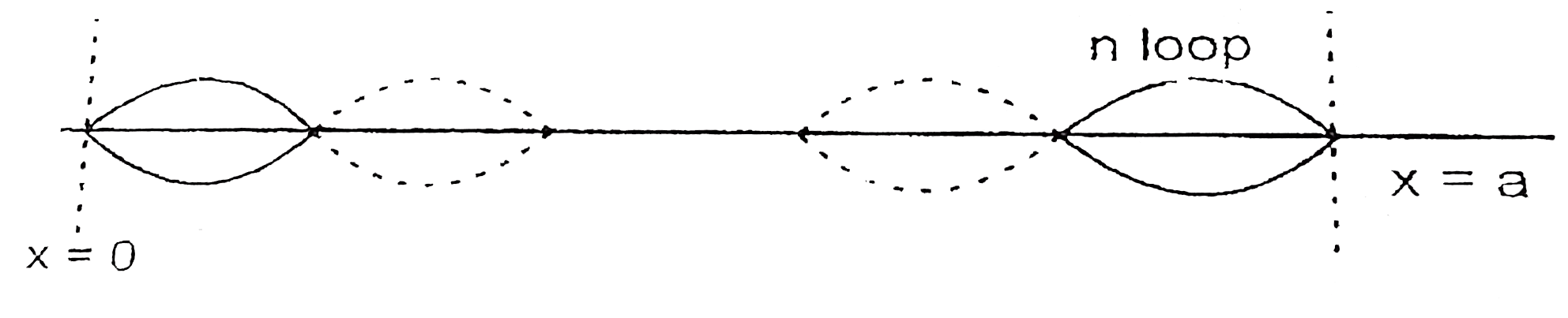
When a particle is restricted to move along x-axis between `x=0` and `x=a`, where `alpha` if of nenometer dimension, its energy can take only certain specific values. The allowed energies of the particle moving in such a restricted region, correspond to the formation of standing waves with nodes at its ends `x=0` and `x=a`. The wavelength of this standing wave is related to the linear momentum p of the particle according to the de Broglie relation. The energy of the particle of mass m is related to its linear momentum as `E=(p^2)/(2m)`. Thus the energy of the particle can be denoted by a quantum number `n` taking values 1,2,3, ...(`n=1`, called the ground state) corresponding to the number of loops in the standing wave.
Use the model described above to answer the following three questions for a particle moving along the line from `x=0` to `x=alpha`. Take `h=6.6xx10^(-34)Js` and `e=1.6xx10^(-19)` C.
Q. The allowed energy for the particle for a particular value of n is proportional to

A

`a^(-2)`

B

`a^(3//2)`

C

`a^(-1)`

D

`a^(2)`

Text Solution

Verified by Experts

The correct Answer is:
A


`n(lambda)/(2) = a` and `p = (h)/(lambda) = (nh)/(2a)`
Energy `E = (p^(2))/(2m) = (n^(2)h^(2))/(8 ma^(2)) rArr E prop (1)/(a^(2))`
Promotional Banner

Topper's Solved these Questions

  • ATOMIC PHYSICS

    RESONANCE ENGLISH|Exercise Advanved level problems|17 Videos
  • ATOMIC PHYSICS

    RESONANCE ENGLISH|Exercise Exercise-2 Part-III : Comprehension|12 Videos
  • ALTERNATING CURRENT

    RESONANCE ENGLISH|Exercise HIGH LEVEL PROBLEMS|11 Videos
  • CAPACITANCE

    RESONANCE ENGLISH|Exercise High Level Problems|16 Videos

Similar Questions

Explore conceptually related problems

When a particle is restricted to move along x-axis between x=0 and x=a , where alpha if of nenometer dimension, its energy can take only certain specific values. The allowed energies of the particle moving in such a restricted region, correspond to the formation of standing waves with nodes at its ends x=0 and x=a . The wavelength of this standing wave is related to the linear momentum p of the particle according to the de Broglie relation. The energy of the particle of mass m is related to its linear momentum as E=(p^2)/(2m) . Thus the energy of the particle can be denoted by a quantum number n taking values 1,2,3, ...( n=1 , called the ground state) corresponding to the number of loops in the standing wave. Use the model described above to answer the following three questions for a particle moving along the line from x=0 to x=alpha . Take h=6.6xx10^(-34)Js and e=1.6xx10^(-19) C Q. The speed of the particle that can take discrete values is proportional to

When a particle is restricted to move along x-axis between x=0 and x=a , where alpha if of nenometer dimension, its energy can take only certain specific values. The allowed energies of the particle moving in such a restricted region, correspond to the formation of standing waves with nodes at its ends x=0 and x=a . The wavelength of this standing wave is related to the linear momentum p of the particle according to the de Broglie relation. The energy of the particle of mass m is related to its linear momentum as E=(p^2)/(2m) . Thus the energy of the particle can be denoted by a quantum number n taking values 1,2,3, ...( n=1 , called the ground state) corresponding to the number of loops in the standing wave. Use the model described above to answer the following three questions for a particle moving along the line from x=0 to x=alpha . Take h=6.6xx10^(-34)Js and e=1.6xx10^(-19) C. Q. If the mass of the particle is m=1.0xx10^(-30) kg and alpha=6.6nm , the energy of the particle in its ground state is closest to

If the linear momentum of a prticle is known can you find its kinetic energy? If the kinetic energy of a particle is known can you find its linear momentum?

When the linear momentum of a particle is increased by 1% its kinetic energy increases by x%. When the kinetic energy of the particle is increased by 300%, its linear momentum increases by y%. The ratio of y to x is

What is the relation between wavelength and momentum of moving particles ?

For a particle moving along x- axis, speed must be increasing for the following graph :

Derive the relation between the wavelength (lambda) of the de broglie wave and kinetic energy (E ) of a moving particle

For a particle moving along the x-axis, mark the correct statement(s).

A particle with total energy E is moving in a potential energy region U(x). Motion of the particle is restricted to the region when

A particle moves along the x-axis from x=0 to x=5m under the influence of a given by F =7-2x + 3x^(2) . The work done by the applied force to the particle is.

RESONANCE ENGLISH-ATOMIC PHYSICS-Exercise -3 part -I JEE (Advanced)
  1. In a mixture of H-He^(+) gas (He^(+) is singly ionized He atom), H ato...

    Text Solution

    |

  2. In a mixture of H-He^(+) gas (He^(+) is singly ionized He atom), H ato...

    Text Solution

    |

  3. When a particle is restricted to move along x-axis between x=0 and x=a...

    Text Solution

    |

  4. When a particle is restricted to move along x-axis between x=0 and x=a...

    Text Solution

    |

  5. When a particle is restricted to move along x-axis between x=0 and x=a...

    Text Solution

    |

  6. Photoelectric effect experiments are performed using three different m...

    Text Solution

    |

  7. An alpha particle and a proton are accelerated from rest by a potentia...

    Text Solution

    |

  8. The key feature of Bohr's spectrum of hydrogen atom is the quantizatio...

    Text Solution

    |

  9. The key feature of Bohr's theory of spectrum of hydrogen atom is the q...

    Text Solution

    |

  10. The key feature of Bohr's theory of spectrum of hydrogen atom is the q...

    Text Solution

    |

  11. if the wavelength of the first line of the balmer series of hydrogen i...

    Text Solution

    |

  12. A dence collection of equal number of electrona and positive ions is ...

    Text Solution

    |

  13. A dence collection of equal number of electrona and positive ions is ...

    Text Solution

    |

  14. A silver sphere of radius 1 cm and work function 4.7 eV is suspended f...

    Text Solution

    |

  15. A pulse of light of duration 100 ns is absorbed completely by a small ...

    Text Solution

    |

  16. The work function of Silver and sodium are 4.6 and 2.3 eV, respective...

    Text Solution

    |

  17. The radius of the orbit of an electron in Hydrogen-like aton is 4.5 al...

    Text Solution

    |

  18. if lambda(Cu) is the wavelength of Kalpha, X-ray line fo copper (atomi...

    Text Solution

    |

  19. A metal surface is illuminated by light of two different wavelengths 2...

    Text Solution

    |

  20. Consider a hydrogen atom with its electron in the n^(th) orbital An el...

    Text Solution

    |

