Home
Class 12
PHYSICS
Photoelectric effect experiments are per...

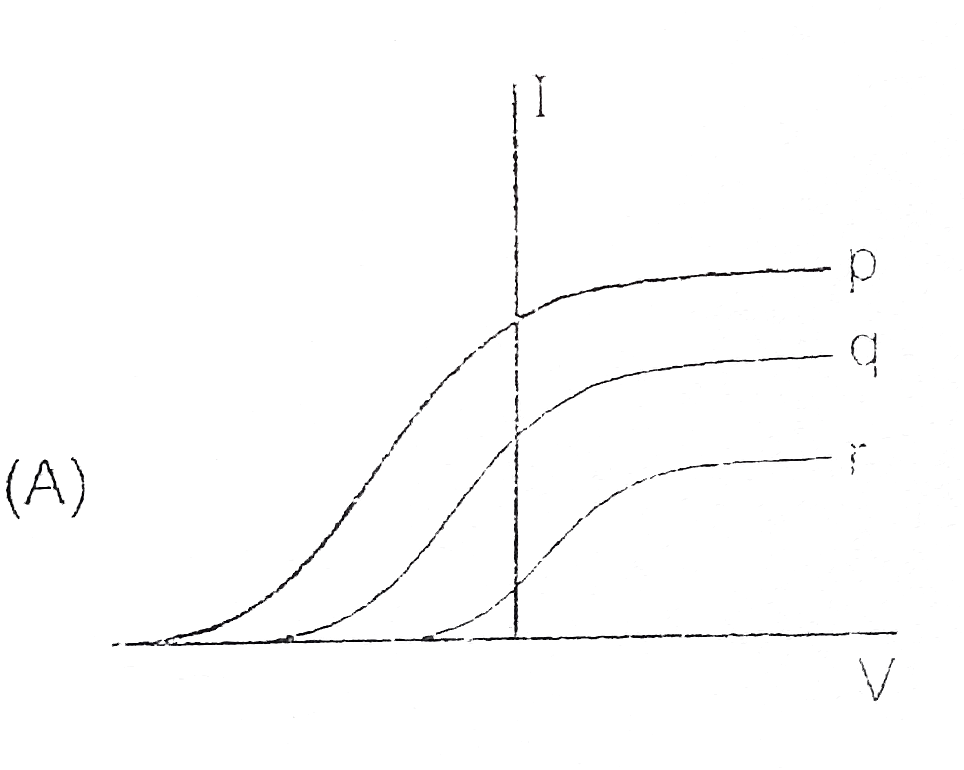
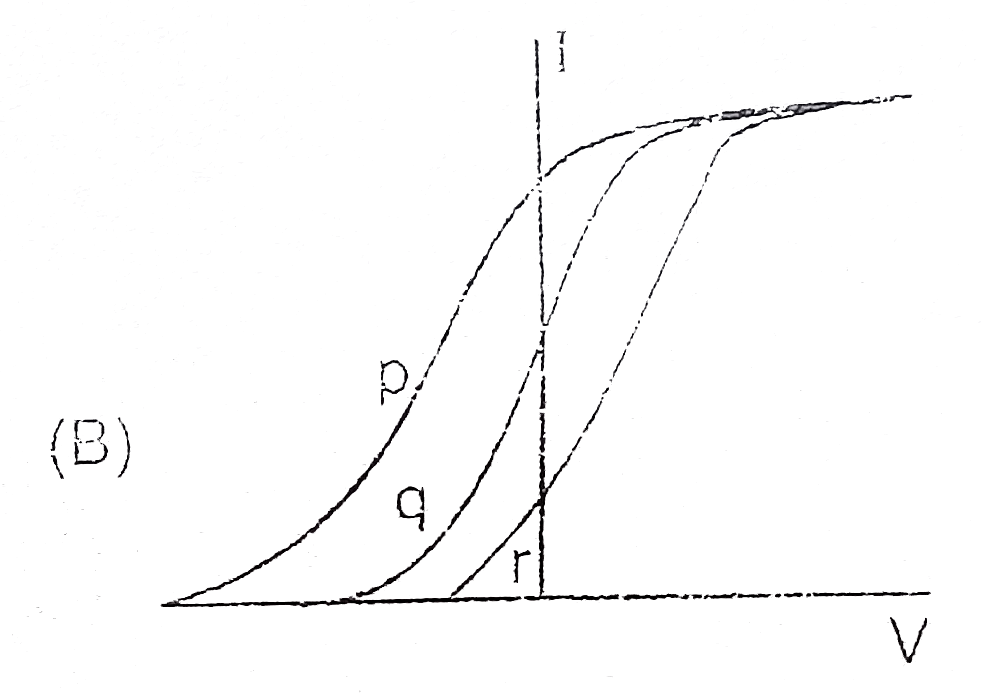
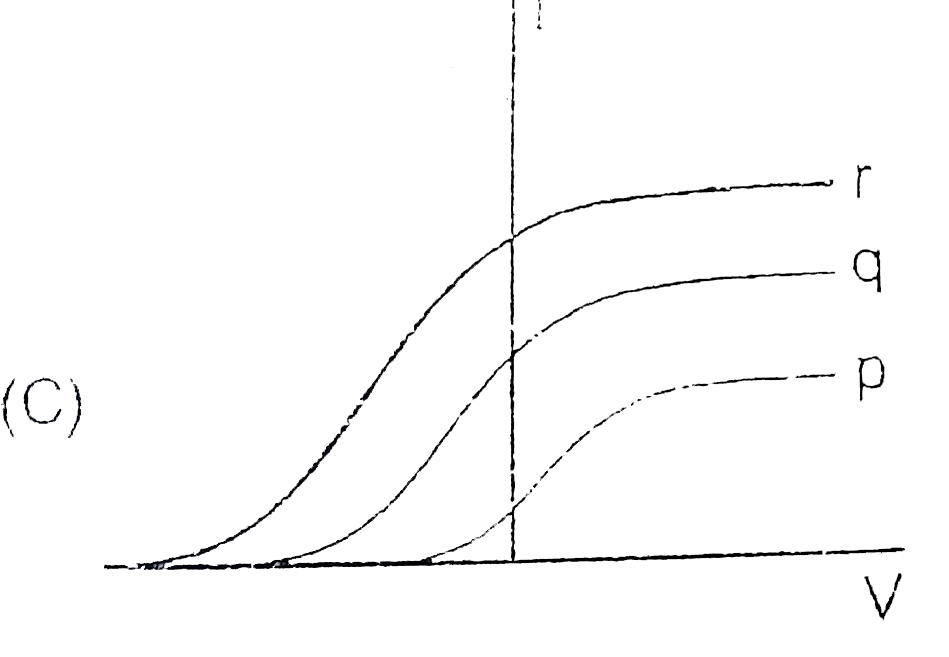
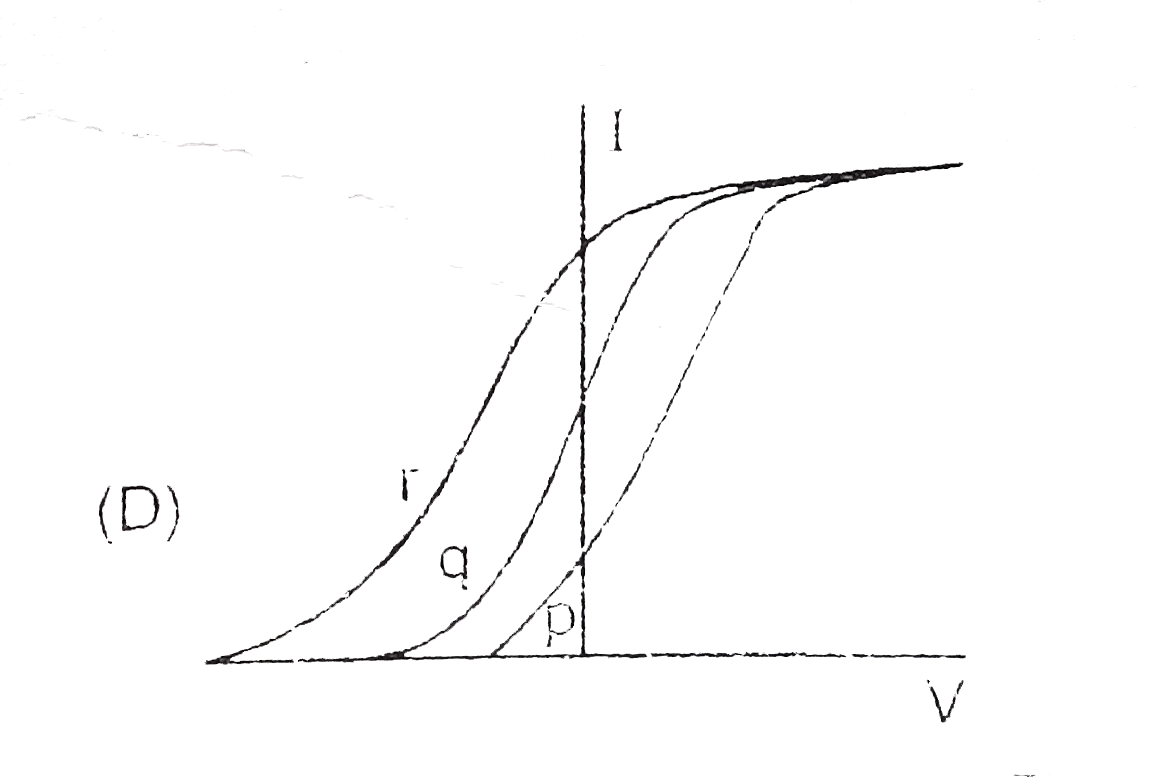
Photoelectric effect experiments are performed using three different metal plates `p,q` and`r` having work function `phi_(p) = 2.0 eV, phi_(e) = 2.5 eV and phi_(r) = 3.0 eV` respectively A light beam containing wavelength of `550nm , 450 nm` and `350nm ` with equal intensities illuminates each of the plates . The correct `I -V` graph for the experiment is [Take hc = 1240 eV nm]

A

B

C

D

Text Solution

AI Generated Solution

The correct Answer is:

To solve the problem related to the photoelectric effect experiments performed using three different metal plates (P, Q, and R) with given work functions and illuminated by light of different wavelengths, we will follow these steps: ### Step 1: Calculate the Energy of the Incident Photons The energy of a photon can be calculated using the formula: \[ E = \frac{hc}{\lambda} \] where \( h \) is Planck's constant, \( c \) is the speed of light, and \( \lambda \) is the wavelength of the light. Given: - \( hc = 1240 \, \text{eV nm} \) We will calculate the energy for each wavelength: 1. **For \( \lambda = 550 \, \text{nm} \)**: \[ E_1 = \frac{1240 \, \text{eV nm}}{550 \, \text{nm}} \approx 2.25 \, \text{eV} \] 2. **For \( \lambda = 450 \, \text{nm} \)**: \[ E_2 = \frac{1240 \, \text{eV nm}}{450 \, \text{nm}} \approx 2.76 \, \text{eV} \] 3. **For \( \lambda = 350 \, \text{nm} \)**: \[ E_3 = \frac{1240 \, \text{eV nm}}{350 \, \text{nm}} \approx 3.54 \, \text{eV} \] ### Step 2: Compare Photon Energy with Work Functions Now we compare the calculated photon energies with the work functions of the metals: - **Metal P**: \( \phi_p = 2.0 \, \text{eV} \) - **Metal Q**: \( \phi_q = 2.5 \, \text{eV} \) - **Metal R**: \( \phi_r = 3.0 \, \text{eV} \) 1. **For Metal P**: - \( E_1 = 2.25 \, \text{eV} \) (greater than \( \phi_p \)) - \( E_2 = 2.76 \, \text{eV} \) (greater than \( \phi_p \)) - \( E_3 = 3.54 \, \text{eV} \) (greater than \( \phi_p \)) - **Conclusion**: All wavelengths can eject electrons. 2. **For Metal Q**: - \( E_1 = 2.25 \, \text{eV} \) (less than \( \phi_q \)) - \( E_2 = 2.76 \, \text{eV} \) (greater than \( \phi_q \)) - \( E_3 = 3.54 \, \text{eV} \) (greater than \( \phi_q \)) - **Conclusion**: Only \( E_2 \) and \( E_3 \) can eject electrons. 3. **For Metal R**: - \( E_1 = 2.25 \, \text{eV} \) (less than \( \phi_r \)) - \( E_2 = 2.76 \, \text{eV} \) (less than \( \phi_r \)) - \( E_3 = 3.54 \, \text{eV} \) (greater than \( \phi_r \)) - **Conclusion**: Only \( E_3 \) can eject electrons. ### Step 3: Determine Stopping Potential The stopping potential \( V_0 \) can be calculated using: \[ V_0 = \frac{E - \phi}{e} \] where \( e \) is the charge of an electron (1 eV corresponds to 1 V for the stopping potential). 1. **For Metal P**: - Maximum energy of emitted electrons: \( E_3 - \phi_p = 3.54 - 2.0 = 1.54 \, \text{eV} \) 2. **For Metal Q**: - Maximum energy of emitted electrons: \( E_2 - \phi_q = 2.76 - 2.5 = 0.26 \, \text{eV} \) 3. **For Metal R**: - Maximum energy of emitted electrons: \( E_3 - \phi_r = 3.54 - 3.0 = 0.54 \, \text{eV} \) ### Step 4: Analyze the Current The current in the photoelectric effect is proportional to the number of emitted electrons. Since: - Metal P can emit electrons from all three wavelengths. - Metal Q can emit from two wavelengths. - Metal R can emit from one wavelength. Thus, the order of current will be: - **Metal P > Metal Q > Metal R** ### Conclusion The correct \( I-V \) graph will show the highest current for Metal P, followed by Metal Q, and the least for Metal R.

To solve the problem related to the photoelectric effect experiments performed using three different metal plates (P, Q, and R) with given work functions and illuminated by light of different wavelengths, we will follow these steps: ### Step 1: Calculate the Energy of the Incident Photons The energy of a photon can be calculated using the formula: \[ E = \frac{hc}{\lambda} \] where \( h \) is Planck's constant, \( c \) is the speed of light, and \( \lambda \) is the wavelength of the light. Given: ...
Promotional Banner

Topper's Solved these Questions

  • ATOMIC PHYSICS

    RESONANCE ENGLISH|Exercise Advanved level problems|17 Videos
  • ATOMIC PHYSICS

    RESONANCE ENGLISH|Exercise Exercise-2 Part-III : Comprehension|12 Videos
  • ALTERNATING CURRENT

    RESONANCE ENGLISH|Exercise HIGH LEVEL PROBLEMS|11 Videos
  • CAPACITANCE

    RESONANCE ENGLISH|Exercise High Level Problems|16 Videos

Similar Questions

Explore conceptually related problems

The photons from the Balmer series in Hydrogen spectrum having wavelength between 450 nm to 700 nm are incident on a metal surface of work function 2 eV Find the maximum kinetic energy of ejected electron (Given hc = 1242 eV nm)

In a photoelectric experiment, the collector plate is at 2.0 V with respect to the emitter plate made of copper phi = 4.5 . The emitter is illuminated by a source of monochromatic light of wavelength 200nm. Find the minimum and maximum kinetic energy of the photoelectrons reaching the collector.

In a photoelectric experiment, the collector plate is at 2.0V with respect to the emitter plate made of copper (phi)=4.5eV) . The emitter is illuminated by a source of monochromatic light of wavelength 2000 Å nm.

If Photon having wavelength 6.2nm was allowed to strike a metal plate having work function 50eV then calculate wavelength associated with emitted electron :

A 60 W bulb is placed at a distance of 4 m from you. The bulb is emtting light of wavelength 600 nm uniformly in all directions. In 0.1 s, how many photons enter your eye if the pupil of the eye is having a diameter of 2mm? [take hc=1240eV-nm]

In an experiment on photoelectric effect, the emitter and the collector plates are placed at a separation of 10cm and are connected through an ammeter without any cell. A magnetic field B exists parallel to the plates. The work function of the emitter is 2.39 e V and the light incident on it has wavelengths between 400nm and 600nm. Find the minimum value of B for which the current registered by the ammeter is zero. Neglect any effect of space charge.

A p-n photodiode is made of a material with a band gap of 2 e V. The minimum frequency of the radiation that can be absorbed by the material is nearly (hc= 1240 eV nm)

The graph between 1//lambda and stopping potential (V) of three metals having work- functions Phi_1 , Phi_2 and Phi_3 in an experiment of photoelectric effect is plotted as shown in the figure. Which of the following statement(s) is/are correct? (Here, lambda is the wavelength of the incident ray).

In a photoelectric effect experimetent, a metallic surface of work function 2.2 eV is illuminated with a light of wavelenght 400 nm. Assume that an electron makes two collisions before being emitted and in each collision 10% additional energy is lost. Q. Find the kinetic energy of this electron as it comes out of the metal.

A metal surface having a work function phi = 2.2 xx 10^(-19) J , is illuminated by the light of wavelengh 1320Å . What is the maximum kinetic energy ( in eV ) of the emitted photoelectron ? [Take h = 6.6 xx 10^(-34) Js ]

RESONANCE ENGLISH-ATOMIC PHYSICS-Exercise -3 part -I JEE (Advanced)
  1. When a particle is restricted to move along x-axis between x=0 and x=a...

    Text Solution

    |

  2. When a particle is restricted to move along x-axis between x=0 and x=a...

    Text Solution

    |

  3. Photoelectric effect experiments are performed using three different m...

    Text Solution

    |

  4. An alpha particle and a proton are accelerated from rest by a potentia...

    Text Solution

    |

  5. The key feature of Bohr's spectrum of hydrogen atom is the quantizatio...

    Text Solution

    |

  6. The key feature of Bohr's theory of spectrum of hydrogen atom is the q...

    Text Solution

    |

  7. The key feature of Bohr's theory of spectrum of hydrogen atom is the q...

    Text Solution

    |

  8. if the wavelength of the first line of the balmer series of hydrogen i...

    Text Solution

    |

  9. A dence collection of equal number of electrona and positive ions is ...

    Text Solution

    |

  10. A dence collection of equal number of electrona and positive ions is ...

    Text Solution

    |

  11. A silver sphere of radius 1 cm and work function 4.7 eV is suspended f...

    Text Solution

    |

  12. A pulse of light of duration 100 ns is absorbed completely by a small ...

    Text Solution

    |

  13. The work function of Silver and sodium are 4.6 and 2.3 eV, respective...

    Text Solution

    |

  14. The radius of the orbit of an electron in Hydrogen-like aton is 4.5 al...

    Text Solution

    |

  15. if lambda(Cu) is the wavelength of Kalpha, X-ray line fo copper (atomi...

    Text Solution

    |

  16. A metal surface is illuminated by light of two different wavelengths 2...

    Text Solution

    |

  17. Consider a hydrogen atom with its electron in the n^(th) orbital An el...

    Text Solution

    |

  18. For photo - electric effect with incident photon wavelength lambda the...

    Text Solution

    |

  19. An electron is an excited state of Li^(2 + )ion has angular momentum 3...

    Text Solution

    |

  20. The intensity of gamma radiation from a given source is I. on passing ...

    Text Solution

    |
