Home
Class 12
PHYSICS
For photo - electric effect with inciden...

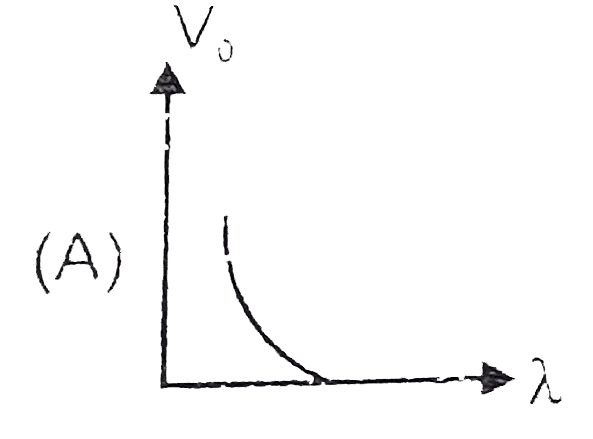
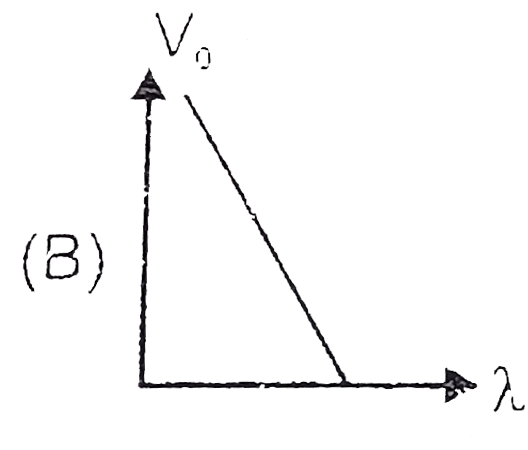
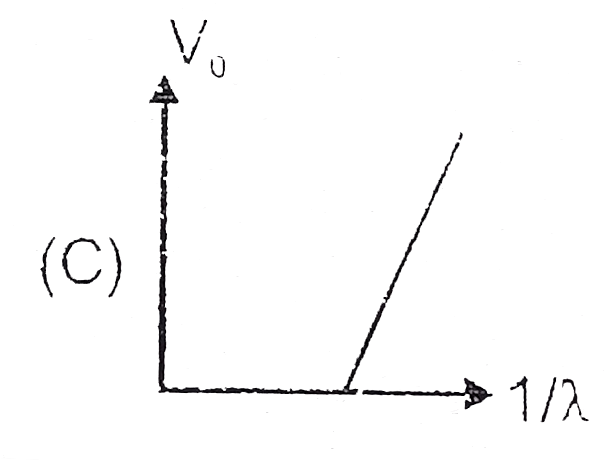
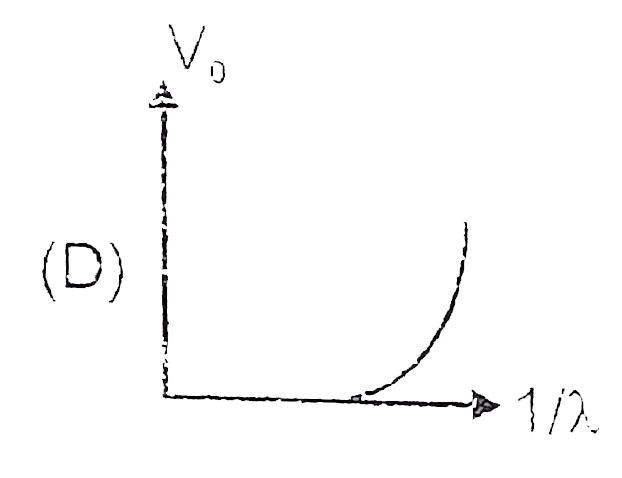
For photo - electric effect with incident photon wavelength `lambda` the stopping is `V_(0)` identify the correct variation(s) of `V_(0)` with `lambda and 1 // lambda`

A

B

C

D

Text Solution

AI Generated Solution

The correct Answer is:

To solve the problem regarding the variation of stopping potential \( V_0 \) with the wavelength \( \lambda \) and \( \frac{1}{\lambda} \) in the context of the photoelectric effect, we can follow these steps: ### Step 1: Understand the Photoelectric Effect Equation The photoelectric effect is described by the equation: \[ E = h \nu = \frac{hc}{\lambda} \] where: - \( E \) is the energy of the incident photon, - \( h \) is Planck's constant, - \( \nu \) is the frequency of the photon, - \( c \) is the speed of light, - \( \lambda \) is the wavelength of the incident photon. The stopping potential \( V_0 \) is related to the kinetic energy of the emitted electrons and can be expressed as: \[ eV_0 = E - \phi \] where: - \( e \) is the charge of the electron, - \( \phi \) is the work function of the material. ### Step 2: Relate Stopping Potential to Wavelength From the above equations, we can substitute \( E \): \[ eV_0 = \frac{hc}{\lambda} - \phi \] Rearranging gives: \[ V_0 = \frac{hc}{e\lambda} - \frac{\phi}{e} \] ### Step 3: Analyze the Equation In the equation \( V_0 = \frac{hc}{e\lambda} - \frac{\phi}{e} \): - The term \( \frac{hc}{e\lambda} \) indicates that \( V_0 \) is inversely proportional to \( \lambda \). - The term \( -\frac{\phi}{e} \) is a constant offset. ### Step 4: Variation with \( \lambda \) As \( \lambda \) increases, the term \( \frac{hc}{e\lambda} \) decreases, leading to a decrease in \( V_0 \). Therefore, the variation of \( V_0 \) with \( \lambda \) is: - **Inverse Relationship**: \( V_0 \) decreases as \( \lambda \) increases. ### Step 5: Variation with \( \frac{1}{\lambda} \) If we express the equation in terms of \( \frac{1}{\lambda} \): \[ V_0 = \frac{hc}{e} \cdot \frac{1}{\lambda} - \frac{\phi}{e} \] Here, \( V_0 \) is directly proportional to \( \frac{1}{\lambda} \): - **Linear Relationship**: \( V_0 \) increases as \( \frac{1}{\lambda} \) increases. ### Conclusion - The variation of stopping potential \( V_0 \) with \( \lambda \) is inversely proportional. - The variation of stopping potential \( V_0 \) with \( \frac{1}{\lambda} \) is directly proportional.

To solve the problem regarding the variation of stopping potential \( V_0 \) with the wavelength \( \lambda \) and \( \frac{1}{\lambda} \) in the context of the photoelectric effect, we can follow these steps: ### Step 1: Understand the Photoelectric Effect Equation The photoelectric effect is described by the equation: \[ E = h \nu = \frac{hc}{\lambda} \] where: ...
Promotional Banner

Topper's Solved these Questions

  • ATOMIC PHYSICS

    RESONANCE ENGLISH|Exercise Advanved level problems|17 Videos
  • ATOMIC PHYSICS

    RESONANCE ENGLISH|Exercise Exercise-2 Part-III : Comprehension|12 Videos
  • ALTERNATING CURRENT

    RESONANCE ENGLISH|Exercise HIGH LEVEL PROBLEMS|11 Videos
  • CAPACITANCE

    RESONANCE ENGLISH|Exercise High Level Problems|16 Videos

Similar Questions

Explore conceptually related problems

Momentum of a photon of wavelength lambda is :

The energy of a photon of wavelength lambda is

The mass of photon of wavelength lambda is given by

lambda_(1) and lambda_(2) are used to illuminated the slits. beta_(1) and beta_(2) are the corresponding fringe widths. The wavelength lambda_(1) can produce photoelectric effect when incident on a metal But the wavelength lambda_(2) cannot produce photoelectric effect. The correct relation between beta_(1) and beta_(2) is

An electron and a photon have same wavelength lambda , what is ratio of their kinetic energies ?

When a metallic surface is illuminated with radiation of wavelength lambda , the stopping potential is V . If the same surface is illuminated with radiation of wavelength 2 lambda , the stopping potential is (V)/(4) . The threshold wavelength surface is : (a) 5lambda (b) (5)/(2)lambda (c) 3lambda (d) 4lambda

When a surface 1 cm thick is illuminated with light of wavelength lambda , the stopping potential is V_(0) , but when the same surface is illuminated by light of wavelength 3lambda , the stopping potential is (V_(0))/(6) . Find the threshold wavelength for metallic surface.

A dye absorbs a photon of wavelength lambda and re - emits the same energy into two phorons of wavelengths lambda_(1) and lambda_(2) respectively. The wavelength lambda is related with lambda_(1) and lambda_(2) as :

When a metalic surface is illuminated with light of wavelength lambda, the stopping potential is V. the same surface is illuminated by light of wavelength 2lambda the stopping potential is (V)/(3) The thershold waelength for the surface is

When a metallic surface is illuminated with monochromatic light of wavelength lambda , the stopping potential is 5 V_0 . When the same surface is illuminated with the light of wavelength 3lambda , the stopping potential is V_0 . Then, the work function of the metallic surface is

RESONANCE ENGLISH-ATOMIC PHYSICS-Exercise -3 part -I JEE (Advanced)
  1. A metal surface is illuminated by light of two different wavelengths 2...

    Text Solution

    |

  2. Consider a hydrogen atom with its electron in the n^(th) orbital An el...

    Text Solution

    |

  3. For photo - electric effect with incident photon wavelength lambda the...

    Text Solution

    |

  4. An electron is an excited state of Li^(2 + )ion has angular momentum 3...

    Text Solution

    |

  5. The intensity of gamma radiation from a given source is I. on passing ...

    Text Solution

    |

  6. A photo cell is illuminated by a small bright source placed 1m away Wh...

    Text Solution

    |

  7. The diagram shows the energy levels for an electron in a certain atom....

    Text Solution

    |

  8. If the kinetic energy of a free electron doubles . Find the factor by ...

    Text Solution

    |

  9. The time taken by a photoelectron to come out after the photon strikes...

    Text Solution

    |

  10. An alpha nucleus of energy (1)/(2)mv^(2) bomobards a heavy nuclear tar...

    Text Solution

    |

  11. The threshold frequency for a metallic surface corresponds to an energ...

    Text Solution

    |

  12. The anode voltage of a photocell is kept fixed. The wavelength lamda o...

    Text Solution

    |

  13. Photon of frequency v has a momentum associated with it. If c is the v...

    Text Solution

    |

  14. Which of the following transitions gives photon of maximum energy?

    Text Solution

    |

  15. suppose an electron is attracted towards the origin by a force k//r, w...

    Text Solution

    |

  16. The transition from the state n = 4 " to " n = 3 in a hydrogen like at...

    Text Solution

    |

  17. The surface of a metal is illuminated with the light of 400nm. The kin...

    Text Solution

    |

  18. Statement-1 : When ultraviolet light is incidient on a photocell, its ...

    Text Solution

    |

  19. If a source of power 4 kW produces 10^(20) photons/second, the radiati...

    Text Solution

    |

  20. Energy required for the electron excitation in Li^(++) from the first ...

    Text Solution

    |
