
Home
Class 12
PHYSICS
The anode voltage of a photocell is kept...

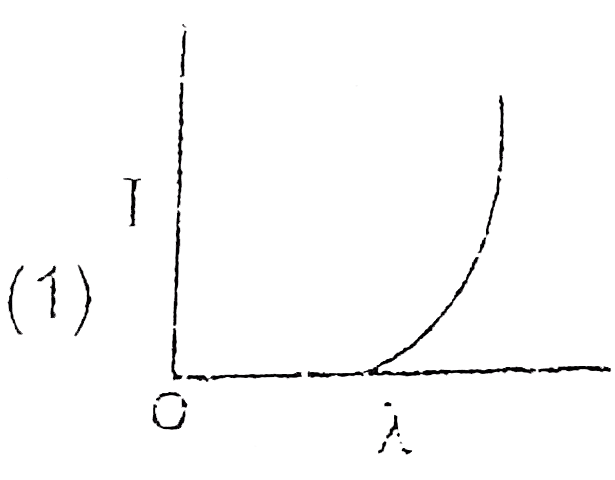
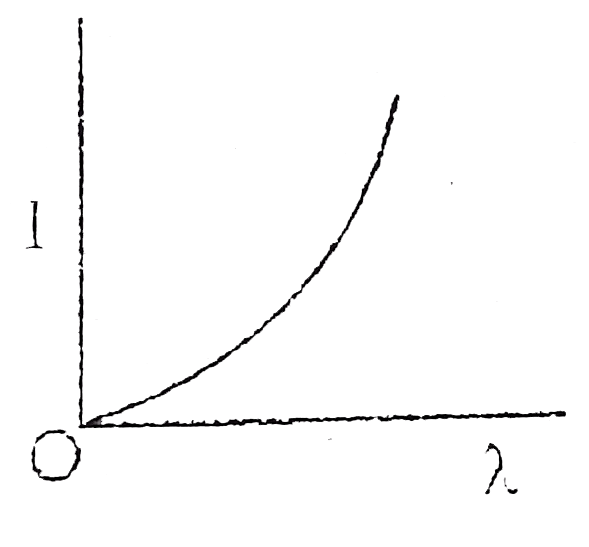
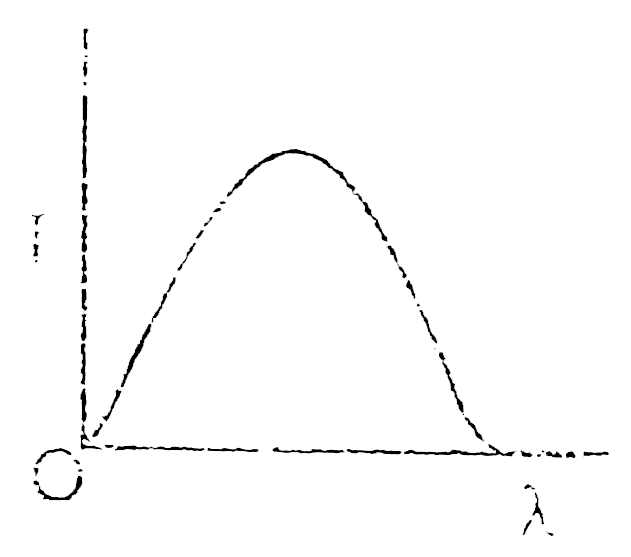
The anode voltage of a photocell is kept fixed. The wavelength `lamda` of the light falling on the cathode is gradually changed. The plate current I of the photocell varies as follows:

A

B

C

D

Text Solution

Verified by Experts

The correct Answer is:

C
Promotional Banner

Topper's Solved these Questions

  • ATOMIC PHYSICS

    RESONANCE ENGLISH|Exercise Advanved level problems|17 Videos
  • ATOMIC PHYSICS

    RESONANCE ENGLISH|Exercise Exercise-2 Part-III : Comprehension|12 Videos
  • ALTERNATING CURRENT

    RESONANCE ENGLISH|Exercise HIGH LEVEL PROBLEMS|11 Videos
  • CAPACITANCE

    RESONANCE ENGLISH|Exercise High Level Problems|16 Videos

Similar Questions

Explore conceptually related problems

The anode voltage of a photo cell is kept fixed. The wavelength lamda of the light falling on the cathode is gradually changed. The plate current I of the photo cell varies as follows

The anode vollage of a photocell is kept fixed . The wavelength lambda of the light falling on the cathode varies as follows

Find the thickness of a plate which will produce a change in optical path equal to half the wavelength lamda of the light passing through it normally. The refractive index of the plate is mu .

In a photoelectric effect experiment , the maximum kinetic energy of the ejected photoelectrons is measured for various wavelength of the incident light. Figure shows a graph of this maximum kinetic energy K_(max) as a function of the wavelength lamda of the light falling on the surface of the metal. Which of the following statement/i is/ are correct?

A vacuum photocell consists of a central cathode and an anode. The internal surface is silver of work function 4.5 eV. The contact potential difference between the electrodes equals to 0.6 V. The photocell is illuminated by light of wavelength 2.3xx10^-7 m. a. What retrading potential difference should be applied between electrodes of the photocell for the photocurrent to drop to zero? b. If a retarding potential of 1V is applied between electrodes at what limiting wavelength lamda of light incident on the cathode will on the cathode will the photoelectric effect begin?

Two identical metal plates show photoelectric effect. Light of wavelength lamda_A falls on plate A and lamda_B fall on plate B lama_A=2lamda_B , The maximum KE of the photoelectrons are K_A and K_B , respectively, Which one of the following is true?

The graph between intensity of light falling on a metallic plate (l) with the current (i) generated is

Electrons are emitted from the cathode of a photocell of negligible work function, when photons of wavelength lamda are incident on it. Derive the expression for the de Broglie wavelength of the electrons emitted in terms of the wavelength of the incident light

Light from a hydrogen tube is incident on the cathode of a photoelectric cell the work function of the cathode surface is 4.2 eV . In order to reduce the photo - current to zero the voltage of the anode relative to the cathode must be made

Two parallel large metal plates, each of area A are piaced at a distance d apart. Light of intensity I and wavelength lambda falls on the plate 1 which is photosensitive. The efficiency of photoelectron emission is 100% . The photoelectrons are immediately swept away from plate 1 in such a way that the plate 2 remains neutral. Find the potential difference between the two plates at any time t , if plate 1 is neutral initially.

RESONANCE ENGLISH-ATOMIC PHYSICS-Exercise -3 part -I JEE (Advanced)
  1. An alpha nucleus of energy (1)/(2)mv^(2) bomobards a heavy nuclear tar...

    Text Solution

    |

  2. The threshold frequency for a metallic surface corresponds to an energ...

    Text Solution

    |

  3. The anode voltage of a photocell is kept fixed. The wavelength lamda o...

    Text Solution

    |

  4. Photon of frequency v has a momentum associated with it. If c is the v...

    Text Solution

    |

  5. Which of the following transitions gives photon of maximum energy?

    Text Solution

    |

  6. suppose an electron is attracted towards the origin by a force k//r, w...

    Text Solution

    |

  7. The transition from the state n = 4 " to " n = 3 in a hydrogen like at...

    Text Solution

    |

  8. The surface of a metal is illuminated with the light of 400nm. The kin...

    Text Solution

    |

  9. Statement-1 : When ultraviolet light is incidient on a photocell, its ...

    Text Solution

    |

  10. If a source of power 4 kW produces 10^(20) photons/second, the radiati...

    Text Solution

    |

  11. Energy required for the electron excitation in Li^(++) from the first ...

    Text Solution

    |

  12. This question has statement - 1 and statement - 2 of the four choice g...

    Text Solution

    |

  13. After absobing a slowly moving neutron of mass m(N) (mometum ~0), a nu...

    Text Solution

    |

  14. Hydrogen atom is excited from ground state to another state with prin...

    Text Solution

    |

  15. A diatomic molecule is made of two masses m(1) and m(2) which are sepa...

    Text Solution

    |

  16. The anode voltage of a photocell is kept fixed. The wavelength lamda o...

    Text Solution

    |

  17. In a hydrogen like atom electron makes transition from an energy level...

    Text Solution

    |

  18. Hydrogen (.(1)H^(1)), Deuterium (.(1)H^(2)), singly ionised Helium (...

    Text Solution

    |

  19. As an electron makes a transition from an excited state to the ground ...

    Text Solution

    |

  20. Ultraviolet light is incident on two photosensitive materials having w...

    Text Solution

    |
