Home
Class 12
CHEMISTRY
Aspartame is 160 times as sweet as sucro...


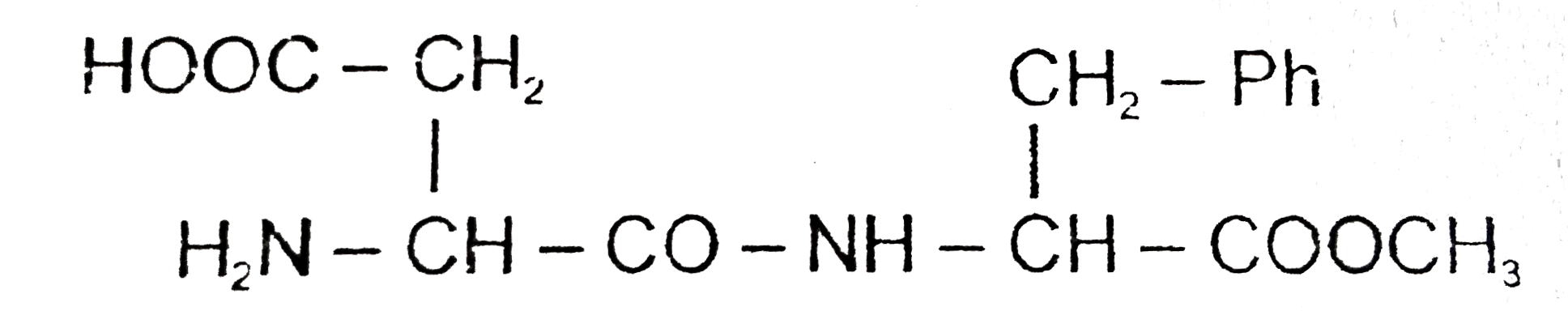
Aspartame is `160` times as sweet as sucrose and is used as a sugar substitude.
the correct statement is (s) about aspartame is (are).
(I)-It is an ester derivative of dipeptide
II-It can be named as aspartyl pheylalnine methyl ester
III-It is tripepetide
IV-It is having four functional groups.

A

I,II

B

I,II,IV

C

II,III,IV

D

only II

Text Solution

Verified by Experts

The correct Answer is:

B

Aspartame is an artificial sweetener, `III`
Promotional Banner

Topper's Solved these Questions

  • BIOMOLECULES

    RESONANCE ENGLISH|Exercise Ex-2(More correct)Part-II|14 Videos
  • BIOMOLECULES

    RESONANCE ENGLISH|Exercise Ex-2(Comprehension)Part-IV|5 Videos
  • BIOMOLECULES

    RESONANCE ENGLISH|Exercise Ex-2(Subjective)Part-I|20 Videos
  • BASIC CONCEPTS

    RESONANCE ENGLISH|Exercise ORGANIC CHEMISTRY(BASIC CONCEPTS)|27 Videos
  • BIOMOLECULES & POLYMER

    RESONANCE ENGLISH|Exercise ORGANIC CHEMISTRY(Biomolecules & Polymer)|34 Videos

Similar Questions

Explore conceptually related problems

Consider the following statements regarding compounds which cause global warming X is a hydrocarbon, A and B are neutral oxides of nitrogen, C is a blue coloured gas and D is released when H_(2)S is reacted with oxygen. Identify the correct statements about X, A , B, C and D. (I) X is mainly present in natural gas (II) In A and B one is diamagnetic and another one is paramagnetic (III) C can be identified by using liquid element in d-block (IV) D causes acid rain

Which of the following statements (s) regarding the cardiac system is/are correct ? (i) Human heart is an ectodermal derivative (ii) Mitral valve guards the opening between the right atrium and left ventricle (iii) SAN is located on the left upper corner of the right atrium (iv) Stroke volume xx Heart rate = Cardiac output.

Consider the following four statements (i)-(iv) about certain desert animals such as kangaroo rat. i) They have dark colour and high rate of reproduction and excrete solid urine ii) They do not drink water, breathe at a slow rate to conserve water and have their body covered with thick hairs iii) They feed on dry seeds and do not required drinking water iv)They excrete very concentrated urine and do not use water to regulate body temperature. Out of these four, which two are correct :

Mark the correct statements about major abiotic factors . I . Temperature on land varies seasonally, increase progressively from the equator towards the from plains to the mountain tops . II. Light is important in animals as they use the diurnal seasonal variations in light intensity and duration as cues for timing their forging, reproductive and migratory activities. III. Various characteristics of the soil such as soil composition, grain size and aggregation determine the percolation and water holding capacity of the soils . IV. The salt concentration is more than 5% in inland waters

Direction : Resistive force proportional to object velocity At low speeds, the resistive force acting on an object that is moving a viscous medium is effectively modeleld as being proportional to the object velocity. The mathematical representation of the resistive force can be expressed as R = -bv Where v is the velocity of the object and b is a positive constant that depends onthe properties of the medium and on the shape and dimensions of the object. The negative sign represents the fact that the resistance froce is opposite to the velocity. Consider a sphere of mass m released frm rest in a liquid. Assuming that the only forces acting on the spheres are the resistive froce R and the weight mg, we can describe its motion using Newton's second law. though the buoyant force is also acting on the submerged object the force is constant and effect of this force be modeled by changing the apparent weight of the sphere by a constant froce, so we can ignore it here. Thus mg - bv = m (dv)/(dt) rArr (dv)/(dt) = g - (b)/(m) v Solving the equation v = (mg)/(b) (1- e^(-bt//m)) where e=2.71 is the base of the natural logarithm The acceleration becomes zero when the increasing resistive force eventually the weight. At this point, the object reaches its terminals speed v_(1) and then on it continues to move with zero acceleration mg - b_(T) =0 rArr m_(T) = (mg)/(b) Hence v = v_(T) (1-e^((vt)/(m))) In an experimental set-up four objects I,II,III,IV were released in same liquid. Using the data collected for the subsequent motions value of constant b were calculated. Respective data are shown in table. {:("Object",I,II,II,IV),("Mass (in kg.)",1,2,3,4),(underset("in (N-s)/m")("Constant b"),3.7,1.4,1.4,2.8):} If an object of mass 2 kg and constant b = 4 (N-s)/(m) has terminal speed v_(T) in a liquid then time required to reach 0.63 v_(T) from start of the motion is :

Direction : Resistive force proportional to object velocity At low speeds, the resistive force acting on an object that is moving a viscous medium is effectively modeleld as being proportional to the object velocity. The mathematical representation of the resistive force can be expressed as R = -bv Where v is the velocity of the object and b is a positive constant that depends onthe properties of the medium and on the shape and dimensions of the object. The negative sign represents the fact that the resistance froce is opposite to the velocity. Consider a sphere of mass m released frm rest in a liquid. Assuming that the only forces acting on the spheres are the resistive froce R and the weight mg, we can describe its motion using Newton's second law. though the buoyant force is also acting on the submerged object the force is constant and effect of this force be modeled by changing the apparent weight of the sphere by a constant froce, so we can ignore it here. Thus mg - bv = m (dv)/(dt) rArr (dv)/(dt) = g - (b)/(m) v Solving the equation v = (mg)/(b) (1- e^(-bt//m)) where e=2.71 is the base of the natural logarithm The acceleration becomes zero when the increasing resistive force eventually the weight. At this point, the object reaches its terminals speed v_(1) and then on it continues to move with zero acceleration mg - b_(T) =0 rArr m_(T) = (mg)/(b) Hence v = v_(T) (1-e^((vt)/(m))) In an experimental set-up four objects I,II,III,IV were released in same liquid. Using the data collected for the subsequent motions value of constant b were calculated. Respective data are shown in table. {:("Object",I,II,II,IV),("Mass (in kg.)",1,2,3,4),(underset("in (N-s)/m")("Constant b"),3.7,1.4,1.4,2.8):} If buoyant force were also taken into account then value of terminal speed would have

Direction : Resistive force proportional to object velocity At low speeds, the resistive force acting on an object that is moving a viscous medium is effectively modeleld as being proportional to the object velocity. The mathematical representation of the resistive force can be expressed as R = -bv Where v is the velocity of the object and b is a positive constant that depends on the properties of the medium and on the shape and dimensions of the object. The negative sign represents the fact that the resistance froce is opposite to the velocity. Consider a sphere of mass m released frm rest in a liquid. Assuming that the only forces acting on the spheres are the resistive froce R and the weight mg, we can describe its motion using Newton's second law. though the buoyant force is also acting on the submerged object the force is constant and effect of this force be modeled by changing the apparent weight of the sphere by a constant froce, so we can ignore it here. Thus mg - bv = m (dv)/(dt) rArr (dv)/(dt) = g - (b)/(m) v Solving the equation v = (mg)/(b) (1- e^(-bt//m)) where e=2.71 is the base of the natural logarithm The acceleration becomes zero when the increasing resistive force eventually the weight. At this point, the object reaches its terminals speed v_(1) and then on it continues to move with zero acceleration mg - b_(T) =0 rArr m_(T) = (mg)/(b) Hence v = v_(T) (1-e^((vt)/(m))) In an experimental set-up four objects I,II,III,IV were released in same liquid. Using the data collected for the subsequent motions value of constant b were calculated. Respective data are shown in table. {:("Object",I,II,II,IV),("Mass (in kg.)",1,2,3,4),(underset("in (N-s)/m")("Constant b"),3.7,1.4,1.4,2.8):} Which object would first acquire half of their respective terminal speed in minimum time from start of the motion of all were released simultaneously ?

Direction : Resistive force proportional to object velocity At low speeds, the resistive force acting on an object that is moving a viscous medium is effectively modeleld as being proportional to the object velocity. The mathematical representation of the resistive force can be expressed as R = -bv Where v is the velocity of the object and b is a positive constant that depends onthe properties of the medium and on the shape and dimensions of the object. The negative sign represents the fact that the resistance froce is opposite to the velocity. Consider a sphere of mass m released frm rest in a liquid. Assuming that the only forces acting on the spheres are the resistive froce R and the weight mg, we can describe its motion using Newton's second law. though the buoyant force is also acting on the submerged object the force is constant and effect of this force be modeled by changing the apparent weight of the sphere by a constant froce, so we can ignore it here. Thus mg - bv = m (dv)/(dt) rArr (dv)/(dt) = g - (b)/(m) v Solving the equation v = (mg)/(b) (1- e^(-bt//m)) where e=2.71 is the base of the natural logarithm The acceleration becomes zero when the increasing resistive force eventually the weight. At this point, the object reaches its terminals speed v_(1) and then on it continues to move with zero acceleration mg - b_(T) =0 rArr m_(T) = (mg)/(b) Hence v = v_(T) (1-e^((vt)/(m))) In an experimental set-up four objects I,II,III,IV were released in same liquid. Using the data collected for the subsequent motions value of constant b were calculated. Respective data are shown in table. {:("Object",I,II,II,IV),("Mass (in kg.)",1,2,3,4),(underset("in (N-s)/m")("Constant b"),3.7,1.4,1.4,2.8):} A small sphere of mass 2.00 g is released from rest in a large vessel filled with oil. The sphere approaches a terminal speed of 10.00 cm/s. Time required to achieve speed 6.32 cm/s from start of the motion is (Take g = 10.00 m//s^(2) ) :

Which of the following statement about Rutherford's model of atom are correct? (i) Considered the nucleus as positively charged. (ii) Established that the alpha -particles are four times as heavy as a hydrogen atom. (iii) Can be compared to solar system. (iv) Was in agreement with Thomson's model.

Consider the following statements. I) Transgenic animals are more sensitive to the toxic substance than non-transgenic animals. II) Useful biological products can be produced by introducing the portion of DNA which codes for a particular product into transgenic animals III) Brazzein is a protein produced by a west African plant, Pentadiplandra brazzeana which is approximately 2000 time as sweet as sugar. Which of the statements are given above are correct?
