Home
Class 11
CHEMISTRY
Two moles of an ideal gas undergo the fo...

Two moles of an ideal gas undergo the following process `:`
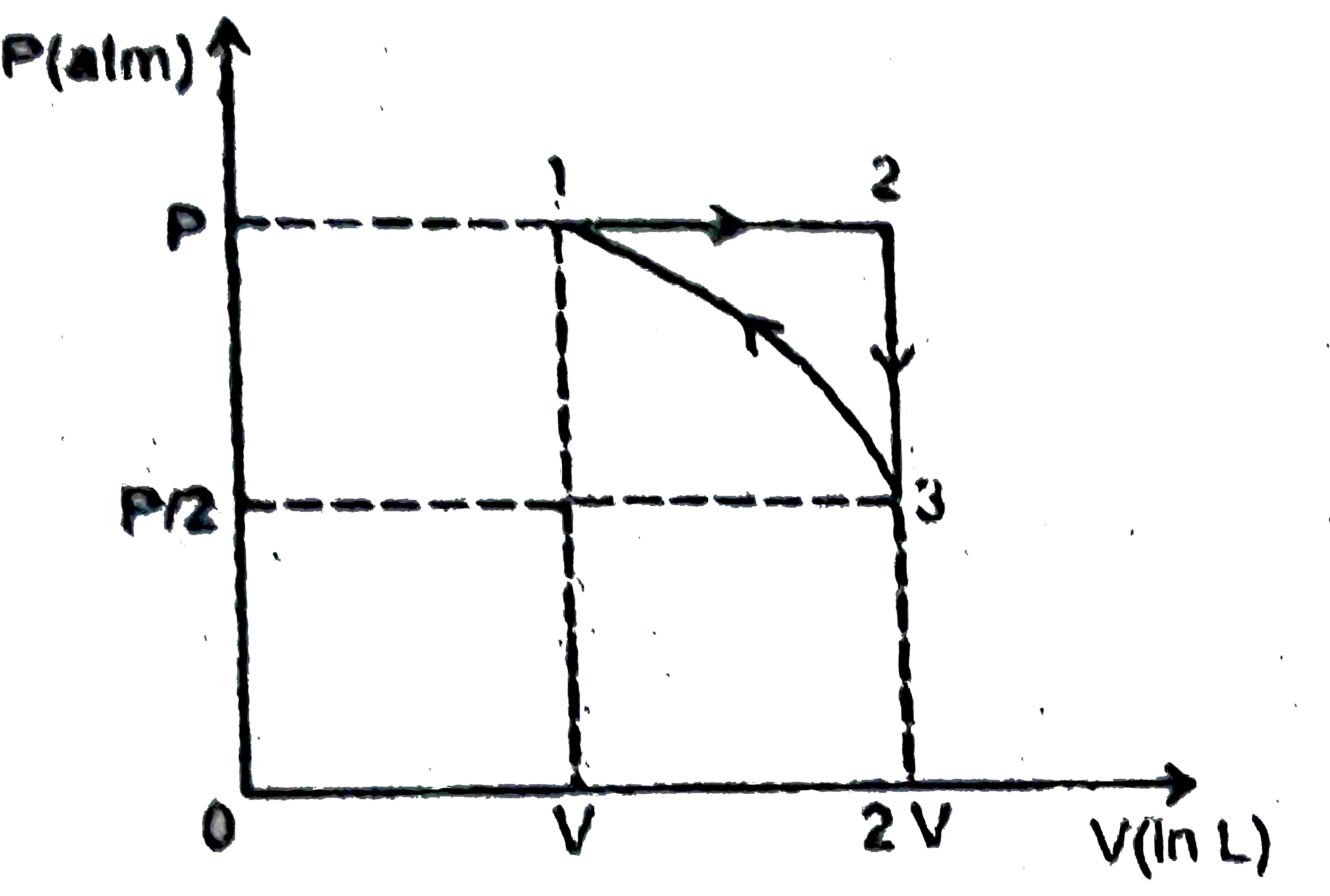
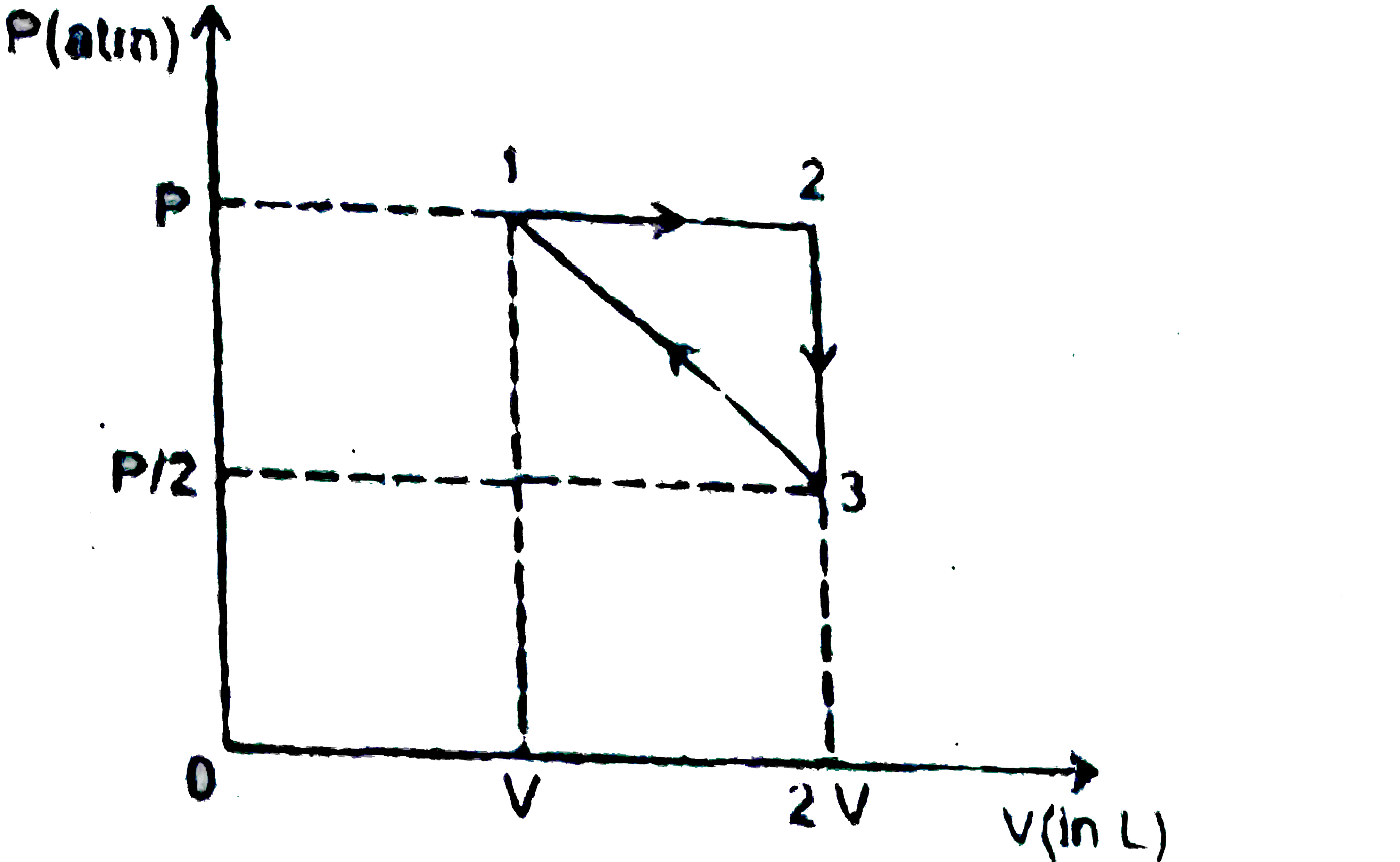
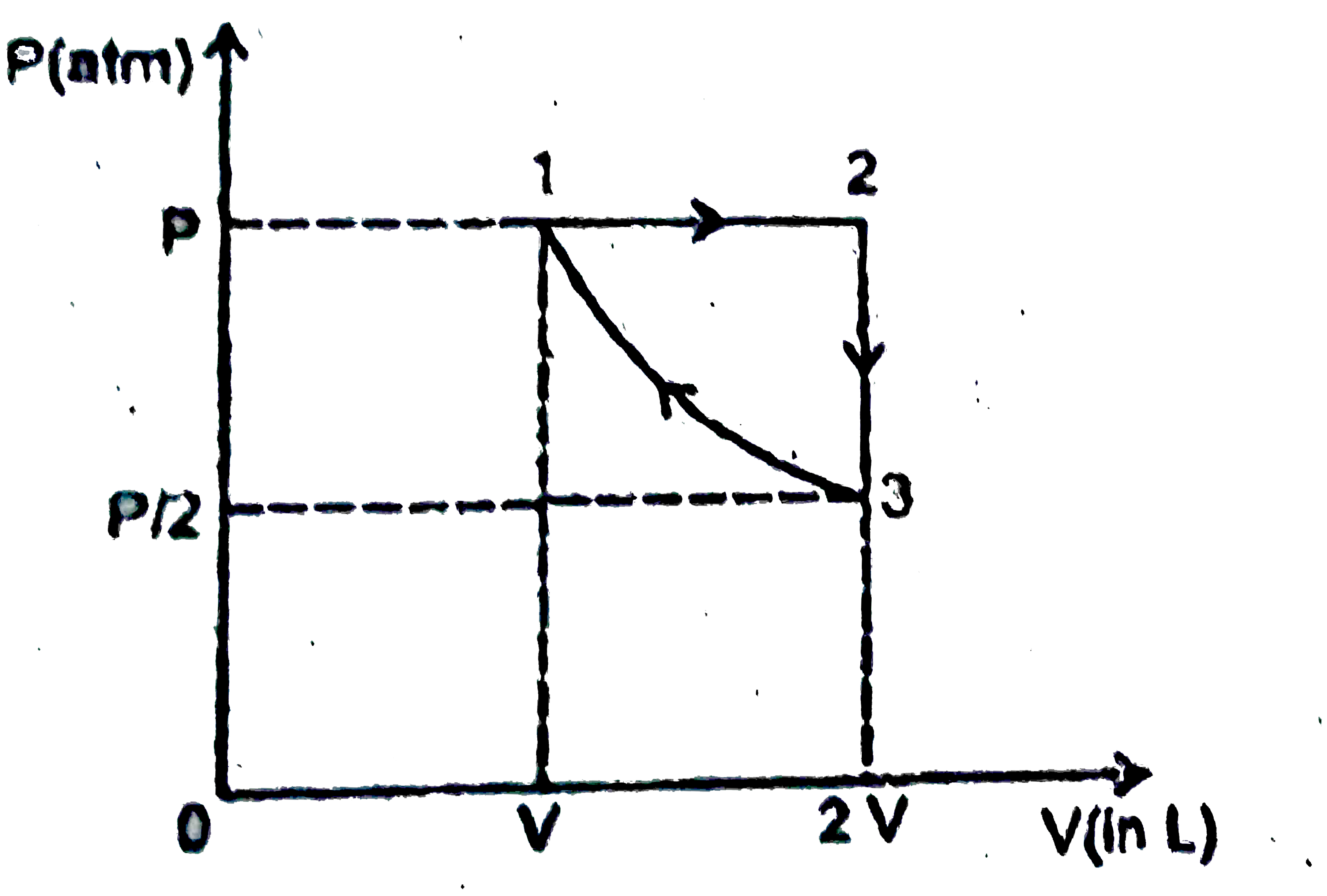
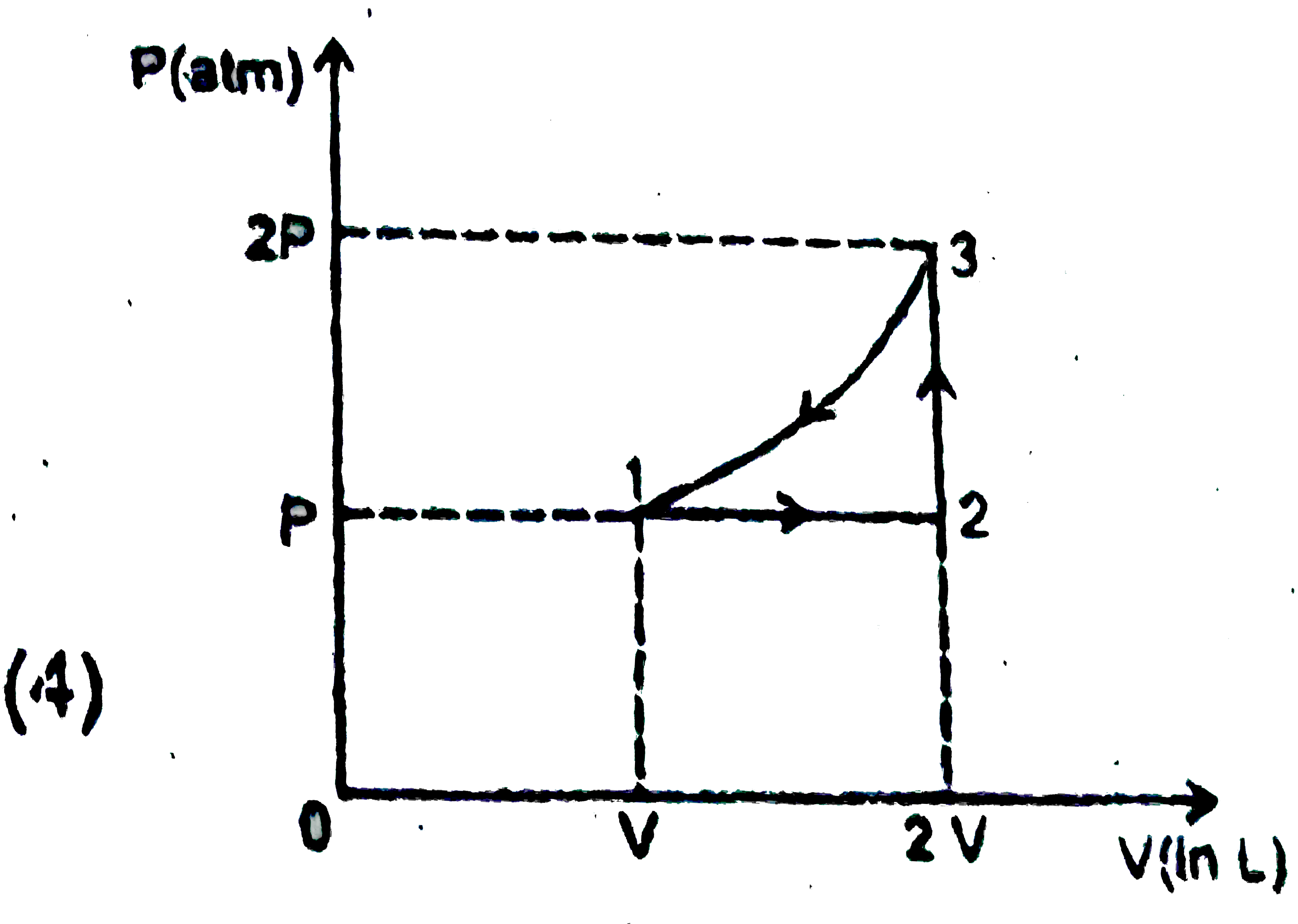
`(a)` a reversible isobaric expansion from `( P` atm, `V L)` to `( P` atm , `2V L)`.
`(b)` a reversible isochoric change of state from `( P` atm , `2V,L)` to `(P//2` atm, `2V L)`
`(c )` a reversible isothermal compression from `(P//2` atm, `2V L)` to `(P ` atm, `V L)`.
Sketch with labels each of the processes on the same `P-V` diagram.

A

B

C

D

Text Solution

AI Generated Solution

The correct Answer is:

To solve the problem, we need to analyze the three processes undergone by the ideal gas and sketch them on a P-V diagram. Let's break down each step: ### Step 1: Identify the Processes 1. **Isobaric Expansion**: The gas expands at constant pressure from (P atm, V L) to (P atm, 2V L). 2. **Isochoric Change**: The gas undergoes a change at constant volume from (P atm, 2V L) to (P/2 atm, 2V L). 3. **Isothermal Compression**: The gas is compressed at constant temperature from (P/2 atm, 2V L) to (P atm, V L). ### Step 2: Sketch the P-V Diagram 1. **Draw the Axes**: - Draw a vertical line for pressure (P) and a horizontal line for volume (V). 2. **Process (a) - Isobaric Expansion**: - Start at point A (P atm, V L). - Move horizontally to the right to point B (P atm, 2V L) since pressure is constant (isobaric). 3. **Process (b) - Isochoric Change**: - From point B (P atm, 2V L), move vertically downwards to point C (P/2 atm, 2V L) since volume is constant (isochoric). 4. **Process (c) - Isothermal Compression**: - From point C (P/2 atm, 2V L), draw a curve back to point A (P atm, V L). This curve should be hyperbolic since it represents an isothermal process where pressure and volume are inversely related. ### Step 3: Label the Points - Label point A as (P atm, V L). - Label point B as (P atm, 2V L). - Label point C as (P/2 atm, 2V L). ### Final Sketch The final P-V diagram will show: - A horizontal line from A to B for the isobaric expansion. - A vertical line from B to C for the isochoric change. - A hyperbolic curve from C back to A for the isothermal compression.
Promotional Banner

Topper's Solved these Questions

  • THERMODYNAMIC & THERMOCHEMISTRY

    RESONANCE ENGLISH|Exercise INORGANIC CHEMISTRY(P-Block Elements)|26 Videos
  • STRUCTURAL IDENTIFICATION & PRACTICAL ORGANIC CHEMISTRY

    RESONANCE ENGLISH|Exercise Section -B|18 Videos

Similar Questions

Explore conceptually related problems

Two moles of a perfect gas undergo the following processes: a. A reversible isobaric expansion from (1.0 atm, 20.0L) to (1.0 atm, 40.0L) b. A reversible isochroic change of state from (1.0 atm, 40.0L) to (0.5 atm, 40.0 L) c. A reversible isothermal expansion from (0.5 atm, 40.0 L) to(1.0 atm, 20.0 L) i. Sketch with lables each of the processes on the same P -V diagram. ii. Calculate the total work (w) and the total heat change (q) involved in the above process. iii. What will be the values of DeltaH for the overall process?

Two moles of a perfect gas undergo the following processes: a. A reversible isobaric expansion from (1.0 atm, 20.0L) to (1.0 atm, 40.0L) . b. A reversible isochroic change of state from (1.0 atm, 40.0L) to (0.5 atm, 40.0 L) c. A reversible isothermal expansion from (0.5 atm, 40.0 L) to(1.0 atm, 20.0 L) . i. Sketch with lables each of the processes on the same P -V diagram. ii. Calculate the total work (w) and teh total heat change (q) involved in the above process. iii. What will be the values of DeltaG and DeltaH for the overall process?

1 mole of an ideal gas undergoes an isothermal reversible expansion form 10 atm to 1 atm at 300 K. What will be the work done ?

A perfect gas undergoes a reversible adiabatic expansion from (300 K, 200 atm) to (90 K, 10 atm). Find the atomicity of gas.

Two moles of an ideal gas at 1 atm are compressed to 2 atm at 273 K. The enthalpy change for the process is

Five moles of an ideal gas undergoes reversible expansion from 1 L to 4 L at 27^oC . The work done and enthalpy change for the process respectively are

One mole of a non-ideal gas undergoes a change of state from (2,0 atm, 3.0 L, 100 K) to (4.0 atm, 5.0 L, 250 K) with a change in internal energy, DeltaU=30.0 Latm. The change on enthalpy of process in (L - atm) is

Calculate the work done during isothermal reversible expansion expansion of one mol of an ideal gas from 10 atm to 1 atm at 300K.

Calculate the work done during isothermal reversible expansion expansion of one mol of an ideal gas from 10 atm to 1 atm at 300K.

For a reversible process at T = 300K, the volume is increased from V_(i)=1L to V_(f)=10L . Calculate Delta H if the process is isothermal -

RESONANCE ENGLISH-THERMODYNAMIC & THERMOCHEMISTRY-INORGANIC CHEMISTRY(P-Block Elements)
  1. In a system, a piston caused an external pressure of 1.25 bar giving a...

    Text Solution

    |

  2. If 1 mole of an ideal gas expands isothermally at 37^(@)C from 15 litr...

    Text Solution

    |

  3. Two moles of an ideal gas undergo the following process : (a) a reve...

    Text Solution

    |

  4. What are the signs of the entropy change ( + or -) in the following: ...

    Text Solution

    |

  5. If HA+NaOH rarr NaA+H(2)O" "DeltaH=-12kcal and HB+NaOH rarr NaB+...

    Text Solution

    |

  6. A reaction has DeltaH=-33 kJ and DeltaS=-58 J//K. This reaction would ...

    Text Solution

    |

  7. In the isothermal reversible compression of 52.0m mol of a perfect gas...

    Text Solution

    |

  8. A child bought a balloon which became very small in size the next day....

    Text Solution

    |

  9. It the following processes, identify the irreversible process :

    Text Solution

    |

  10. If bond energy of H(2),F(2) and HF are in the ratio 2:1:3 and DeltaH(a...

    Text Solution

    |

  11. One mole of a non-ideal gas undergoes a change of state from (1.0 atm,...

    Text Solution

    |

  12. Calculate the final pressure of a sample of carbon dioxide that expand...

    Text Solution

    |

  13. The heat evolved from the combustion of carbon is used to heat water. ...

    Text Solution

    |

  14. The equilibrium constant for A(g)+B(2)(g) hArr AB(2)(g)" "k(p)=1...

    Text Solution

    |

  15. When 1L of NaOH(1M) is mixed with 1L of HCl(1M) the temperature of rea...

    Text Solution

    |

  16. 2Fe + 3/2 O2 rarr Fe(2)O(3) " "xkJ//"mole" 2Fe + O(2) rarr 2F...

    Text Solution

    |

  17. The species which by definition has zero standard molar enthalpy of fo...

    Text Solution

    |

  18. In which of the following changes at constant pressure, is work done b...

    Text Solution

    |

  19. One gram of an organic liquid X (molecular mass 78) liberates 160 J of...

    Text Solution

    |

  20. Bond energies are equal to dissociation energies in case of :

    Text Solution

    |
