Home
Class 12
CHEMISTRY
What will be the order of reaction and r...

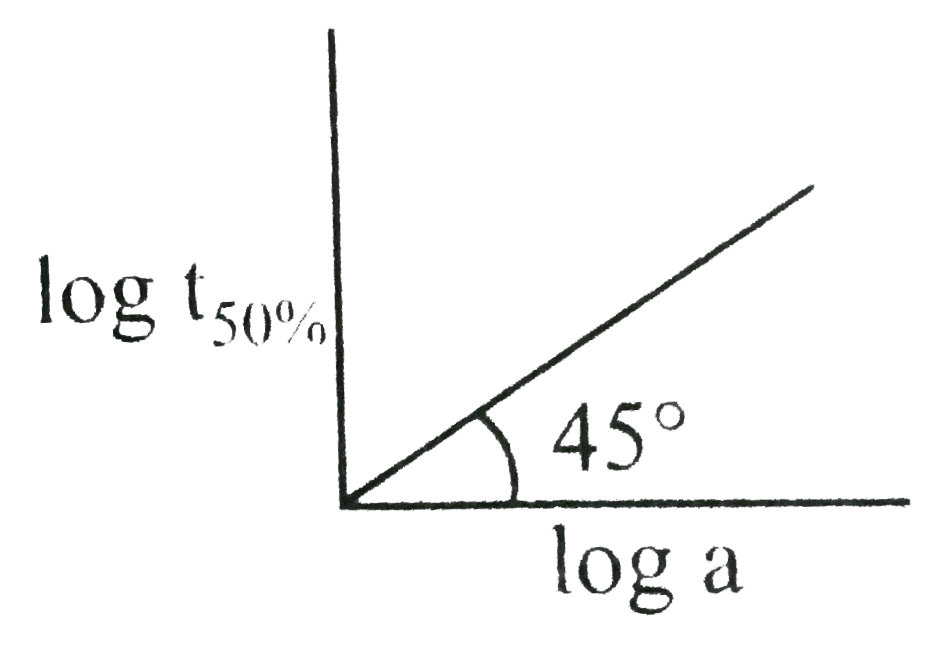
What will be the order of reaction and rate constant for a chemical change having `log t_(50%)` versue log concentration of `(a)` curves as:

A

zero order

B

First order

C

Second order

D

None of these

Text Solution

Verified by Experts

The correct Answer is:

1

`t_(1//2)=(a)/(2k)=k',a,`
`log(t_(1//2))=logk'+loga`
Promotional Banner

Topper's Solved these Questions

  • CARBONYL COMPOUNDS (ALDEHYDES & KETONES ) & CARBOXYLIC ACID

    RESONANCE ENGLISH|Exercise Part -IV|23 Videos
  • CHEMISTRY IN EVERYDAY LIFE

    RESONANCE ENGLISH|Exercise ORGANIC CHEMISTRY(Chemistry in every day life)|31 Videos

Similar Questions

Explore conceptually related problems

What will be the order of reaction for a chemical change having log t_((1)/(2)) vs log a? ( where a = initial concentration of rectant, t_((1)/(2)) =half life)

The rate constant of a reaction with nth order will have units:

For the hydrolysis of methyl acetate in aqueous solution, the following results were obtained : (a) Show that it follows pseudo first order reaction, as the concentration of water remains constant. (b) Calculate the average rate of reaction between the time interval 10 to 20 seconds. (Given : log 2 = 0.3010, log 4 = 0.6021)

The unit of rate constant of zero order and first order chemical reactions are respectively :

(a) For a reaction A+BrarrP, the rate is given by Rate =K[A][B]^(2) (i) How is the rate of reaction affected if the concentration of B is doubled ? (ii) What is the overall order of reaction if A is present in large excess ? (b) A first order reaction takes 30 minutes for 50% completion. Calculate the time required for 90% completion of this reaction.

For a second order reaction, 2Ararr Products, a plot of log t_(1//2) vs log a (where a is initial concentration) will give an intercept equal to which one of the following?

A first order reaction takes 40 min for 30% decomposition. Calculate t_(1//2) . (Given log 7 =0.845)

Assertion : The rate of reaction is the rate of change of concentration of a reactant or a product. Reason : Rate of reaction remians constant during the complete reaction.

The half-life of a chemical reaction does not change by either increasing or decreasing the initial concentration of reactant. What is the order of the reaction?

For a chemical reaction A rarr B , it is found that the rate of reaction doubles when the concentration of A is increased 4 times. What is the order of reaction ? Suggest the rate law also.

RESONANCE ENGLISH-CHEMICAL KINETICS-PHYSICAL CHEMITRY (CHEMICAL KNIETICS & RADIOACTIVITY)
  1. For a chemical reaction A rarr Products, the rate of disappearance of ...

    Text Solution

    |

  2. At the point of intersection of the two curves shown, the conc. of B i...

    Text Solution

    |

  3. The decomposition of N(2)O(5) occurs as, 2N(2)O(5) rarr4NO(2)+O(2) and...

    Text Solution

    |

  4. The rate constant for an isomerization reaction, A rarr B is 4.5 xx 10...

    Text Solution

    |

  5. A hypothetical reaction A(2) + B(2) rarr 2AB follows the mechanism as ...

    Text Solution

    |

  6. For an exothermic chemical process ocuuring in two process occuring in...

    Text Solution

    |

  7. For the reaction , 2NO2+F5rarr 2NO2F following mechanism has been pro...

    Text Solution

    |

  8. For the reaction, 2NO(g) + 2H(2)(g) rarr N(2)(g) + 2H(2)O(g) The ...

    Text Solution

    |

  9. What will be the order of reaction and rate constant for a chemical ch...

    Text Solution

    |

  10. The unit of rate constant of elementary reaction depends upon the:

    Text Solution

    |

  11. For an elementary reaction 2A+BtoA(2)B if the volume of vessel is quic...

    Text Solution

    |

  12. The decomposition of azo methane, at certain temperature according to ...

    Text Solution

    |

  13. For a complex reaction A overset(k) rarr products E(a1)=180kJ //mol ...

    Text Solution

    |

  14. Atoms .(7)^(A)X, (8)^(B)Y " and " (9)^(17)Z are such that .(8)Y is an ...

    Text Solution

    |

  15. The number of neutrons accompanying the formation of .(54)Xe^(139) and...

    Text Solution

    |

  16. A sample of radiative substance is found 90% of it’s initial amount af...

    Text Solution

    |

  17. For a given reaction A rarr Product, rate is 1xx10^(-4)M s^(-1) when ...

    Text Solution

    |

  18. Milk turns sour at 40^(@)C three times as faster as 0^(@)C. Hence E(a)...

    Text Solution

    |

  19. Graph between log k and 1//T [k rate constant (s^(-1)) and T and the t...

    Text Solution

    |

  20. In a first order reaction, the concentrations of the reactant, 30 minu...

    Text Solution

    |
