
Home
Class 12
MATHS
For which of the following graphs the qu...

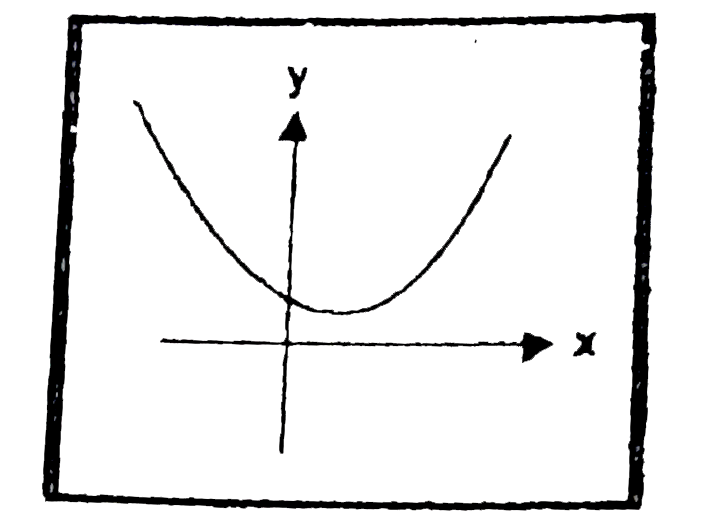
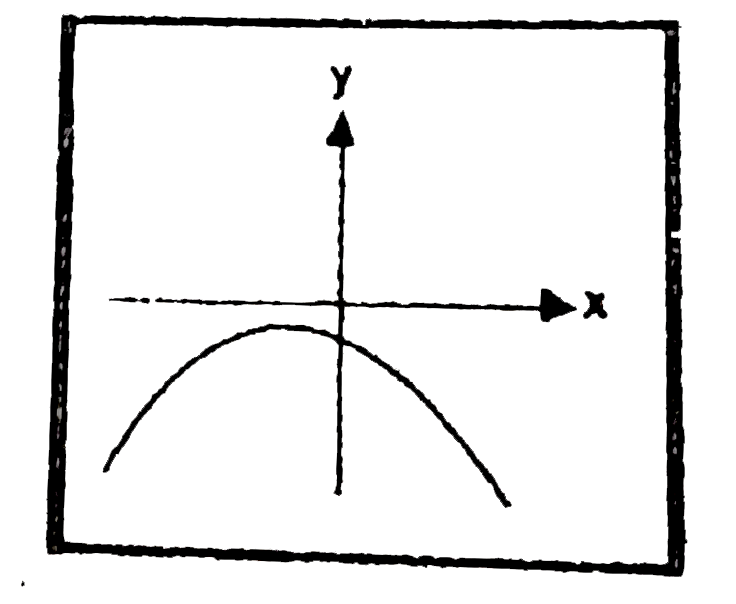
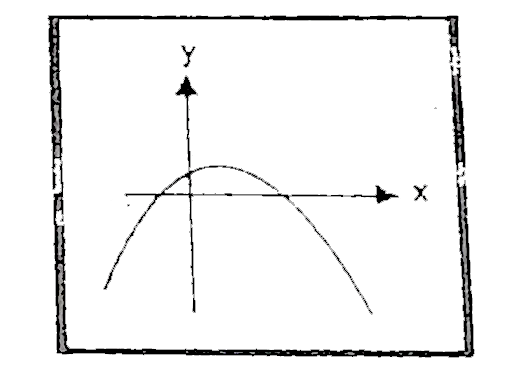
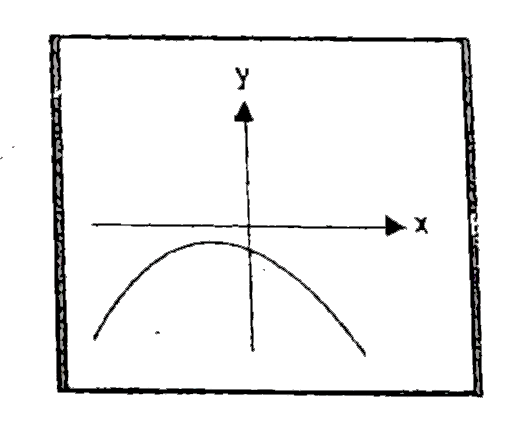
For which of the following graphs the quadratic expression `y=ax^(2)+bx+c` the product `abc` is negative ?

A

B

C

D

Text Solution

Verified by Experts

The correct Answer is:
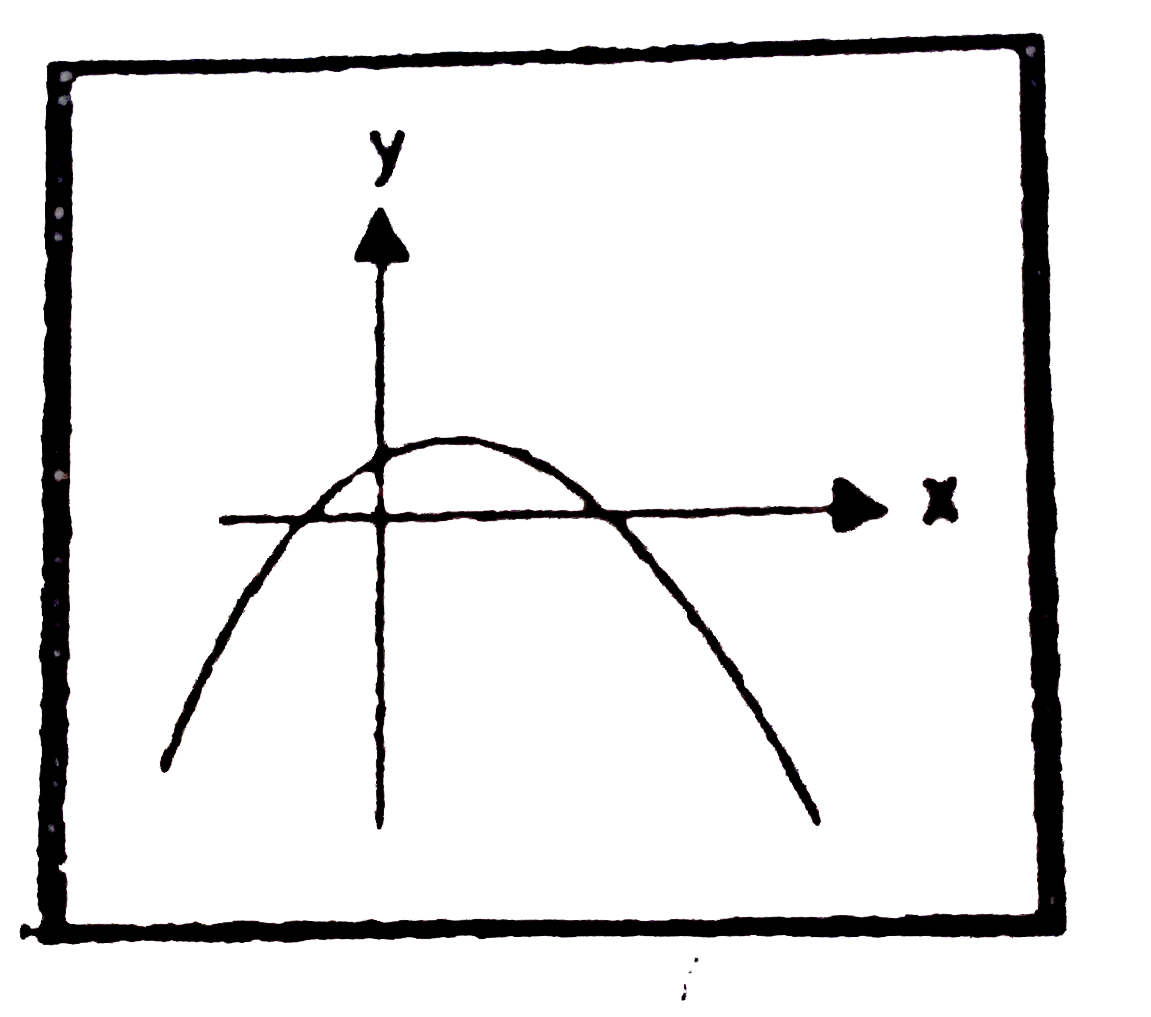
A, B, C, D

(A). `(-b)/(2a)le0`
`implies-bge0[becauseale0]`
`ale0,cle0,ble0`
(B).
`(-b)/(2a)ge0implies-ble0impliesbge0`
`ale0,cle0,ble0`
`becauseabcle0`
(C).
`(-b)/(2a)ge0implies-bge0impliesble0`
`age0,cge0,ble`
`becauseabcle0`
(D).
`ale0,cle0,ble0`
`becausele0`
Promotional Banner

Topper's Solved these Questions

  • TEST PAPERS

    RESONANCE ENGLISH|Exercise MATHEMATICS|259 Videos
  • TEST PAPERS

    RESONANCE ENGLISH|Exercise PART - I MATHMATICS|84 Videos
  • TEST PAPER

    RESONANCE ENGLISH|Exercise MATHEMATICS|48 Videos
  • TEST SERIES

    RESONANCE ENGLISH|Exercise MATHEMATICS|132 Videos

Similar Questions

Explore conceptually related problems

If a,b,c in R, then for which of the following graphs of the quadratic polynomial y = ax ^(2) -2bx+ c (a ne 0), the product (abc) is negative ?

The quadratic expression ax ^(2)+bx+c gt 0 AA x in R, then :

Which of the following is not the graph of a quadratic polynomial?

The quadratic equation ax^(2)+bx+c=0 has real roots if:

which of the following graph represents the expression f(x) = ax^2 + bx + c (a!=0) when a>0,b<0 $ c<0 ?

If the minimum value of the quadratic expression y =ax ^(2)+bx +c is negative attained at negative vlaue of x, then :

Which of the following can be the correct expression for the graph of the quadratic shown above ?

The graph of a quadratic expression ax^(2)+bx+c is shown beside. Which of the following is correct?

Find the values of a, for which the quadratic expression ax^2 + (a - 2) x - 2 is negative for exactly two integral values of x .

The value of 'a' for which the quadratic expression ax^(2)+|2a-3|x-6 is positive for exactly two integral values of x is

RESONANCE ENGLISH-TEST PAPERS-Math
  1. The quadratic equation ax^(2)+bx+c=0 has real roots if:

    Text Solution

    |

  2. Let Delta^(2) be the discriminant and alpha,beta be the roots of the e...

    Text Solution

    |

  3. For which of the following graphs the quadratic expression y=ax^(2)+bx...

    Text Solution

    |

  4. if (3sin^(-1)x+pix-pi)^(2)+{sin(cos^(-1)((x)/(5)))}^(2)-2sin(cos^(-1)(...

    Text Solution

    |

  5. For the A.P given by a(1),a(2). . .a(n) . . . ., the equation satisfi...

    Text Solution

    |

  6. If underset(r=1)overset(n)Sigma r(r+1)(2r +3)=an^4+bn^3+cn^2+dn +e th...

    Text Solution

    |

  7. If a(1),a(2),a(3)(a(1)gt0) are three successive terms of a GP with com...

    Text Solution

    |

  8. The value of lamda so that the matric A^(-1)-lamdaI is singular where ...

    Text Solution

    |

  9. Let F(alpha)=[cosalpha-sinalpha0sinalphacosalpha0 0 0 1] and G(beta)=[...

    Text Solution

    |

  10. Let f(x)=(sin^(-1)x)/(cos^(-1)x)+(cos^(-1)x)/(tan^(-1)x)+(tan^(-1)x)/(...

    Text Solution

    |

  11. The value of x for which |{:(x,2,2),(3,x,2),(3,3,x):}|+|{:(1-x,2,4),(2...

    Text Solution

    |

  12. Let f(x)=-4.sqrt(e^(1-x))+1+x+(x^(2))/(2)+(x^(3))/(3). If g(x) is inve...

    Text Solution

    |

  13. Find the integral values of a for which the equation x^4-(a^2-5a+6)x^2...

    Text Solution

    |

  14. Find the number of positive integral solution of the equation tan^(-1)...

    Text Solution

    |

  15. If the equation x^(4)-4x^(3)+ax^(2)+bx+1=0 has four positive roots, f...

    Text Solution

    |

  16. The sum of three numbers forming a geometric progression is equal to 5...

    Text Solution

    |

  17. if cos^(-1)((1)/(sqrt(2))(cos((7pi)/(5))-sin((2pi)/(5)))=(ppi)/(q) (wh...

    Text Solution

    |

  18. if a in R and equation (a-2)(x-[x])^(2)+2(x-[x])+a^(2)=0 (where [x] re...

    Text Solution

    |

  19. Let M be a 3xx3 matrix satisfying M[0 1 0]=M[1-1 0]=[1 1-1],a n dM[1 1...

    Text Solution

    |

  20. If f(x)=(a^(x))/(a^(x)+sqrt(a))(agt0),g(n)=sum(r=1)^(2n-1)2f((r)/(2n))...

    Text Solution

    |